


Triglyceride and HDL-C Dyslipidemia and Risks of Coronary Heart Disease and Ischemic Stroke by Glycemic Dysregulation Status: The Strong Heart Study
- PMID: 28122840
- PMCID: PMC5360283
- DOI: 10.2337/dc16-1958
Triglyceride and HDL-C Dyslipidemia and Risks of Coronary Heart Disease and Ischemic Stroke by Glycemic Dysregulation Status: The Strong Heart Study
Abstract
Objective: High triglyceride (TG) levels and low HDL cholesterol (HDL-C) levels are risk factors for cardiovascular disease. It is unclear whether this relationship depends on glycemic dysregulation, sex, or LDL cholesterol (LDL-C) level.
Research design and methods: We studied 3,216 participants (40% men, 41% with diabetes) who were free of cardiovascular disease at baseline in a community-based, prospective cohort of American Indians (median follow-up 17.7 years). Cox models estimated hazard ratios (HRs) and 95% CIs for incident ischemic stroke and coronary heart disease (CHD) in relation to combined TG and HDL-C status, where a fasting TG level ≥150 mg/dL was "high" and a fasting HDL-C level <40 mg/dL for men (<50 mg/dL for women) was "low." Models included age, sex, BMI, smoking, diabetes, fasting LDL-C level, antihypertensive medications, physical activity, estimated glomerular filtration rate, and urinary albumin-to-creatinine ratio.
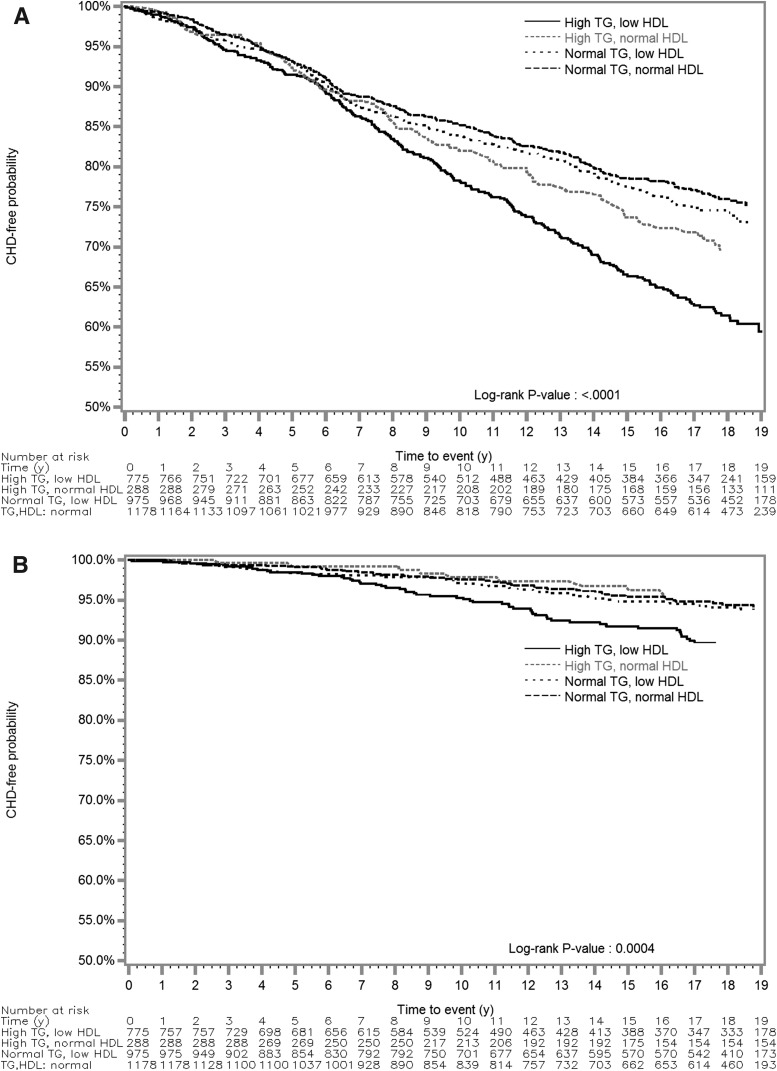
Results: Participants with high TG and low HDL levels had a 1.32-fold greater HR (95% CI 1.06-1.64) for CHD than those with normal TG and normal HDL levels. It was observed in participants with diabetes, but not in those without diabetes, that high TG plus low HDL levels were associated with a 1.54-fold greater HR (95% CI 1.15-2.06) for CHD (P value for interaction = 0.003) and a 2.13-fold greater HR (95% CI 1.06-4.29) for stroke (P value for interaction = 0.060). High TG and low HDL level was associated with CHD risk in participants with an LDL-C level of ≥130 mg/dL, but this was not observed in those participants with lower LDL-C levels. Sex did not appear to modify these associations.
Conclusions: Adults with both high TG and low HDL-C, particularly those with diabetes, have increased risks of incident CHD and stroke. In particular, those with an LDL-C level ≥130 mg/dL may have an increased risk of incident stroke.
© 2017 by the American Diabetes Association.
Figures
References
-
- Tanne D, Koren-Morag N, Graff E, Goldbourt U. Blood lipids and first-ever ischemic stroke/transient ischemic attack in the Bezafibrate Infarction Prevention (BIP) Registry: high triglycerides constitute an independent risk factor. Circulation 2001;104:2892–2897 - PubMed
-
- O’Donnell MJ, Xavier D, Liu L, et al.; INTERSTROKE investigators . Risk factors for ischaemic and intracerebral haemorrhagic stroke in 22 countries (the INTERSTROKE study): a case-control study. Lancet 2010;376:112–123 - PubMed
-
- Carey VJ, Bishop L, Laranjo N, Harshfield BJ, Kwiat C, Sacks FM. Contribution of high plasma triglycerides and low high-density lipoprotein cholesterol to residual risk of coronary heart disease after establishment of low-density lipoprotein cholesterol control. Am J Cardiol 2010;106:757–763 - PMC - PubMed
-
- Libby P. The forgotten majority: unfinished business in cardiovascular risk reduction. J Am Coll Cardiol 2005;46:1225–1228 - PubMed
MeSH terms
Substances
Grants and funding
LinkOut - more resources
Full Text Sources
Other Literature Sources
Medical
Miscellaneous
