. 2017 Jan;41(1):23-30.
doi: 10.1016/j.jgr.2015.12.005. Epub 2015 Dec 17.

Ginsenoside Rg1 suppresses early stage of adipocyte development via activation of C/EBP homologous protein-10 in 3T3-L1 and attenuates fat accumulation in high fat diet-induced obese zebrafish

Affiliations

Ginsenoside Rg1 suppresses early stage of adipocyte development via activation of C/EBP homologous protein-10 in 3T3-L1 and attenuates fat accumulation in high fat diet-induced obese zebrafish

Eun-Jeong Koh et al. J Ginseng Res. 2017 Jan.

Abstract

Background: Ginsenoside Rg1 is a class of steroid glycoside and triterpene saponin in Panax ginseng. Many studies suggest that Rg1 suppresses adipocyte differentiation in 3T3-L1. However, the detail molecular mechanism of Rg1 on adipogenesis in 3T3-L1 is still not fully understood.

Methods: 3T3-L1 preadipocyte was used to evaluate the effect of Rg1 on adipocyte development in the differentiation in a stage-dependent manner in vitro. Oil Red O staining and Nile red staining were conducted to measure intracellular lipid accumulation and superoxide production, respectively. We analyzed the protein expression using Western blot in vitro. The zebrafish model was used to investigate whether Rg1 suppresses the early stage of fat accumulation in vivo.

Results: Rg1 decreased lipid accumulation in early-stage differentiation of 3T3-L1 compared with intermediate and later stages of adipocyte differentiation. Rg1 dramatically increased CAAT/enhancer binding protein (C/EBP) homologous protein-10 (CHOP10) and subsequently reduced the C/EBPβ transcriptional activity that prohibited the initiation of adipogenic marker expression as well as triglyceride synthase. Rg1 decreased the expression of extracellular signal-regulated kinase 1/2 and glycogen synthase kinase 3β, which are also essential for stimulating the expression of CEBPβ. Rg1 also reduced reactive oxygen species production because of the downregulated protein level of nicotinamide adenine dinucleotide phosphate hydrogen (NADPH) oxidase 4 (NOX4). While Rg1 increased the endogenous antioxidant enzymes, it also dramatically decreased the accumulation of lipid and triglyceride in high fat diet-induced obese zebrafish.

Conclusion: We demonstrated that Rg1 suppresses early-stage differentiation via the activation of CHOP10 and attenuates fat accumulation in vivo. These results indicate that Rg1 might have the potential to reduce body fat accumulation in the early stage of obesity.

Keywords: 3T3-L1; CON, control; ND, nondifferentiated preadipocyte; Rg1; obesity; reactive oxygen species; zebrafish.


Figures
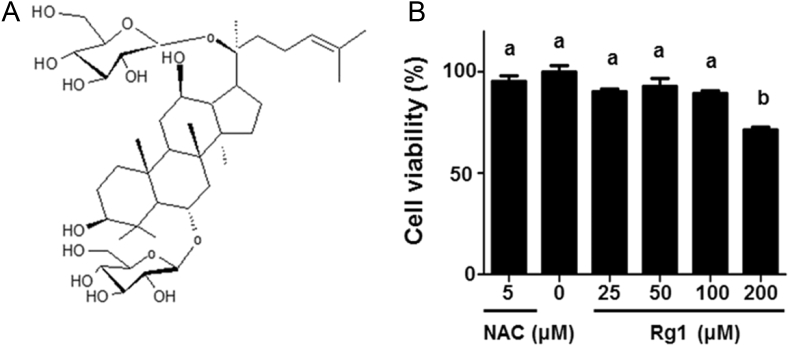
Fig. 1
Fig. 1
Structure of Rg1 and its cytotoxicity in 3T3-L1 preadipocyte. (A) Chemical structure of Rg1 (C42H72O14). (B) 3T3-L1 preadipocyte were treated with 0μM, 25μM, 50μM, 100μM, and 200μM Rg1, and 5μM NAC for 24 h. Cell viability was measured by XTT assay at 450 nm and 690 nm. The experiment was performed in hexaplicates. Results were analyzed by one-way ANOVA and Duncan's multiple range test. Values with different superscript letters are significantly different, p < 0.05. ANOVA, analysis of variance; NAC, N-acetyl cystein; XTT, 2,3-bis(2-methoxy-4-nitro-5-sulfophenyl)-2H-tetrazolium-5-carbox-anilide.
Fig. 2
Fig. 2
Rg1 downregulates adipogenic factors and triglyceride synthetic enzymes during adipogenesis in 3T3-L1 cells. (A) Lipid accumulation was measured with Oil Red O assay in 3T3-L1 cells differentiated with the presence or absence of 25μM, 50μM, 100μM Rg1/5μM NAC during 8 d and determined at 490 nm. Results were analyzed by one-way ANOVA and Duncan's multiple range test. The experiment was performed in hexaplicates. Values with different superscript letters are significantly different, p < 0.05. (B) Cell lysates differentiated during 8 d were subjected to Western blot to analyze C/EBPα, PPARγ, and aP2 protein expression. The experiment was performed in triplicate. (C) Cell lysates differentiated during 8 d were subjected to Western blot to analyze LPAT, Lipin1, and DGAT1 protein expression. The experiment was performed in triplicate. ANOVA, analysis of variance; C/EBPα, CAAT/enhancer binding protein α; CON, control; NAC, N-acetyl cystein; ND, nondifferentiated preadipocyte; PPARγ, peroxisome proliferator-activated receptor γ.
Fig. 3
Fig. 3
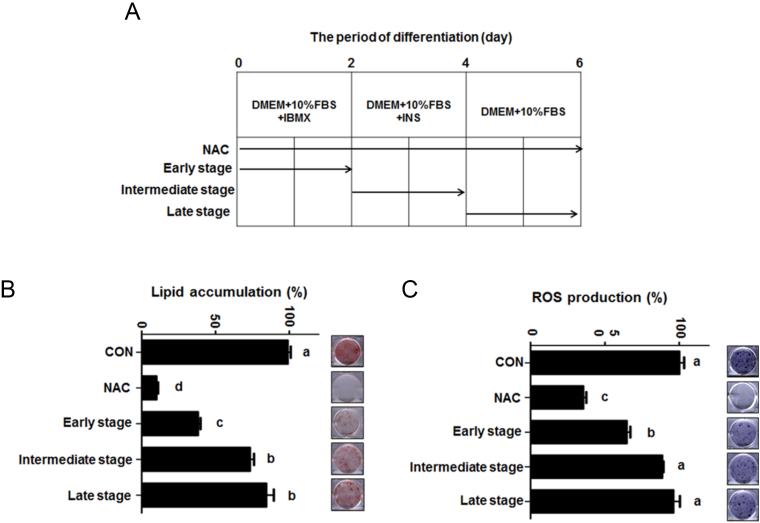
Rg1 preferentially suppresses lipid accumulation and ROS production at an early stage of adipogenesis. (A) Preadipocyte differentiation was initiated by IBMX, dexamethasone, and insulin in the presence or absence of 5mM NAC or 100μM Rg1 for the indicated tables. (B) Lipid accumulation was evaluated by Oil Red O assay in 3T3-L1 cells differentiated in the presence or absence of 5mM NAC/100μM Rg1 for the indicated tables and determined at 490 nm. Results were analyzed by one-way ANOVA and Duncan's multiple range test. These data were measured as the standard deviation of hexaplicates. Values with different superscript letters are significantly different, p < 0.05. (C) ROS production was subjected to NBT assay in cells differentiated during 6 d for the indicated tables and determined at 570 nm. Results were analyzed with one-way ANOVA and Duncan's multiple range test. The experiment was performed in hexaplicates. Values with different superscript letters are significantly different, p < 0.05. ANOVA, analysis of variance; CON, control; IBMX, 3-isobutyl-1-methylxanthine; NAC, N-acetyl cystein; ROS, reactive oxygen species.
Fig. 4
Fig. 4
Rg1 regulates antioxidant enzymes during early adipogenesis in 3T3-L1 cells. (A) ROS production was detected by DCF-DA in cells differentiated in the treatment of 5mM NAC and 25μM, 50μM, and 100μM Rg1 during 24 h and determined at 480 nm against 530 nm. Results were analyzed with one-way ANOVA and Duncan's multiple range test. The experiment was performed in hexaplicates. Values with different superscript letters are significantly different, p < 0.05. (B) Cell lysates differentiated during 24 h were subjected to Western blot to analyze antioxidant enzymes and NOX4 protein expression. The experiment was performed in triplicate. ANOVA, analysis of variance; CON, control; DCF-DA, 2,7′-dichlorodihydrofluoresceindiacetate; NAC, N-acetyl cystein; ND, nondifferentiated preadipocyte; NOX 4, nicotinamide adenine dinucleotide phosphate hydrogen oxidase 4; ROS, reactive oxygen species.
Fig. 5
Fig. 5
Effect of Rg1 on early adipogenic factor by regulating antioxidant enzymes during early adipogenesis in 3T3-L1 cells. (A) Cell lysates differentiated during 24 h were subjected to Western blot to analyze C/EBPβ and CHOP10 protein expression. The experiment was performed in triplicate. (B) Cell lysates differentiated during 24 h were subjected to Western blot to analyze GSK3β, ERK1/2, and p38 MAPK protein expression. The experiment was performed in triplicate. CHOP10, C/EBP homologous protein-10; CON, control; ERK1/2, extracellular signal-regulated kinases 1/2; GSK3β, glycogen synthase kinase 3β; MAPK, mitogen-activated protein kinases; ND, nondifferentiated preadipocyte.
Fig. 6
Fig. 6
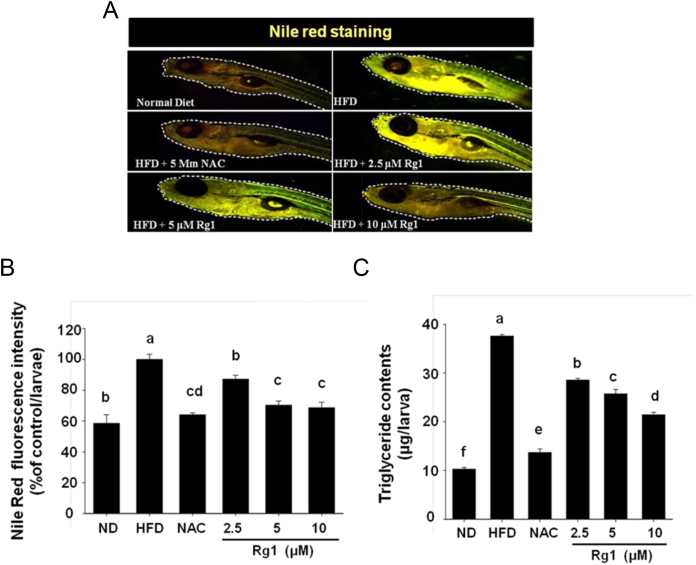
Rg1 supplementation impairs lipid accumulation in high fat diet-induced obese Zebrafish. (A) Lipid accumulation was evaluated by Nile Red staining in zebrafishes grown with HFD in the presence or absence of 5μM, 10μM, 2.5μM Rg1/5μM NAC during 20 dpf and visualized under a fluorescence microscope (n = 3). (B) Quantification of Nile Red fluorescence intensity. Results were analyzed by one-way ANOVA and Duncan's multiple range test. The experiment was performed in triplicate. Values with different superscript letters are significantly different, p < 0.05. (C) Triglyceride was subjected to TG assay in 20 dpf zebrafishes grown with HFD in the presence or absence of 5μM, 10μM, 2.5μM Rg1/5μM NAC, and measured at 540 nm. Results were analyzed by one-way ANOVA and Duncan's multiple range test. The experiment was performed in triplicate. Values with different superscript letters are significantly different, p < 0.05. ANOVA, analysis of variance; CON, control; dpf, days postfertilization; NAC, N-acetyl cystein; HFD, high fat diet; ND, nondifferentiated preadipocyte; TG, triglyceride.

References

    1. Wahba I.M., Mak R.H. Obesity and obesity-initiated metabolic syndrome: mechanistic links to chronic kidney disease. Clin J Am Soc Nephrol. 2007;2:550–562. - PubMed
    1. Guilherme A., Virbasius J.V., Puri V., Czech M.P. Adipocyte dysfunctions linking obesity to insulin resistance and type 2 diabetes. Nat Rev Mol Cell Biol. 2008;9:367–377. - PMC - PubMed
    1. Cornelius P., MacDougald O.A., Lane M.D. Regulation of adipocyte development. Annu Rev Nutr. 1994;14:99–129. - PubMed
    1. MacDougald O.A., Lane M.D. Transcriptional regulation of gene expression during adipocyte differentiation. Annu Rev Biochem. 1995;64:345–373. - PubMed
    1. Mandrup S., Lane M.D. Regulating adipogenesis. J Biol Chem. 1997;272:5367–5370. - PubMed

LinkOut - more resources