. 2017 Jan;13(1):342-348.
doi: 10.3892/etm.2016.3938. Epub 2016 Nov 30.

SIRT4 overexpression protects against diabetic nephropathy by inhibiting podocyte apoptosis

Affiliations

SIRT4 overexpression protects against diabetic nephropathy by inhibiting podocyte apoptosis

Jian-Xia Shi et al. Exp Ther Med. 2017 Jan.

Retraction in

Abstract

Diabetic nephropathy is a diabetic complication associated with capillary damage and increased mortality. Sirtuin 4 (SIRT4) plays an important role in mitochondrial function and the pathogenesis of metabolic diseases, including aging kidneys. The aim of the present study was to investigate the association between SIRT4 and diabetic nephropathy in a glucose-induced mouse podocyte model. A CCK-8 assay showed that glucose simulation significantly inhibited podocyte proliferation in a time- and concentration-dependent manner. Reverse transcription-quantitative polymerase chain reaction and western blot analysis showed that the mRNA and protein levels of SIRT4 were notably decreased in a concentration-dependent manner in glucose-simulated podocytes. However, SIRT4 overexpression increased proliferation and suppressed apoptosis, which was accompanied by increases in mitochondrial membrane potential and reduced production of reactive oxygen species (ROS). Notably, SIRT4 overexpression downregulated the expression of apoptosis-related proteins NOX1, Bax and phosphorylated p38 and upregulated the expression of Bcl-2 in glucose-simulated podocytes. In addition, SIRT4 overexpression significantly attenuated the inflammatory response, indicated by reductions in the levels of TNF-α, IL-1β and IL-6. These results demonstrate for the first time that the overexpression of SIRT4 prevents glucose-induced podocyte apoptosis and ROS production and suggest that podocyte apoptosis represents an early pathological mechanism leading to diabetic nephropathy.

Keywords: apoptosis; diabetic nephropathy; glucose; podocytes; sirtuin 4.


Figures
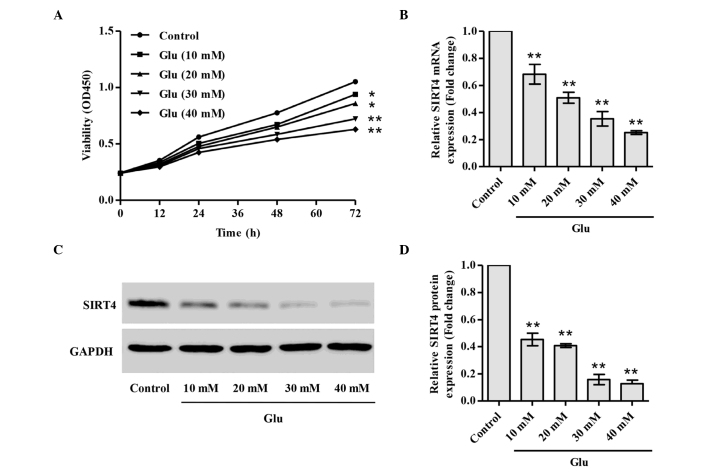
Figure 1.
Figure 1.
Glucose inhibits podocyte proliferation and downregulates SIRT4 expression. Podocytes were stimulated with glucose at different concentrations. (A) Proliferation was analyzed by Cell Counting kit-8 assay after 0, 12, 24, 36, 48, 60 and 72 h glucose stimulation. (B) mRNA expression levels of SIRT4 were examined using quantitative polymerase chain reaction, and protein expression levels of SIRT4 were examined using western blot analysis; (C) representative blots and (D) relative SIRT4 expression levels are shown. *P<0.05, **P<0.01 vs. control. SIRT4, sirtuin 4; Glu, glucose; OD, optical density.
Figure 2.
Figure 2.
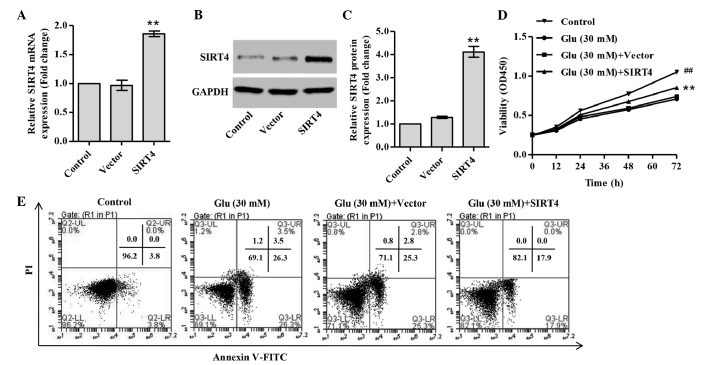
SIRT4 overexpression induces podocyte proliferation and inhibits apoptosis. Podocytes were stimulated with 30 mM glucose following transduction with SIRT4-overexpressing vector. (A) mRNA expression of SIRT4 was examined using reverse transcription-quantitative polymerase chain reaction, and protein levels were evaluated using western blot analysis; (B) representative blots and (C) relative SIRT4 expression levels are shown. (D) Proliferation was analyzed by Cell Counting kit-8 assay. (E) Apoptosis was analyzed by flow cytometry. **P<0.01 vs. control; ##P<0.01 vs. Glu (30 mM). SIRT4, sirtuin 4; Glu, glucose; OD, optical density.
Figure 3.
Figure 3.
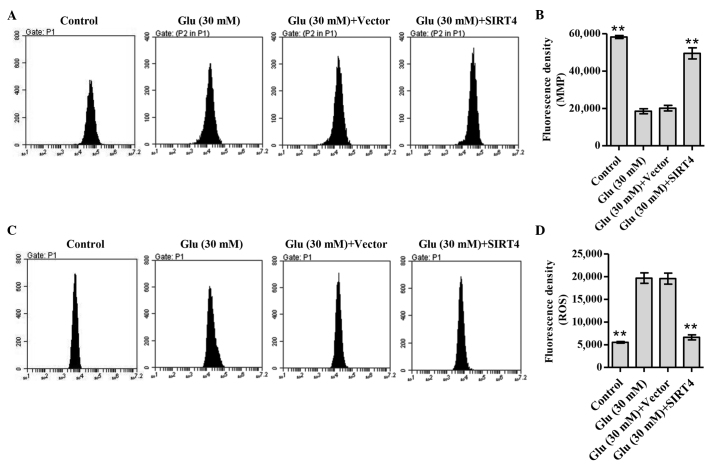
SIRT4 overexpression increases MMP elicitation and decreases ROS production. Podocytes were stimulated with 30 mM glucose after transduction with SIRT4-overexpressing vector. (A) Podocytes incubated with fluorescent probe JC-1 were analyzed by flow cytometry; (B) fluorescent density indicated the MMP. (C) Podocytes were incubated with fluorescent probe dichlorodihydrofluorescein diacetate and analyzed by flow cytometry; (D) fluorescent density indicated ROS levels. **P<0.01 vs. Glu (30 mM). SIRT4, sirtuin 4; MMP, mitochondrial membrane potential; ROS, reactive oxygen species; Glu, glucose.
Figure 4.
Figure 4.
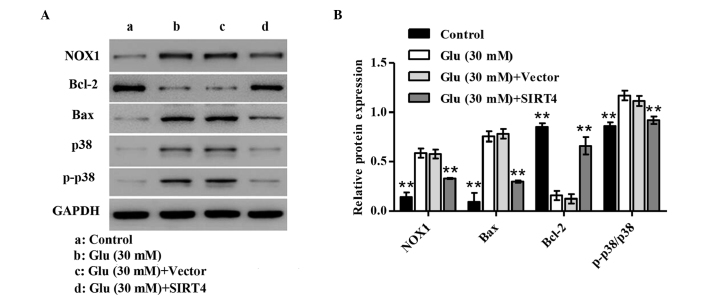
SIRT4 overexpression regulates apoptosis-related protein expression. Podocytes were stimulated with 30 mM glucose after transduction with SIRT4-overexpressing vector. (A) Western blotting and (B) quantification of NOX1, Bax, Bcl-2 and p38 expression levels in different groups. **P<0.01 vs. Glu (30 mM). SIRT4, sirtuin 4; NOX1, NADPH oxidase 1; Bcl-2, B-cell lymphoma 2; Bax, Bcl-2-associated X protein; Glu, glucose.
Figure 5.
Figure 5.
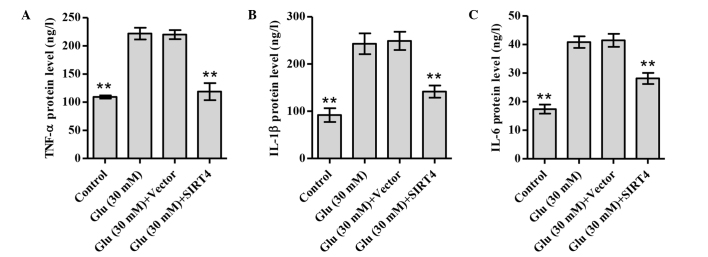
SIRT4 overexpression represses the production of TNF-α, IL-1β and IL-6. Podocytes were stimulated with 30 mM glucose after transduction with SIRT4-overexpressing vector. ELISA analysis of (A) TNF-α, (B) IL-1β and (C) IL-6 protein expression in different groups. **P<0.01 vs. Glu (30 mM). SIRT4, sirtuin 4; TNF, tumor necrosis factor; IL, interleukin; Glu, glucose.

References

    1. Lopes AA. End-stage renal disease due to diabetes in racial/ethnic minorities and disadvantaged populations. Ethnic Dis. 2009;19:S1-47–S1-51. (Suppl 1) - PubMed
    1. Kihm L. Hypertension and diabetic nephropathy. Exp Clin Endocrinol Diabetes. 2016;124:333–334. doi: 10.1055/s-0042-110231. - DOI - PubMed
    1. Glastras SJ, Tsang M, Teh R, Chen H, McGrath RT, Zaky AA, Pollock CA, Saad S. Maternal obesity promotes diabetic nephropathy in rodent offspring. Sci Rep. 2016;6:27769. doi: 10.1038/srep27769. - DOI - PMC - PubMed
    1. Kikkawa R, Koya D, Haneda M. Progression of diabetic nephropathy. Am J Kidney Dis. 2003;41:S19–S21. doi: 10.1053/ajkd.2003.50077. (Suppl 1) - DOI - PubMed
    1. Wendt T, Tanji N, Guo J, Hudson BI, Bierhaus A, Ramasamy R, Arnold B, Nawroth PP, Yan SF, D'Agati V, Schmidt AM. Glucose, glycation and rage: Implications for amplification of cellular dysfunction in diabetic nephropathy. J Am Soc Nephrol. 2003;14:1383–1395. doi: 10.1097/01.ASN.0000065100.17349.CA. - DOI - PubMed

Publication types