


Post operative capnostream monitoring in patients with obstructive sleep apnoea symptoms - Case series
- PMID: 28123650
- PMCID: PMC5241624
- DOI: 10.1016/j.slsci.2016.12.004
Post operative capnostream monitoring in patients with obstructive sleep apnoea symptoms - Case series
Abstract
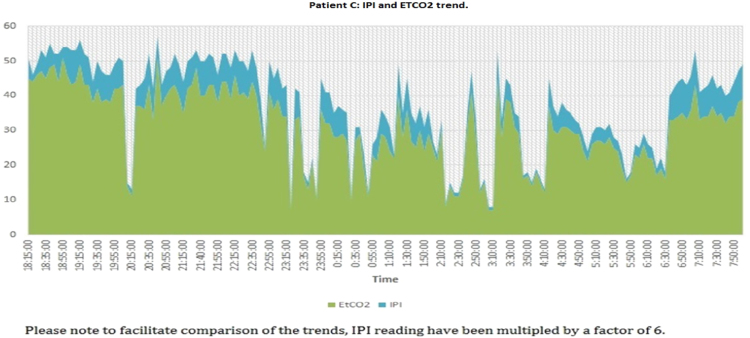
Obstructive sleep apnoea (OSA) patients on opioid analgesic have an increased incidence of postoperative respiratory complications; prevention of these may be possible with appropriate post-operative monitoring. We recruited 4 OSA patients who had general anaesthesia for orthopaedic and septoplasty surgery. They required Patient Controlled Analgesia (PCA) or oral opioids in the post-operative period, hence continuous Saturation of Oxygen (Spo2), End Tidal Carbon dioxide (EtCo2) monitoring on Capnostream monitor with Integrated Pulmonary Index (IPI) was organized in high dependency unit. Overnight data was collected every 30 s which included pulse rate, respiratory rate, EtCo2, Spo2, and IPI. The nursing staff was also asked to document if any intervention was carried out due to altered IPI. For first two patient events occurred during various hours but there were no significant events in early night even though increased opioid use at that time. During the period of desaturation nurse intervention required to increase the O2 flow in the first patient but corrected spontaneously in the second patient. IPI index improved over a period of 2 min in most of the events. The duration of desaturation did not correspond with the IPI in only once, remaining period the clinical symptoms were consistent with fall in O2 saturation. The microstream capnography with IPI may provide complete respiratory status of the patient because of its comprehensive parameters on one screen. Main limitation was duration of monitoring was limited to overnight. Capnostream monitoring with IPI may have a role in patients monitoring with OSA on PCA in the postoperative ward but more trials are necessary.
Keywords: Capnostream monitor; Integrated pulmonary index; Obstructive sleep apnoea; Opioid analgesia; Post operative analgesia; Respiratory complications.
Figures



References
-
- Overweight and obesity in adults in Australia: a snapshot, 2007–08. Australian Bureau of statistics latest issue released at 11:30 AM (CANBERRA TIME) 27/05/2011 First Issue.
-
- Liao P.1, Yegneswaran B., Vairavanathan S., Zilberman P., Chung F. Postoperative complications in patients with obstructive sleep apnea: a retrospective matched cohort study. Can J Anaesth. 2009;56(11):819–828. - PubMed
-
- Memtsoudis S., Liu S.S., Ma Y. Perioperative pulmonary outcomes in patients with sleep apnea after noncardiac surgery. Anesth Analg. 2011;112:113–121. - PubMed
-
- Cashman J.N., Dolin S.J. Respiratory and haemodynamic effects of acute postoperative pain management: evidence from published data. Br J Anaesth. 2004;93:212–223. - PubMed
Publication types
LinkOut - more resources
Full Text Sources
Other Literature Sources
