. 2016 Nov 4;5(12):e1254854.
doi: 10.1080/2162402X.2016.1254854. eCollection 2016.

Synthetic RORγ agonists regulate multiple pathways to enhance antitumor immunity

Affiliations

Synthetic RORγ agonists regulate multiple pathways to enhance antitumor immunity

Xiao Hu et al. Oncoimmunology. .

Abstract

RORγt is the key transcription factor controlling the development and function of CD4+ Th17 and CD8+ Tc17 cells. Across a range of human tumors, about 15% of the CD4+ T cell fraction in tumor-infiltrating lymphocytes are RORγ+ cells. To evaluate the role of RORγ in antitumor immunity, we have identified synthetic, small molecule agonists that selectively activate RORγ to a greater extent than the endogenous agonist desmosterol. These RORγ agonists enhance effector function of Type 17 cells by increasing the production of cytokines/chemokines such as IL-17A and GM-CSF, augmenting expression of co-stimulatory receptors like CD137, CD226, and improving survival and cytotoxic activity. RORγ agonists also attenuate immunosuppressive mechanisms by curtailing Treg formation, diminishing CD39 and CD73 expression, and decreasing levels of co-inhibitory receptors including PD-1 and TIGIT on tumor-reactive lymphocytes. The effects of RORγ agonists were not observed in RORγ-/- T cells, underscoring the selective on-target activity of the compounds. In vitro treatment of tumor-specific T cells with RORγ agonists, followed by adoptive transfer to tumor-bearing mice is highly effective at controlling tumor growth while improving T cell survival and maintaining enhanced IL-17A and reduced PD-1 in vivo. The in vitro effects of RORγ agonists translate into single agent, immune system-dependent, antitumor efficacy when compounds are administered orally in syngeneic tumor models. RORγ agonists integrate multiple antitumor mechanisms into a single therapeutic that both increases immune activation and decreases immune suppression resulting in robust inhibition of tumor growth. Thus, RORγ agonists represent a novel immunotherapy approach for cancer.

Keywords: Adoptive cell therapy; PD-1; RORγ; Tc17; Th17; co-inhibitory receptors; co-stimulatory receptors; immunotherapy.


Figures
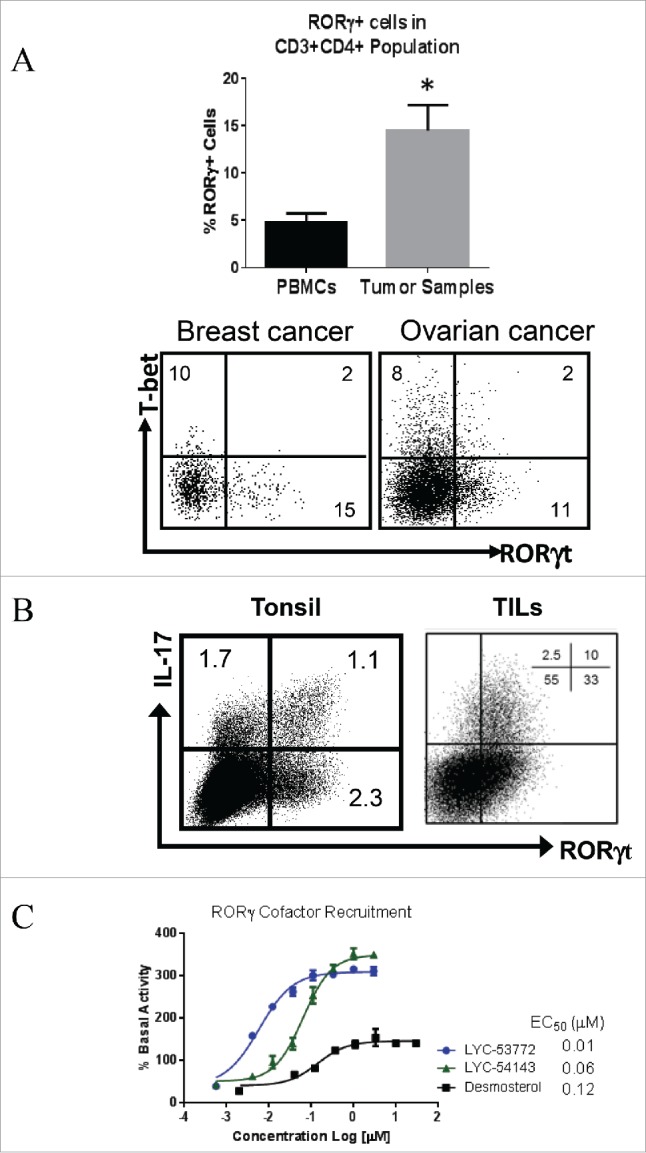
Figure 1.
Figure 1.
Expression of RORγ in human tumors and identification of RORγ agonists. (A) RORγ+ T cells are present in significant fractions in TILs from various tumor types. Total of 14 tumor samples from colon, ovarian, lung, breast and head and neck cancers. Cells were gated on CD45+CD3+CD4+. *p = 0.03 tumor vs. PBMCs. Unpaired, two-tailed t-test. Bottom. Flow graph shows an example of staining. (B) Co-staining of IL-17A and RORγt shows partial overlap of RORγ and IL-17A expressing cells. (C) A TR-FRET-based assay was used to show that RORγ agonists increase co-activator recruitment. Each data point represents mean ± standard deviation (SD) of biological triplicates.
Figure 2.
Figure 2.
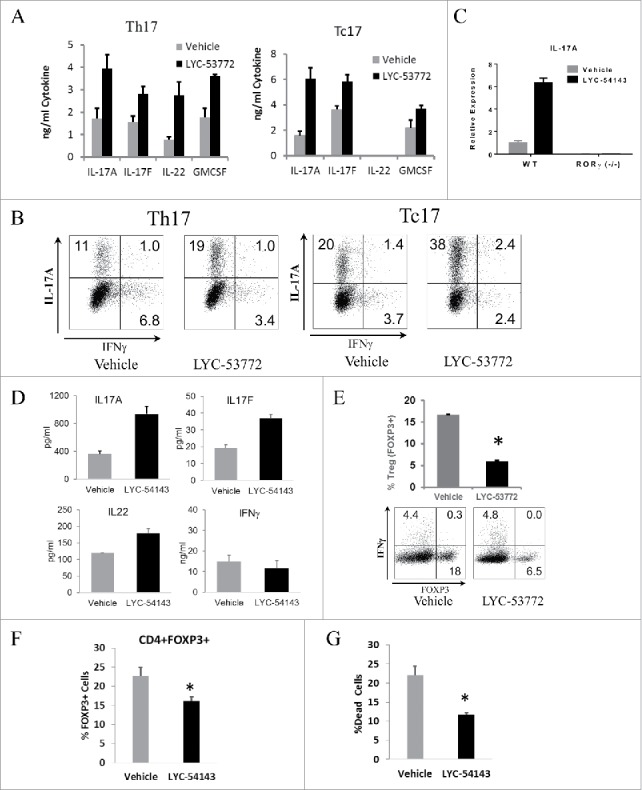
RORγ agonists enhance Type 17 differentiation and cytokine production. (A) RORγ agonist LYC-53772 increased Type 17 cytokines when added to both Th17 and Tc17 differentiation cultures. LYC-53772 vs. vehicle, p < 0.007 for Th17 and p < 0.03 for Th17 and Tc17, respectively. Data represent mean ± SD of biological quadruplicates. (B) LYC-53772 increased the percentage of CD4+IL-17A+ (Th17, left) and CD8+IL-17A+ (Tc17, right) cells with minimal effects on their production of IFNγ (representative flow graph). (C) Elevated IL-17A expression was dependent on RORγ. IL-17A mRNA was assayed by qPCR. Data represent mean ± SD of biological triplicates. (D) RORγ agonist LYC-54143 increased cytokine production in human PBMCs polarized under Type 17 conditions. LYC-54143 vs. vehicle, p < 0.03 for IL-17A, IL-17F, or IL-22, p = 0.5 for IFNγ. Data represent mean ± SD of biological duplicates from one healthy donor. Similar results were obtained for > 4 healthy donors. (E) LYC-53772 decreased the percentage of FOXP3+ cells during differentiation of murine Treg cells. *p = 1.6 × 10⁻⁷ LYC-53772 vs. Vehicle. (F) LYC-54143 decreased FOXP3+ cells during Type 17 differentiation of human PBMCs. *p = 0.009, LYC-54143 vs. Vehicle. Data represent mean ± SD of biological triplicates from one healthy donor. Similar results were obtained for three healthy donors. (G) LYC-54143 decreased the percentage of dead murine Type 17 T cells after differentiation and resting for 3 days. *p = 0.0001, LYC-54143 vs. Vehicle. Data represent mean ± SD of biological triplicates. LYC-53772 was used at 10 µM and LYC-54143 at 5 µM.
Figure 3.
Figure 3.
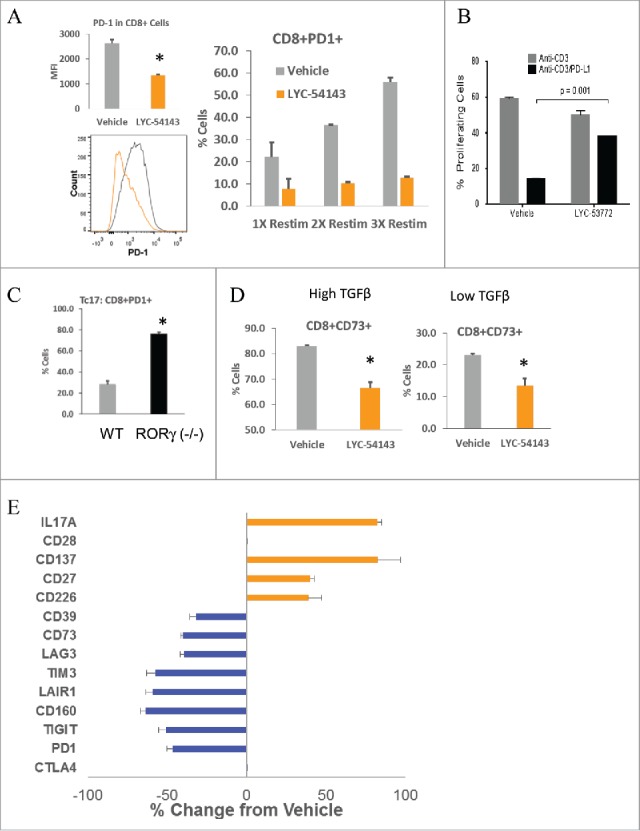
RORγ agonists modulate the expression of multiple co-regulatory molecules. (A) LYC-54143 decreased expression of PD-1 as well as percentage of PD-1+ cells in Tc17 cells. Left: MFI of PD-1 after one re-stimulation with anti-CD3. *p = 0.0002 LYC-54143 vs. Vehicle. Data represent mean ± SD of biological triplicates. A representative histogram is shown to compare vehicle (gray) with LYC-54143 (orange) treated samples. Right: percentage of PD-1+ cells after 1, 2, or 3 re-stimulations with anti-CD3. LYC-54143 was present during Tc17 differentiation but not during re-stimulation. (B) LYC-53772 counteracted the inhibitory effects of PD-L1. Proliferation of Type 17 T cells after re-stimulation with either anti-CD3 or anti-CD3/PD-L1 was analyzed using CFSE labeled cells. Data represent mean ± SD of biological duplicates. (C) Comparison of PD-1 expression in WT and RORγ deficient cells. *p = 0.00001 between WT and RORγ (−/−) cells. Data represent mean ± SD of biological triplicates. (D) LYC-54143 decreased the percentage of CD73+ cells in the presence of high (1.25 ng/mL) or low (0.25 ng/mL) concentrations of TGFβ. *p < 0.002 Vehicle vs. LYC-54143. Data represent mean ± SD of biological triplicates. (E) LYC-54143 increased the expression of multiple co-stimulatory receptors and decreased the expression of multiple co-inhibitory receptors in Type 17 T cells. The expression of indicated proteins was analyzed by flow cytometry. The frequencies of positive cells for each marker in vehicle and LYC-54143-treated cells were used to calculate % Change from Vehicle. Data represent mean ± SD of biological triplicates.
Figure 4.
Figure 4.
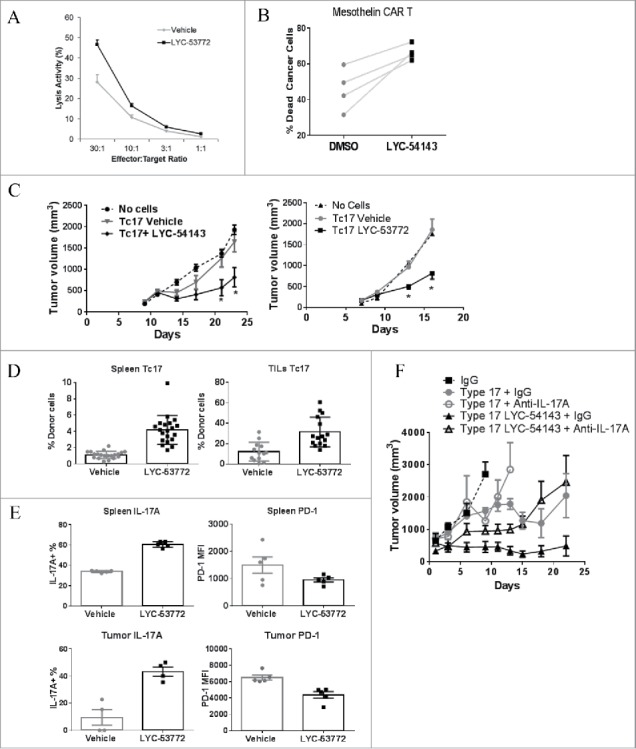
RORγ agonist treatment enhances cytotoxic activity of Tc17 cells in vitro and after transfer into tumor-bearing mice. (A) LYC-54143-treated Tc17 cells differentiated from OT-I T cells had better cytotoxic activity against EG7 lymphoma cells. p < 0.006 at all effector:target ratios LYC-54143 vs. Vehicle. Each data point represents mean ± SD of biological triplicates. B. LYC-54143 increased mesothelin CAR T mediated killing of K562.Meso tumor cells. p < 0.01, paired, two-tailed t-test. Differentiated Type 17 T cells from four donors treated with DMSO or LYC-54143 were transduced with a Meso-CAR construct and mixed with K562.Meso tumor cells. Killing of K562.Meso cells was assayed using flow cytometry. (C) Adoptive transfer of RORγ agonist treated Tc17 cells showed superior tumor growth inhibition in mice implanted with EG7 tumor cells. Left: LYC-54143 treated cells. *p < 0.025 LYC54143 vs. Vehicle. Multiple t-tests. Right: LYC-53772-treated cells. *p < 0.001 LYC53772 vs. Vehicle. Multiple t-tests. “No cells” group contains 10 mice and each of the Tc17-cell groups contains ≥12 mice. (D) Higher frequency of transferred donor cells were detected in the LYC-53772-treated group in both spleen and tumor at the end of the study. p < 0.0002 LYC-53772 vs. Vehicle. (E) LYC-53772-treated, adoptively transferred donor Tc17 cells from both spleen and tumor at the end of the study showed enhanced IL-17A production and reduced PD-1 expression. Percentage IL-17A+ cells among donor cells were assessed. PD-1 expression on donor cells was expressed as PD-1 MFI. LYC-53772 vs. Vehicle, p = 0.008 and 0.028, respectively, for IL-17A+ donor cells from spleen and TILs; p = 0.11 and 0.008, respectively, for PD-1 MFI in donor cells from spleen and TILs. (F) Neutralization of IL-17A with anti-IL-17A antibody reduced the antitumor efficacy of Type 17 cells treated with or without LYC-54143. Trp-1 and Pmel-1 T cells were differentiated into Type 17 cells and transferred into mice with B16 melanoma. IL-17A was neutralized by dosing anti-IL-17A antibody five times every other day starting from the day of transfer. N = 5 per group. p < 0.0001, Type 17 + IgG vs. Type 17 LYC-54143 + IgG; p = 0.0002, Type 17 LYC-54143 + IgG vs. Type 17 LYC-54143 + Anti-IL17A; p = 0.77, Type 17 + IgG vs. Type17 + Anti-IL17A and p = 0.37, Type 17 + Anti-IL17A vs. Type 17 LYC-54143 + Anti-IL17A. Mann–Whitney test.
Figure 5.
Figure 5.
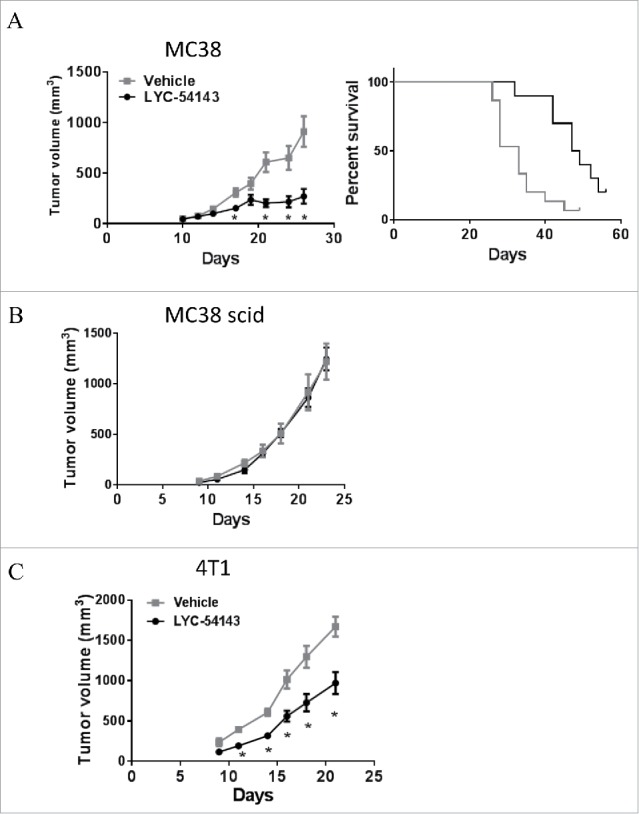
RORγ agonist LYC-54143 is efficacious in syngeneic tumor models. (A) LYC-54143 dosed twice daily at 100 mg/kg starting 3 days after subcutaneous tumor implantation, inhibited growth of MC38 colorectal tumor cells. Left: tumor growth curve *p < 0.01, LYC-54143 vs. Vehicle. N = 10 mice per group. Right: survival curve. Survival is defined as maintaining tumor size below ethical end points without significant weight loss (>20 %) or tumor ulceration. p = 0.0015 between the two groups, Log-rank (Mantel-Cox) test. (B) Efficacy is dependent on the presence of an intact immune system. No tumor growth inhibition with LYC-54143 treatment was observed when MC38 cells were implanted into SCID.Beige mice. N = 10 mice per group. (C) LYC-54143 was efficacious in the 4T1 breast cancer model. p < 0.004 LYC-54143 vs. Vehicle. N = 10 mice per group.

References

    1. Cua DJ, Tato CM. Innate IL-17-producing cells: the sentinels of the immune system. Nat Rev Immunol 2010; 10:479-89; PMID:20559326; http://dx.doi.org/ 10.1038/nri2800 - DOI - PubMed
    1. Ivanov II, McKenzie BS, Zhou L, Tadokoro CE, Lepelley A, Lafaille JJ, Cua DJ, Littman DR. The orphan nuclear receptor RORgammat directs the differentiation program of proinflammatory IL-17+ T helper cells. Cell 2006; 126:1121-33; PMID:16990136; http://dx.doi.org/ 10.1016/j.cell.2006.07.035 - DOI - PubMed
    1. Codarri L, Gyulveszi G, Tosevski V, Hesske L, Fontana A, Magnenat L, Suter T, Becher B. RORgammat drives production of the cytokine GM-CSF in helper T cells, which is essential for the effector phase of autoimmune neuroinflammation. Nat Immunol 2011; 12:560-7; PMID:21516112; http://dx.doi.org/ 10.1038/ni.2027 - DOI - PubMed
    1. Manel N, Unutmaz D, Littman DR. The differentiation of human T(H)-17 cells requires transforming growth factor-β and induction of the nuclear receptor RORgammat. Nat Immunol 2008; 9:641-9; PMID:18454151; http://dx.doi.org/ 10.1038/ni.1610 - DOI - PMC - PubMed
    1. Dong C. Differentiation and function of pro-inflammatory Th17 cells. Microbes Infect / Institut Pasteur 2009; 11:584-8; PMID:19371793; http://dx.doi.org/10875923 10.1016/j.micinf.2009.04.001 - DOI - PMC - PubMed

Publication types