


The Association Between IGF-1 Levels and the Histologic Severity of Nonalcoholic Fatty Liver Disease
- PMID: 28125073
- PMCID: PMC5288606
- DOI: 10.1038/ctg.2016.72
The Association Between IGF-1 Levels and the Histologic Severity of Nonalcoholic Fatty Liver Disease
Abstract
Objectives: The mechanisms responsible for the development of nonalcoholic fatty liver disease (NAFLD) and progression to nonalcoholic steatohepatitis (NASH) are incompletely understood. Growing evidence suggests that growth hormone (GH) and insulin-like growth factor-1 (IGF-1) may have roles in the development and progression of NAFLD. We hypothesized that lower serum IGF-1 levels would be associated with increased liver fat accumulation, inflammation, and fibrosis in a group of meticulously phenotyped obese subjects with liver biopsies.
Methods: A retrospective, cross-sectional study was performed at Massachusetts General Hospital, Boston, MA, USA and St. Mary's Hospital, Richmond, VA, USA. Liver biopsies were performed in 142 subjects during NAFLD work-up or bariatric surgery and were graded by a single, blinded pathologist. Main outcome measures included liver histology and serum IGF-1.
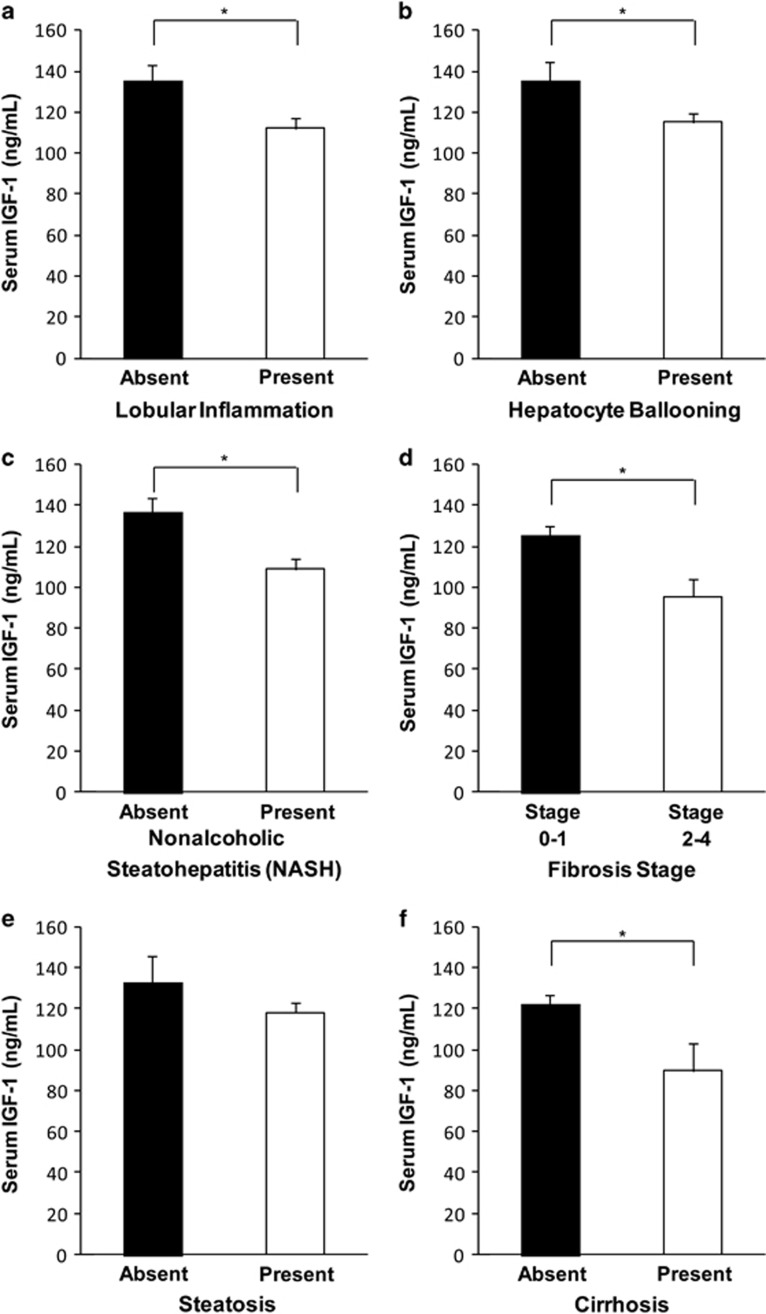
Results: Mean age was 52±10 years and body mass index (BMI) was 43±9 kg/m2. Mean serum IGF-1 was lower in subjects with lobular inflammation (112±47 vs. 136±57 ng/ml, P=0.01), hepatocyte ballooning (115±48 vs. 135±57 ng/ml, P=0.05), higher fibrosis stage (stage 2-4 vs. 0-1; 96±40 vs. 125±51 ng/ml, P=0.005), and NASH (109±45 vs. 136±57 ng/ml, P=0.002). All results remained significant after controlling for age, BMI, and a diagnosis of diabetes, and all but hepatocyte ballooning (trend, P=0.06) remained significant after excluding individuals with cirrhosis. Steatosis was not significantly associated with mean serum IGF-1 levels.
Conclusions: Low serum IGF-1 levels are associated with increased histologic severity of NAFLD when rigorously controlled for age, BMI, the presence of diabetes, and after the exclusion of subjects with cirrhosis. Further investigation is warranted to determine the differential effects of GH and IGF-1 on the development and progression of NAFLD, which could further elucidate pathophysiology and identify therapeutic targets.
Conflict of interest statement
Guarantor of the article: Karen K. Miller, MD. Specific author contributions: L.E.D., M.A.B., K.E.C., and K.K.M. contributed to study design. K.E.C., S.A.O., and L.E.D. contributed to data collection. J.M. performed all pathology review. L.E.D., K.E.C., M.A.B., B.J.Y., and J.C.S. performed statistical analysis and data interpretation. L.E.D., K.E.C., M.S., and K.K.M. contributed to writing the manuscript. All authors reviewed and approved the manuscript before submission. Financial support: This work was supported by National Institutes of Health grants R01 HL 077674, K24 HL092902, K23 RR023090, K23 DK099422, and T32 DK007028, as well as the Harvard Clinical and Translational Science Center (CTSC) grant UL1 RR025758. Potential competing interests: None.
Figures
References
-
- Browning JD, Kumar KS, Saboorian MH et al. Ethnic differences in the prevalence of cryptogenic cirrhosis. Am J Gastroenterol 2004; 99: 292–298. - PubMed
-
- Wong VW, Wong GL, Choi PC et al. Disease progression of non-alcoholic fatty liver disease: a prospective study with paired liver biopsies at 3 years. Gut 2010; 59: 969–974. - PubMed
-
- Charlton MR, Burns JM, Pedersen RA et al. Frequency and outcomes of liver transplantation for nonalcoholic steatohepatitis in the United States. Gastroenterology 2011; 141: 1249–1253. - PubMed
-
- Wong RJ, Cheung R, Ahmed A. Nonalcoholic steatohepatitis is the most rapidly growing indication for liver transplantation in patients with hepatocellular carcinoma in the U.S. Hepatology 2014; 59: 2188–2195. - PubMed
-
- Chalasani N, Younossi Z, Lavine JE et al. The diagnosis and management of non-alcoholic fatty liver disease: practice guideline by the American Association for the Study of Liver Diseases, American College of Gastroenterology, and the American Gastroenterological Association. Am J Gastroenterol 2012; 107: 811–826. - PubMed
Grants and funding
LinkOut - more resources
Full Text Sources
Other Literature Sources
Miscellaneous
