


Family caregiver burden: the burden of caring for lung cancer patients according to the cancer stage and patient quality of life
- PMID: 28125154
- PMCID: PMC5790667
- DOI: 10.1590/S1806-37562016000000177
Family caregiver burden: the burden of caring for lung cancer patients according to the cancer stage and patient quality of life
Abstract
Objective:: Patients with lung cancer experience different feelings and reactions, based on their family, social, cultural, and religious backgrounds, which are a source of great distress, not only for the patients but also for their family caregivers. This study aimed to evaluate the impact that lung cancer stage and quality of life (QoL) of lung cancer patients have on caregiver burden.
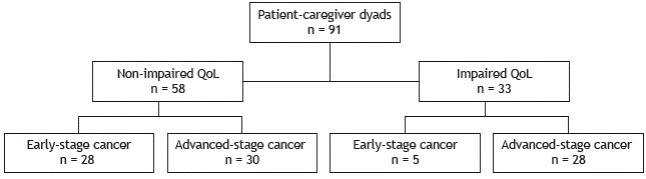
Methods:: This was a prospective cross-sectional study. Consecutive patient-caregiver dyads were selected and asked to complete the Hospital Anxiety and Depression Scale and the Medical Outcomes Study 36-item ShortForm Health Survey (SF-36). Family caregivers also completed the Caregiver Burden Scale. Group-based modeling was used in order to identify patients with early- or advanced-stage cancer (IA to IIIA vs. IIIB to IV) plus non-impaired or impaired QoL (SF36 total score > 50 vs. ≤ 50). Patient-caregiver dyads were stratified into four groups: early-stage cancer+non-impaired QoL; advanced-stage cancer+non-impaired QoL; early-stage cancer+impaired QoL; and advanced-stage cancer+impaired QoL.
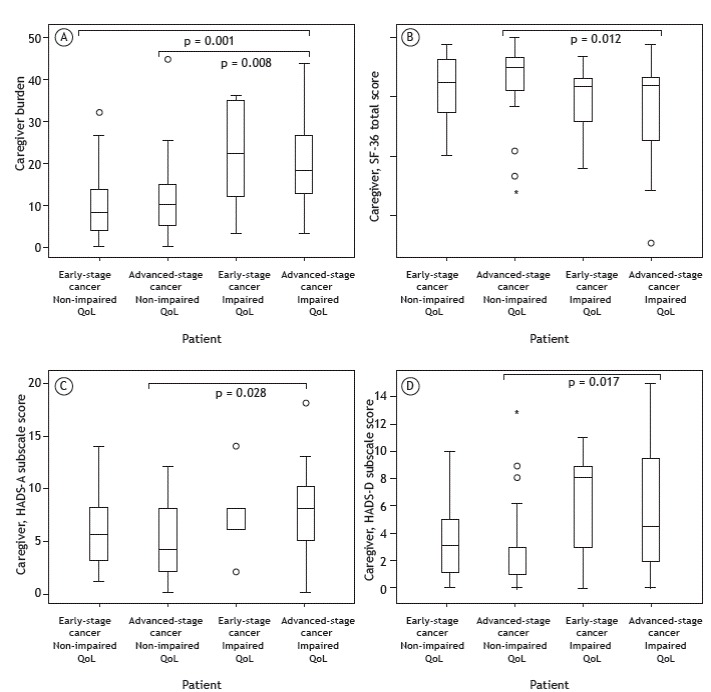
Results:: We included 91 patient-caregiver dyads. The majority of the patients were male and heavy smokers. Family caregivers were younger and predominantly female. The burden, QoL, level of anxiety, and level of depression of caregivers were more affected by the QoL of the patients than by their lung cancer stage. The family caregivers of the patients with impaired QoL showed a higher median burden than did those of the patients with non-impaired QoL, regardless of disease stage.
Conclusions:: Caregiver burden is more affected by patient QoL than by lung cancer stage.
Objetivo:: Pacientes com câncer de pulmão vivenciam diferentes sentimentos e reações, dependendo de sua formação familiar, social, cultural e religiosa, que são fonte de grande sofrimento, não só para os pacientes mas também para seus cuidadores familiares. Este estudo objetivou avaliar o impacto do estágio do câncer de pulmão e da qualidade de vida (QV) dos pacientes com câncer de pulmão na sobrecarga do cuidador.
Métodos:: Estudo prospectivo transversal. Díades paciente-cuidador foram selecionadas consecutivamente e solicitadas a preencher a Hospital Anxiety and Depression Scale e o Medical Outcomes Study 36-item Short-Form Health Survey (SF-36). Os cuidadores familiares também preencheram a Caregiver Burden Scale. Utilizou-se a modelagem de grupos para identificar pacientes com câncer em estágio inicial ou avançado (IA a IIIA vs. IIIB a IV) mais QV não comprometida ou comprometida (pontuação total no SF36 > 50 vs. ≤ 50). As díades paciente-cuidador foram estratificadas em quatro grupos: câncer em estágio inicial+QV não comprometida; câncer em estágio avançado+QV não comprometida; câncer em estágio inicial+QV comprometida; e câncer em estágio avançado+QV comprometida.
Resultados:: Foram incluídas 91 díades paciente-cuidador. A maioria dos pacientes era do sexo masculino e grande fumante. Os cuidadores familiares eram mais jovens e predominantemente do sexo feminino. A sobrecarga, QV, nível de ansiedade e nível de depressão dos cuidadores foram mais afetados pela QV dos pacientes do que pelo estágio do câncer de pulmão. Os cuidadores familiares dos pacientes com QV comprometida apresentaram maior mediana de sobrecarga do que os dos pacientes com QV não comprometida, independentemente do estágio da doença.
Conclusões:: A sobrecarga do cuidador é mais afetada pela QV do paciente do que pelo estágio do câncer de pulmão.
Objetivo:: Pacientes com câncer de pulmão vivenciam diferentes sentimentos e reações, dependendo de sua formação familiar, social, cultural e religiosa, que são fonte de grande sofrimento, não só para os pacientes mas também para seus cuidadores familiares. Este estudo objetivou avaliar o impacto do estágio do câncer de pulmão e da qualidade de vida (QV) dos pacientes com câncer de pulmão na sobrecarga do cuidador.
Métodos:: Estudo prospectivo transversal. Díades paciente-cuidador foram selecionadas consecutivamente e solicitadas a preencher a Hospital Anxiety and Depression Scale e
o Medical Outcomes Study 36-item Short-Form Health Survey (SF-36). Os cuidadores familiares também preencheram a Caregiver Burden Scale. Utilizou-se a modelagem de grupos para identificar pacientes com câncer em estágio inicial ou avançado (IA a IIIA vs. IIIB a IV) mais QV não comprometida ou comprometida (pontuação total no SF36 > 50 vs. ≤ 50). As díades paciente-cuidador foram estratificadas em quatro grupos: câncer em estágio inicial+QV não comprometida; câncer em estágio avançado+QV não comprometida; câncer em estágio inicial+QV comprometida; e câncer em estágio avançado+QV comprometida.
Resultados:: Foram incluídas 91 díades paciente-cuidador. A maioria dos pacientes era do sexo masculino e grande fumante. Os cuidadores familiares eram mais jovens e predominantemente do sexo feminino. A sobrecarga, QV, nível de ansiedade e nível de depressão dos cuidadores foram mais afetados pela QV dos pacientes do que pelo estágio do câncer de pulmão. Os cuidadores familiares dos pacientes com QV comprometida apresentaram maior mediana de sobrecarga do que os dos pacientes com QV não comprometida, independentemente do estágio da doença.
Conclusões:: A sobrecarga do cuidador é mais afetada pela QV do paciente do que pelo estágio do câncer de pulmão.
Figures
References
-
- Siegel R, Ma J, Zou Z, Jemal A. Cancer statistics, 2014. CA Cancer J Clin. 2014;64(1):9–29. http://dx.doi.org/10.3322/caac.21208 - DOI - PubMed
-
- Blum K, Sherman DW. Understanding the experience of caregivers: a focus on transitions. Semin Oncol Nurs. 2010;26(4):243–258. http://dx.doi.org/10.1016/j.soncn.2010.08.005 - DOI - PubMed
-
- Hirdes JP, Freeman S, Smith TF, Stolee P. Predictors of caregiver distress among palliative home care clients in Ontario evidence based on the interRAI Palliative Care. Palliat Support Care. 2012;10(3):155–163. http://dx.doi.org/10.1017/S1478951511000824 - DOI - PubMed
-
- Adelman R, Tmanova LL, Delgado D, Dion S, Lachs MS. Caregiver burden a clinical review. JAMA. 2014;311(10):1052–1060. http://dx.doi.org/10.1001/jama.2014.304 - DOI - PubMed
-
- Schubart JR, Kinzie MB, Farace E. Caring for the brain tumor patient family caregiver burden and unmet needs. Neuro Oncol. 2008;10(1):61–72. http://dx.doi.org/10.1215/15228517-2007-040 - DOI - PMC - PubMed
MeSH terms
LinkOut - more resources
Full Text Sources
Other Literature Sources
Medical
Research Materials
