


Systematic Review of the Toxicity of Long-Course Oral Corticosteroids in Children
- PMID: 28125632
- PMCID: PMC5268779
- DOI: 10.1371/journal.pone.0170259
Systematic Review of the Toxicity of Long-Course Oral Corticosteroids in Children
Abstract
Background: Long courses of oral corticosteroids are commonly used in children in the management of chronic conditions. Various adverse drug reactions (ADRs) are known to occur with their use. This systematic review aimed to identify the most common and serious ADRs and to determine their relative risk levels.
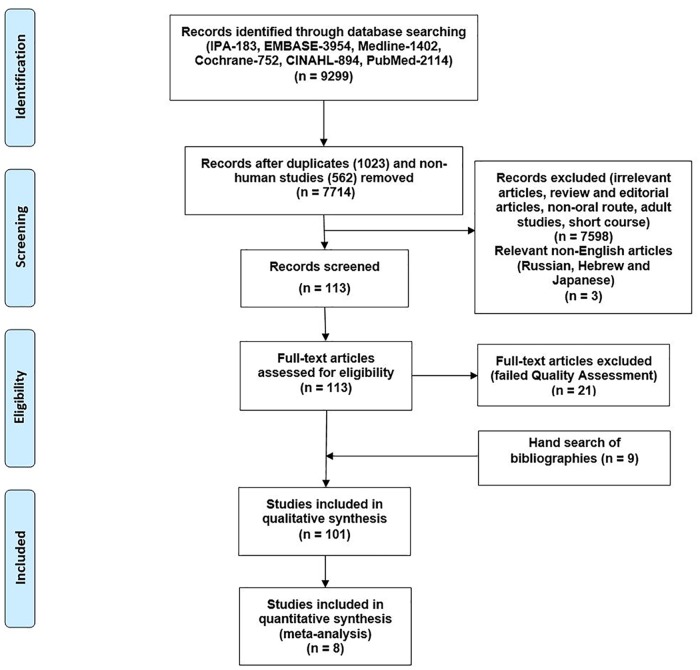
Methods: A literature search of Embase, Medline, International Pharmaceutical Abstracts, CINAHL, Cochrane Library and PubMed was performed with no language restrictions in order to identify studies where oral corticosteroids were administered to patients aged 28 days to 18 years of age for at least 15 days of treatment. Each database was searched from their earliest dates to January 2016. All studies providing clear information on ADRs were included.
Results: One hundred and one studies including 33 prospective cohort studies; 21 randomised controlled trials; 21 case series and 26 case reports met the inclusion criteria. These involved 6817 children and reported 4321 ADRs. The three ADRs experienced by the highest number of patients were weight gain, growth retardation and Cushingoid features with respective incidence rates of 21.1%, 18.1% and 19.4% of patients assessed for these ADRs. 21.5% of patients measured showed decreased bone density and 0.8% of patients showed osteoporosis. Biochemical HPA axis suppression was detected in 269 of 487 patients where it was measured. Infection was the most serious ADR, with twenty one deaths. Varicella zoster was the most frequent infection (9 deaths).
Conclusions: Weight gain, growth retardation and Cushingoid features were the most frequent ADRs seen when long-course oral corticosteroids were given to children. Increased susceptibility to infection was the most serious ADR.
Conflict of interest statement
I have read the journal's policy and the authors of this manuscript have the following competing interests: Imti Choonara is an Academic Editor of the journal.
Figures

References
-
- Williams KW, Andrews AL, Heine D, Russell WS, Titus MO. Parental preference for short- versus long-course corticosteroid therapy in children with asthma presenting to the pediatric emergency department. Clin Pediatr (Phila). 2013;52: 30–4. - PubMed
-
- Citterio F. Steroid side effects and their impact on transplantation outcome. Transplantation. 2001;72: S75–80. - PubMed
-
- Hunder GG, Sheps SG, Allen GL, Joyce JW. Daily and alternate-day corticosteroid regimens in treatment of giant cell arteritis: comparison in a prospective study. Ann Intern Med. 1975;82: 613–8. - PubMed
-
- REICHLING GH, KLIGMAN AM. Alternate-day corticosteroid therapy. Arch Dermatol. 1961;83: 980–3. - PubMed
Publication types
MeSH terms
Substances
LinkOut - more resources
Full Text Sources
Other Literature Sources
Medical
Molecular Biology Databases
Research Materials
Miscellaneous
