


Method for estimating high sdLDL-C by measuring triglyceride and apolipoprotein B levels
- PMID: 28125987
- PMCID: PMC5270205
- DOI: 10.1186/s12944-017-0417-6
Method for estimating high sdLDL-C by measuring triglyceride and apolipoprotein B levels
Abstract
Background: We previously developed an assay to directly measure small dense (sd) low-density lipoprotein cholesterol (LDL-C) levels, which is not widely used in general clinical practice. Therefore, we propose a simpler method, "LDL window," that uses conventional methods for estimating high sdLDL-C levels.
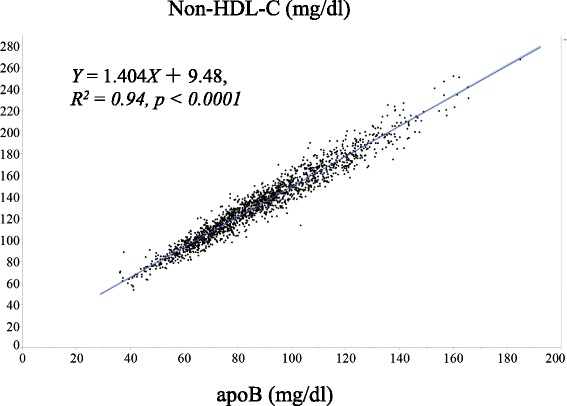
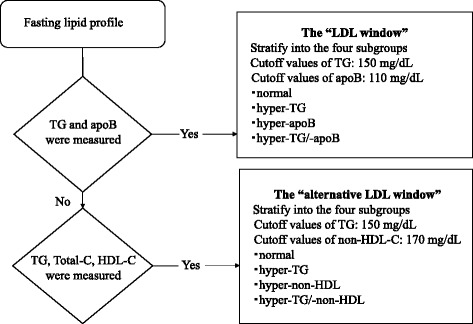
Methods: We analyzed our previous studies (2006-2008) on healthy subjects and patients with type 2 diabetes and coronary artery disease (CAD). The sdLDL-C level was measured using the precipitation method, and LDL size was determined using gradient gel electrophoresis. The "LDL window" comprises the estimation of LDL particle number and size. We adopted apolipoprotein B (apoB) for the estimation of the LDL particle number and used 110 mg/dL as the cutoff value for hyper-apoB. Triglycerides (TGs) are a powerful inverse determinant of LDL particle size. Therefore, we adopted TG for the estimation of the LDL particle size and used 150 mg/dL as the cutoff value for hyper-TG. Subjects were stratified into the following four subgroups: normal, hyper-TG, hyper-apoB, and hyper-TG/-apoB. Non-high-density lipoprotein cholesterol (non-HDL-C) is a surrogate marker for apoB; therefore, the "alternative LDL window" comprised non-HDL-C (cutoff, 170 mg/dL) and TG.
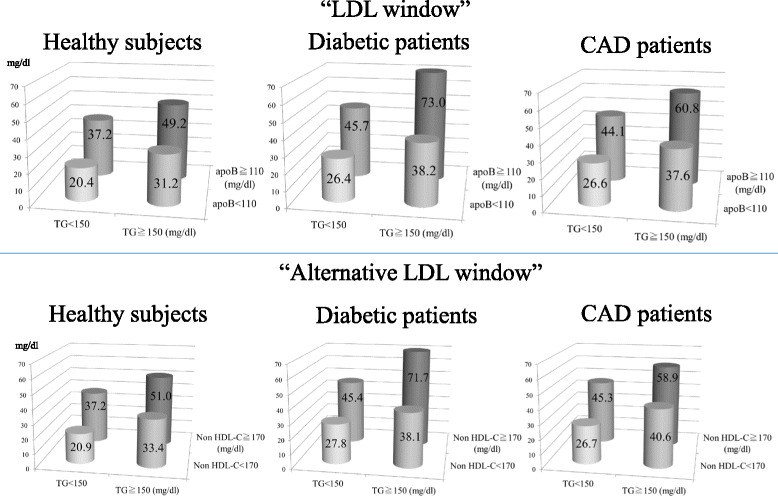
Results: The top quartile (Q4) of sdLDL-C (>31 mg/dL) doubled in patients with diabetes and CAD. The hyper-TG/-apoB group in the "LDL window" represented >90% Q4 and <4% Q1 and Q2, irrespective of the subjects. The sdLDL-C levels in the hyper-TG/-apoB group were 50% higher in patients with diabetes and CAD than those in controls. Similar results were obtained using the "alternative LDL window."
Conclusions: Our proposed "LDL window" may help identify patients at high risk of CAD independent of LDL-C.
Keywords: Apolipoprotein B; Cholesterol; Coronary artery disease; Small dense low-density lipoproteins; Triglycerides.
Figures
References
MeSH terms
Substances
LinkOut - more resources
Full Text Sources
Other Literature Sources
Medical
Miscellaneous
