


A U-shaped Association Between Blood Pressure and Cognitive Impairment in Chinese Elderly
- PMID: 28126139
- PMCID: PMC5294228
- DOI: 10.1016/j.jamda.2016.11.011
A U-shaped Association Between Blood Pressure and Cognitive Impairment in Chinese Elderly
Abstract
Objectives: Higher or lower blood pressure may relate to cognitive impairment, whereas the relationship between blood pressure and cognitive impairment among the elderly is not well-studied. The study objective was to determine whether blood pressure is associated with cognitive impairment in the elderly, and, if so, to accurately describe the association.
Design: Cross-sectional data from the sixth wave of the Chinese Longitudinal Healthy Longevity Survey (CLHLS) conducted in 2011.
Setting: Community-based setting in longevity areas in China.
Participants: A total of 7144 Chinese elderly aged 65 years and older were included in the sample.
Measures: Systolic blood pressures (SBP) and diastolic blood pressures (DBP) were measured, pulse pressure (PP) was calculated as (SBP) - (DBP) and mean arterial pressures (MAP) was calculated as 1/3(SBP) + 2/3(DBP). Cognitive function was assessed via a validated Mini-Mental State Examination (MMSE).
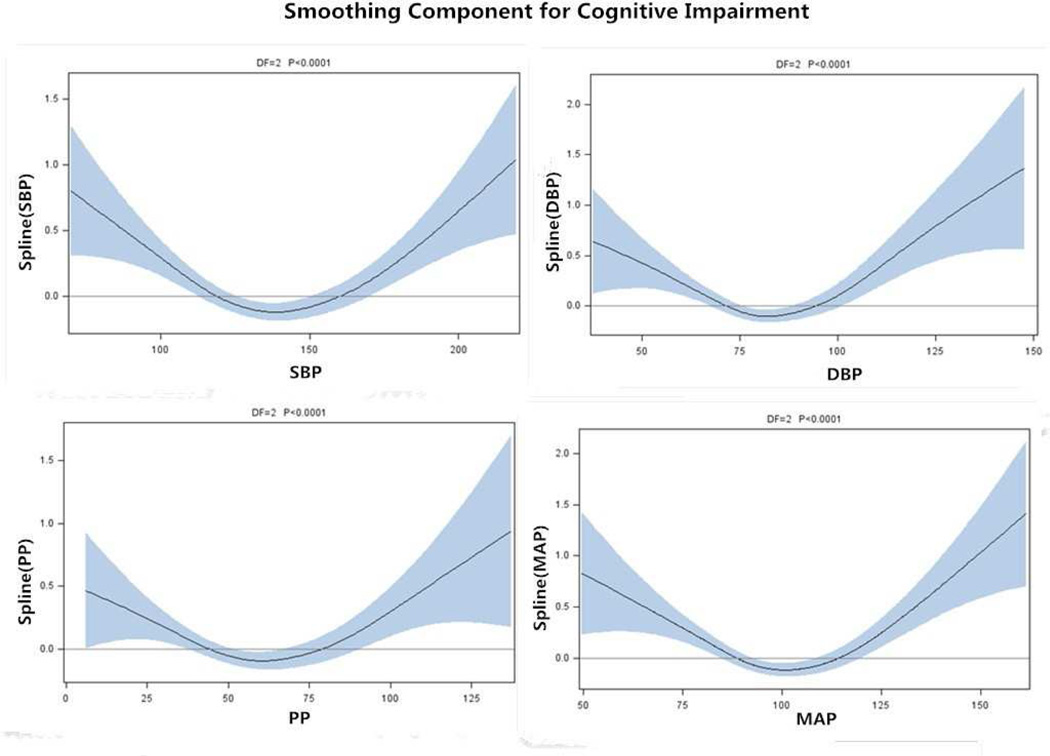
Results: Based on the results of generalized additive models (GAMs), U-shaped associations were identified between cognitive impairment and SBP, DBP, PP, and MAP. The cutpoints at which risk for cognitive impairment (MMSE <24) was minimized were determined by quadratic models as 141 mm Hg, 85 mm Hg, 62 mm Hg, and 103 mm Hg, respectively. In the logistic models, U-shaped associations remained for SBP, DBP, and MAP but not PP. Below the identified cutpoints, each 1-mm Hg decrease in blood pressure corresponded to 0.7%, 1.1%, and 1.1% greater risk in the risk of cognitive impairment, respectively. Above the cutpoints, each 1-mm Hg increase in blood pressure corresponded to 1.2%, 1.8%, and 2.1% greater risk of cognitive impairment for SBP, DBP, and MAP, respectively.
Conclusion: A U-shaped association between blood pressure and cognitive function in an elderly Chinese population was found. Recognition of these instances is important in identifying the high-risk population for cognitive impairment and to individualize blood pressure management for cognitive impairment prevention.
Keywords: Blood pressure; cognitive impairment; curvilinear association; elderly; hypertension; hypotension.
Copyright © 2016 AMDA – The Society for Post-Acute and Long-Term Care Medicine. All rights reserved.
Conflict of interest statement
None.
Figures
References
-
- Abete P, Della-Morte D, Gargiulo G, et al. Cognitive impairment and cardiovascular diseases in the elderly. A heart-brain continuum hypothesis. Ageing Res Rev. 2014;18:41–52. - PubMed
-
- Skoog I, Lernfelt B, Landahl S, et al. 15-year longitudinal study of blood pressure and dementia. Lancet. 1996;347:1141–1145. - PubMed
-
- Paran E, Anson O, Reuveni H. Blood pressure and cognitive functioning among independent elderly. Am J Hypertens. 2003;16:818–826. - PubMed
-
- Molander L, Gustafson Y, Lövheim H. Longitudinal associations between blood pressure and dementia in the very old. Dement Geriatr Cogn Disord. 2010;30:269–276. - PubMed
MeSH terms
Grants and funding
LinkOut - more resources
Full Text Sources
Other Literature Sources
Medical
Miscellaneous
