


Risk factors for 30-day unplanned readmission following infrainguinal endovascular interventions
- PMID: 28126175
- PMCID: PMC5293151
- DOI: 10.1016/j.jvs.2016.08.093
Risk factors for 30-day unplanned readmission following infrainguinal endovascular interventions
Abstract
Objective: Unplanned hospital readmissions following surgical interventions are associated with adverse events and contribute to increasing health care costs. Despite numerous studies defining risk factors following lower extremity bypass surgery, evidence regarding readmission after endovascular interventions is limited. This study aimed to identify predictors of 30-day unplanned readmission following infrainguinal endovascular interventions.
Methods: We identified all patients undergoing an infrainguinal endovascular intervention in the targeted vascular module of the American College of Surgeons National Surgical Quality Improvement Program between 2012 and 2014. Perioperative outcomes were stratified by symptom status (chronic limb-threatening ischemia [CLI] vs claudication). Patients who died during index admission and those who remained in the hospital after 30 days were excluded. Indications for unplanned readmission related to the index procedure were evaluated. Multivariable logistic regression was used to identify preoperative and in-hospital (during index admission) risk factors of 30-day unplanned readmission.
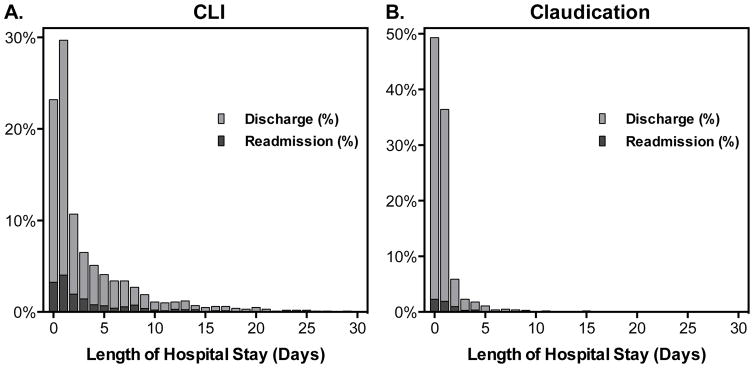
Results: There were 4449 patients who underwent infrainguinal endovascular intervention, of whom 2802 (63%) had CLI (66% tissue loss) and 1647 (37%) had claudication. The unplanned readmission rates for CLI and claudication patients were 16% (n = 447) and 6.5% (n = 107), respectively. Mortality after index admission was higher for readmitted patients compared with those not readmitted (CLI, 3.4% vs 0.7% [P < .001]; claudication, 2.8% vs 0.1% [P < .01]). Approximately 50% of all unplanned readmissions were related to the index procedure. Among CLI patients, the most common indication for readmission related to the index procedure was wound or infection related (42%), whereas patients with claudication were mainly readmitted for recurrent symptoms of peripheral vascular disease (28%). In patients with CLI, predictors of unplanned readmission included diabetes (odds ratio, 1.3; 95% confidence interval, 1.01-1.6), congestive heart failure (1.6; 1.1-2.5), renal insufficiency (1.7; 1.3-2.2), preoperative dialysis (1.4; 1.02-1.9), tibial angioplasty/stenting (1.3; 1.04-1.6), in-hospital bleeding (1.9; 1.04-3.5), in-hospital unplanned return to the operating room (1.9; 1.1-3.5), and discharge other than to home (1.5; 1.1-2.0). Risk factors for those with claudication were dependent functional status (3.5; 1.4-8.7), smoking (1.6; 1.02-2.5), diabetes (1.5; 1.01-2.3), preoperative dialysis (3.6; 1.6-8.3), procedure time exceeding 120 minutes (1.8; 1.1-2.7), in-hospital bleeding (2.9; 1.2-7.4), and in-hospital unplanned return to the operating room (3.4; 1.2-9.4).
Conclusions: Unplanned readmission after endovascular treatment is relatively common, especially in patients with CLI, and is associated with substantially increased mortality. Awareness of these risk factors will help providers identify patients at high risk who may benefit from early surveillance, and prophylactic measures focused on decreasing postoperative complications may reduce the rate of readmission.
Copyright © 2016 Society for Vascular Surgery. Published by Elsevier Inc. All rights reserved.
Figures
References
-
- Jencks SF, Williams MV, Coleman EA. Rehospitalizations among patients in the Medicare fee-for-service program. N Engl J Med. 2009;360(14):1418–1428. - PubMed
-
- Sellers MM, Merkow RP, Halverson A, Hinami K, Kelz RR, Bentrem DJ, et al. Validation of new readmission data in the American College of Surgeons National Surgical Quality Improvement Program. J Am Coll Surg. 2013;216(3):420–427. - PubMed
-
- Gerhardt G, Yemane A, Apostle K, Oelschlaeger A, Rollins E, Brennan N. Evaluating whether changes in utilization of hospital outpatient services contributed to lower Medicare readmission rate. Medicare Medicaid Res Rev. 2014;4(1) doi: 10.5600/mmrr2014-004-01-b03. eCollection 2014. - DOI - PMC - PubMed
Publication types
MeSH terms
Grants and funding
LinkOut - more resources
Full Text Sources
Other Literature Sources
Medical
Research Materials
Miscellaneous
