


Contraceptive knowledge and use among women living in the poorest areas of five Mesoamerican countries
- PMID: 28126542
- PMCID: PMC5493184
- DOI: 10.1016/j.contraception.2017.01.005
Contraceptive knowledge and use among women living in the poorest areas of five Mesoamerican countries
Abstract
Objective: To identify factors associated with contraceptive use among women in need living in the poorest areas in five Mesoamerican countries: Guatemala, Honduras, Nicaragua, Panama and State of Chiapas (Mexico).
Study design: We analyzed baseline data of 7049 women of childbearing age (15-49 years old) collected for the Salud Mesoamérica Initiative. Data collection took place in the 20% poorest municipalities of each country (July, 2012-August, 2013).
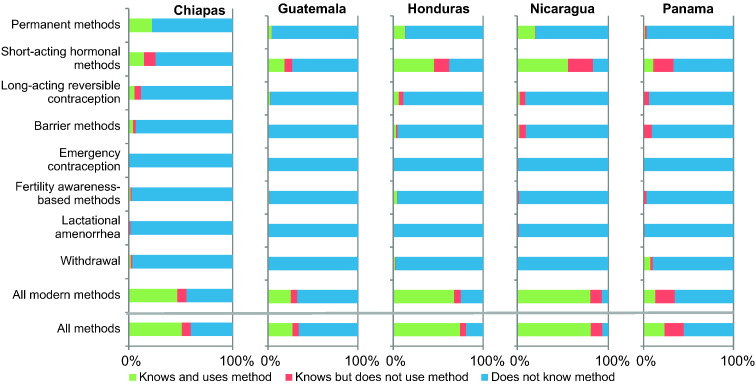
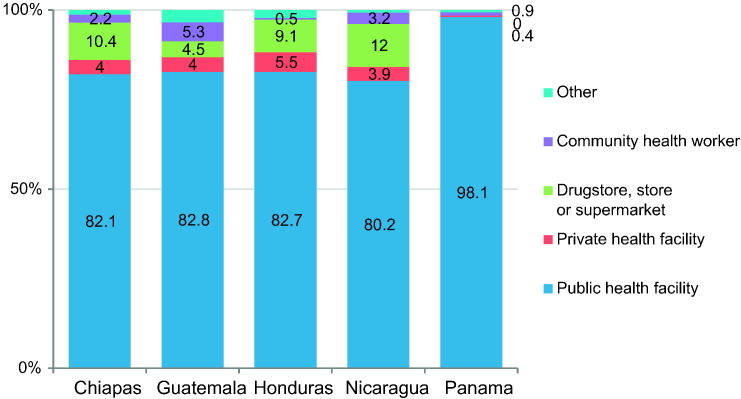
Results: Women in the poorest areas were very poorly informed about family planning methods. Concern about side effects was the main reason for nonuse. Contraceptive use was lower among the extremely poor (<$1.25 USD PPP per day) [odds ratio (OR): 0.75; confidence interval (CI): 0.59-0.96], those living more than 30 min away from a health facility (OR 0.71, CI: 0.58-0.86), and those of indigenous ethnicity (OR 0.50, CI: 0.39-0.64). Women who were insured and visited a health facility also had higher odds of using contraceptives than insured women who did not visit a health facility (OR 1.64, CI: 1.13-2.36).
Conclusions: Our study showed low use of contraceptives in poor areas in Mesoamerica. We found the urgent need to improve services for people of indigenous ethnicity, low education, extreme poverty, the uninsured, and adolescents. It is necessary to address missed opportunities and offer contraceptives to all women who visit health facilities. Governments should aim to increase the public's knowledge of long-acting reversible contraception and offer a wider range of methods to increase contraceptive use.
Implications: We show that unmet need for contraception is higher among the poorest and describe factors associated with low use. Our results call for increased investments in programs and policies targeting the poor to decrease their unmet need.
Keywords: Contraceptive knowledge; Family planning; Health inequalities; Poverty; Salud Mesoamerica; Unmet need.
Copyright © 2017 The Authors. Published by Elsevier Inc. All rights reserved.
Figures
References
-
- Restrepo-Méndez M.C., Barros A.J.D., Requejo J., Duran P., de Francisco Serpa L.A., Franca G.V.A. Progress in reducing inequalities in reproductive, maternal, newborn, and child health in Latin America and the Caribbean: an unfinished agenda. Rev Panam Salud Pública. 2015;38:9–16. - PubMed
-
- Becerril-Montekio V., López-Dávila L. Sistema de salud de Guatemala. Salud Pública Méx. 2011;53:S197–S208. - PubMed
-
- Bermúdez-Madriz J.L., Sáenz M. del R., Muiser J., Acosta M. Sistema de salud de Honduras. Salud Pública Méx. 2011;53:S209–S219. - PubMed
-
- Muiser J., Sáenz M. del R., Bermúdez J.L. Sistema de salud de Nicaragua. Salud Pública Méx. 2011;53:S233–S242. - PubMed
-
- INEGI, CONAPO . Instituto Nacional de Estadística y Geografía y Consejo Nacional de Población; Mexico: 2015. Encuesta Nacional de la Dinámica Demográfica ENADID 2014: Principales Resultados.
MeSH terms
LinkOut - more resources
Full Text Sources
Other Literature Sources
Medical
Miscellaneous
