. 2017:2017:5163575.
doi: 10.1155/2017/5163575. Epub 2017 Jan 3.

Antibiofilm and Antioxidant Activity of Propolis and Bud Poplar Resins versus Pseudomonas aeruginosa

Affiliations

Antibiofilm and Antioxidant Activity of Propolis and Bud Poplar Resins versus Pseudomonas aeruginosa

Stefania De Marco et al. Evid Based Complement Alternat Med. 2017.

Abstract

Pseudomonas aeruginosa is a common biofilm-forming bacterial pathogen implicated in lung, skin, and systemic infections. Biofilms are majorly associated with chronic lung infection, which is the most severe complication in cystic fibrosis patients characterized by drug-resistant biofilms in the bronchial mucus with zones, where reactive oxygen species concentration is increased mainly due to neutrophil activity. Aim of this work is to verify the anti-Pseudomonas property of propolis or bud poplar resins extracts. The antimicrobial activity of propolis and bud poplar resins extracts was determined by MIC and biofilm quantification. Moreover, we tested the antioxidant activity by DPPH and neutrophil oxidative burst assays. In the end, both propolis and bud poplar resins extracts were able to inhibit P. aeruginosa biofilm formation and to influence both swimming and swarming motility. Moreover, the extracts could inhibit proinflammatory cytokine production by human PBMC and showed both direct and indirect antioxidant activity. This work is the first to demonstrate that propolis and bud poplar resins extracts can influence biofilm formation of P. aeruginosa contrasting the inflammation and the oxidation state typical of chronic infection suggesting that propolis or bud poplar resins can be used along with antibiotic as adjuvant in the therapy against P. aeruginosa infections related to biofilm.


Conflict of interest statement

The authors declare no competing financial interests.

Figures
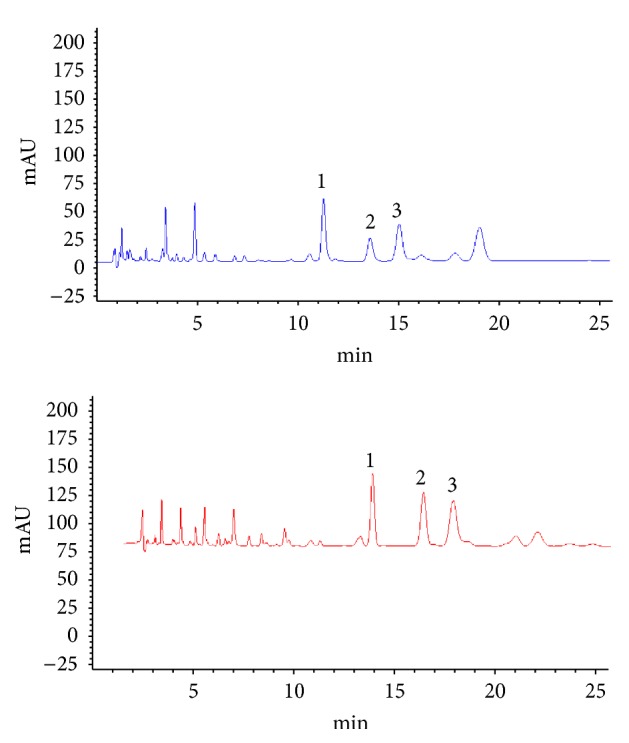
Figure 1
Figure 1
Phytochemical analysis of propolis and bud poplar resins. Chromatogram of poplar bud resins extract (blue line) and propolis extract (red line). Chrysin (1), galangin (2), and pinocembrin (3) were quantified using pure substances as external standards. The concentration was calculated by means of a calibration curve in the range of 0.1–0.02 mg/mL.
Figure 2
Figure 2
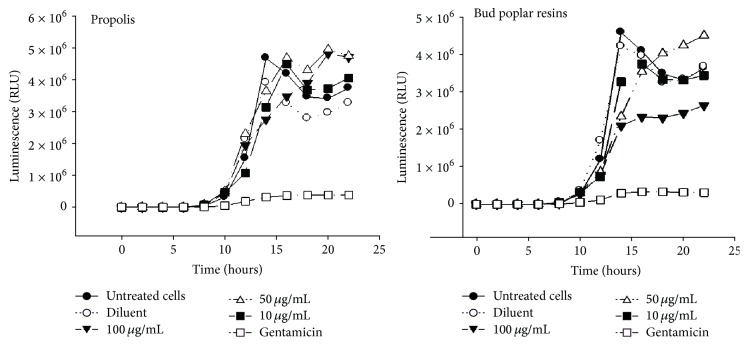
Growth curve of Pseudomonas aeruginosa P1242 in presence of propolis and bud poplar resins extracts. P. aeruginosa cells were grown in presence or absence of extracts at 10, 50, and 100 μg/mL for 24 h at 37°C. Gentamicin (1.8 μg/mL) was used as positive control. Luminescence of live cells in the culture is expressed as relative luminescence units (RLU).
Figure 3
Figure 3
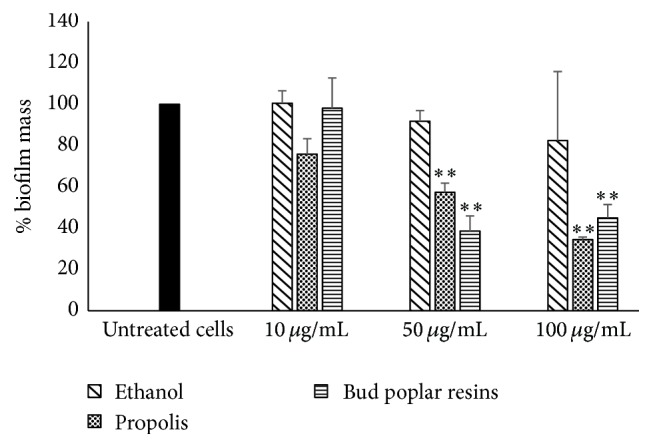
Effect of propolis and bud poplar resins extracts on biofilm formation. P. aeruginosa biofilm was developed in presence or absence of different extracts (10, 50, and 100 μg/mL) or diluent (same concentration present in the propolis solutions) for 24 h at 37°C. Biofilm biomass was quantified by crystal violet assay (absorbance 570 nm). ∗∗P < 0.01 (biofilm grown in the presence of propolis or bud poplar resins extracts versus biofilm formed in presence of diluent).
Figure 4
Figure 4
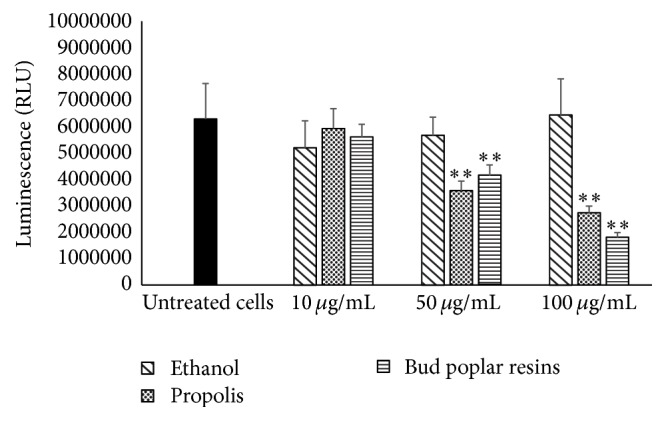
Effect of propolis and bud poplar resins extracts on sessile Pseudomonas aeruginosa. P. aeruginosa biofilm was developed in presence or absence of different extracts (10, 50, and 100 μg/mL) or diluent (same concentration present in the propolis solutions) for 24 h at 37°C. ∗∗P < 0.01 (sessile bacteria in biofilm formed in the presence of propolis and bud poplar resins extracts versus sessile bacteria in biofilm formed in presence of diluent).
Figure 5
Figure 5
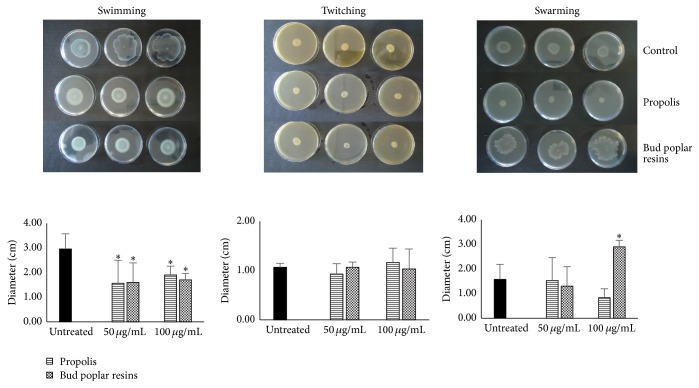
Swimming, twitching, and swarming motility of Pseudomonas aeruginosa in presence of propolis or bud poplar resins extracts. Swimming, twitching, and swarming motility were determined by measuring the radius of bacterial colony, hazy or turbid zone. P < 0.05 (colonies grown in the presence of propolis versus colonies formed in presence of diluent).
Figure 6
Figure 6
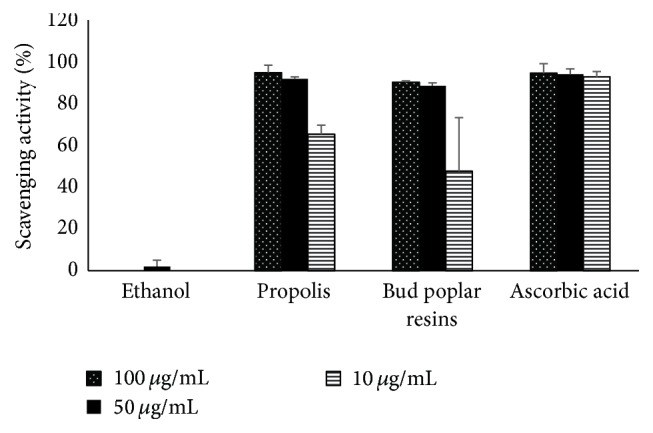
Antioxidant activity of propolis and bud poplar resins extracts. Results are expressed as % of DPPH scavenging activity. Data represent the mean ± SD of 2 or more independent experiments performed in triplicate.
Figure 7
Figure 7
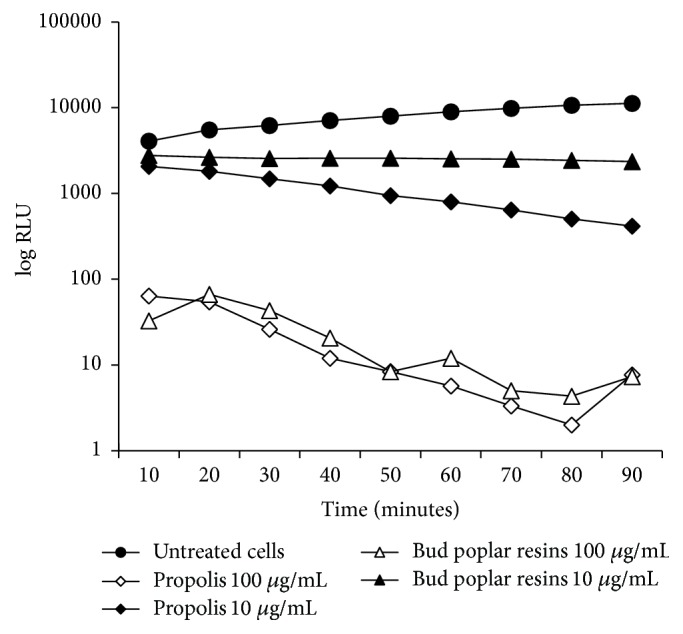
Antioxidant activity of different concentrations of propolis and bud poplar resins extracts on ROS production in human neutrophils. Antioxidant activity of different concentrations of extracts on ROS production in human neutrophils stimulated with PMA has been determined by luminol-dependent chemiluminescence assay. Results are expressed as Log of RLU (relative luminescence units). The figure is representative of two independent experiments with similar profiles performed in triplicate.
Figure 8
Figure 8
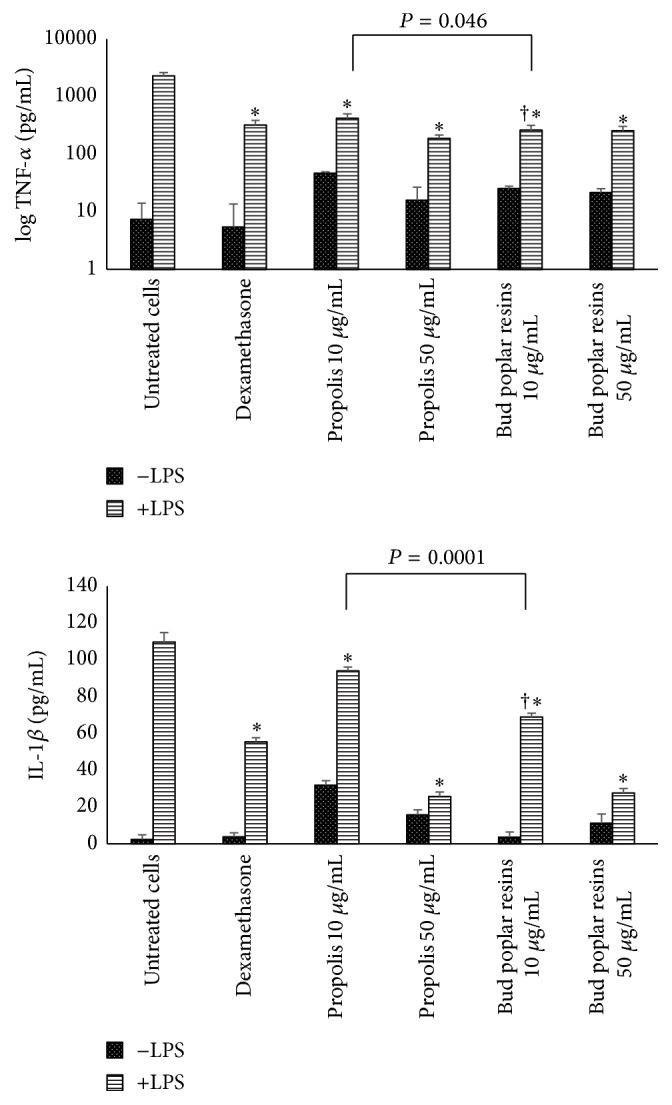
Anti-inflammatory activity of propolis and bud poplar resins extracts. TNF-α and IL-1β production by PBMC in response to LPS in presence of propolis or bud poplar resins extracts. PBMC were stimulated for 4 h with LPS (1 μg/mL) and then treated overnight with extracts at the concentration of 10 and 50 μg/mL. After incubation, supernatants were recovered and tested for the presence of TNF-α and IL-1β by ELISA assay. Data are expressed as mean ± SEM for three samples pooled from three independent experiments. P < 0.05 (propolis plus LPS-treated cells versus LPS-treated cells) and P < 0.05 (bud poplar resins extract plus LPS-treated cells versus propolis extract plus LPS-treated cells). Differences were analyzed by t test.

References

    1. Bankova V. S., De Castro S. L., Marcucci M. C. Propolis: recent advances in chemistry and plant origin. Apidologie. 2000;31(1):3–15. doi: 10.1051/apido:2000102. - DOI
    1. Bankova V., Popova M., Bogdanov S., Sabatini A.-G. Chemical composition of European propolis: expected and unexpected results. Zeitschrift für Naturforschung C: A Journal of Biosciences. 2002;57(5-6):530–533. - PubMed
    1. Salomão K., Pereira P. R. S., Campos L. C., et al. Brazilian propolis: correlation between chemical composition and antimicrobial activity. Evidence-Based Complementary and Alternative Medicine. 2008;5(3):317–324. doi: 10.1093/ecam/nem058. - DOI - PMC - PubMed
    1. Bankova V. Recent trends and important developments in propolis research. Evidence-Based Complementary and Alternative Medicine. 2005;2(1):29–32. doi: 10.1093/ecam/neh059. - DOI - PMC - PubMed
    1. Dudonné S., Poupard P., Coutiére P., et al. Phenolic composition and antioxidant properties of poplar bud (Populus nigra) extract: individual antioxidant contribution of phenolics and transcriptional effect on skin aging. Journal of Agricultural and Food Chemistry. 2011;59(9):4527–4536. doi: 10.1021/jf104791t. - DOI - PubMed

LinkOut - more resources