


Research prioritization of men's health and urologic diseases
- PMID: 28128909
- PMCID: PMC5433369
- DOI: 10.1590/S1677-5538.IBJU.2016.0047
Research prioritization of men's health and urologic diseases
Abstract
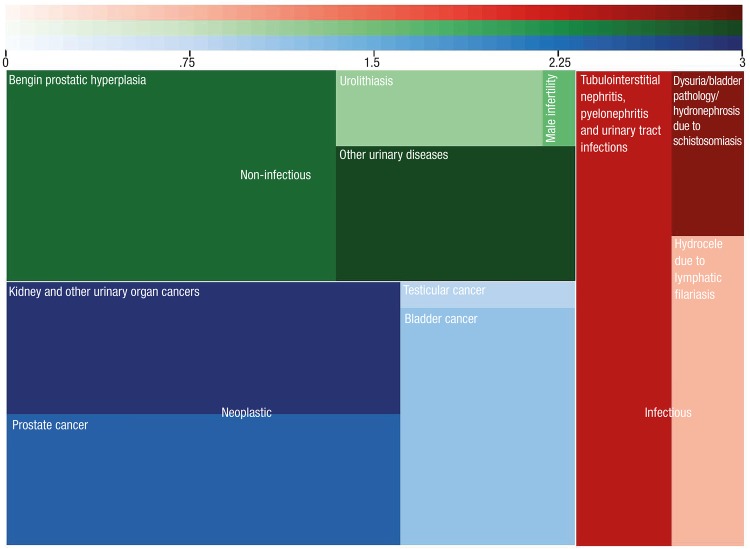
Objectives: We sought to determine whether disease representation in the Cochrane Database of Systematic Reviews (CDSR) reflects disease burden, measured by the Global Burden of Disease (GBD) Study as disability-adjusted life-years (DALYs).
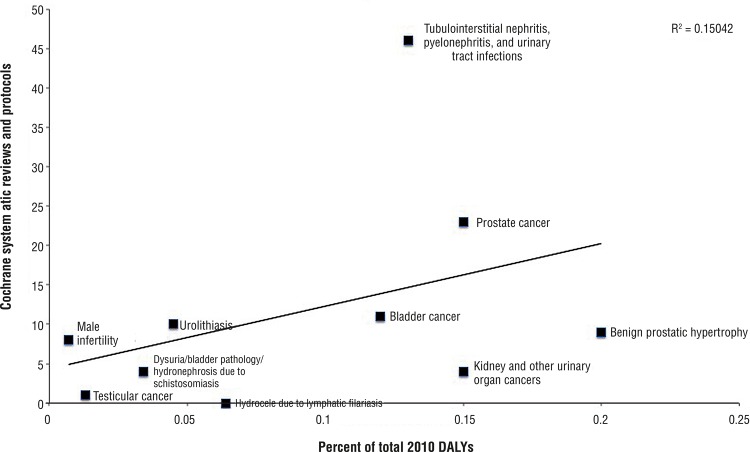
Materials and methods: Two investigators performed independent assessment of ten men's health and urologic diseases (MHUDs) in CDSR for systematic review and protocol representation, which were compared with percentage of total 2010 DALYs for the ten conditions. Data were analyzed for correlation using Spearman rank analysis.
Results: Nine of ten MHUDs were represented by at least one CDSR review. There was a poor and statistically insignificant positive correlation between CDSR representation and disease burden (rho = 0.42, p = 0.23). CDSR representation was aligned with disease burden for three conditions, greater than disease burden for one condition, and less than disease burden for six conditions.
Conclusions: These results yield high-quality estimates to inform future research prioritization for MHUDs. While prioritization processes are complex and multi-faceted, disease burden should be strongly considered. Awareness of research priority setting has the potential to minimize research disparities on a global scale.
Keywords: Infertility, Male; Men’s Health; Urologic Diseases.
Copyright® by the International Brazilian Journal of Urology.
Conflict of interest statement
None declared.
Figures
References
-
- Fleurence RL. Setting priorities for research: a practical application of ‘payback’ and expected value of information. Health Econ. 2007;16:1345–1357. - PubMed
-
- Nasser M, Welch V. Prioritization of systematic reviews leads prioritization of research gaps and needs. J Clin Epidemiol. 2013;66:522–523. - PubMed
-
- Murray CJ, Ezzati M, Flaxman AD, Lim S, Lozano R, Michaud C, et al. GBD 2010: design, definitions, and metrics. Lancet. 2012;380:2063–2066. - PubMed
-
- Lozano R, Naghavi M, Foreman K, Lim S, Shibuya K, Aboyans V, et al. Global and regional mortality from 235 causes of death for 20 age groups in 1990 and 2010: a systematic analysis for the Global Burden of Disease Study 2010. Lancet. 2012;380:2095–2128. Erratum in: Lancet. 2013;381:628. - PMC - PubMed
MeSH terms
LinkOut - more resources
Full Text Sources
Other Literature Sources
Medical
