. 2019 Jan-Feb;17(1):49-69.
doi: 10.1080/15402002.2016.1276018. Epub 2017 Jan 27.

A Tailored Intervention for PAP Adherence: The SCIP-PA Trial

Affiliations

A Tailored Intervention for PAP Adherence: The SCIP-PA Trial

Amy M Sawyer et al. Behav Sleep Med. 2019 Jan-Feb.

Abstract

Objective/background: Positive airway pressure (PAP) is highly efficacious treatment but nonadherence is prevalent with little improvement over the last 15 years. Tailored interventions show promise for promoting adherence to other treatments. The study objective was to examine feasibility and acceptability of a tailored intervention to promote PAP adherence.

Participants: The convenience sample met inclusion criteria: newly diagnosed OSA; treatment-naïve; ≥ 18 years.

Exclusion criteria: previous obstructive sleep apnea (OSA) diagnosis and treatment; new psychiatric diagnosis; use of oxygen/bilevel PAP; secondary sleep disorder. Adults (n = 118) were randomized to tailored intervention (TI; n = 61) or usual care (UC; n = 57); application of a priori exclusion criteria resulted in 30 participants per assignment who were middle-aged (51.3 ± 11.1 years) adults (70% male) with severe OSA (apnea hypopnea index [AHI], 35.9 ± 25.2).

Methods: Randomized, double-blind, single-site pilot controlled trial. A multiphased tailored intervention targeting social cognitive perceptions of OSA-PAP treatment was delivered at four intervals. Descriptive analysis, group differences, and self-efficacy change scores by t-test, and thematic analysis of acceptability data are reported.

Results: One-week PAP use among TI was 35 min greater than UC condition (p = 0.20; Cohen's d = 0.336). Treatment use decreased at 1 month and 3 months (NS). Per-protocol delivery of face-to-face intervention delivery was 100% but lower for telephone intervention delivery. Personalized approach was valued by participants.

Conclusions: A tailored intervention approach is acceptable to participants and feasibly implemented in a clinical sleep center setting. The intervention effect size at 1 week is consistent with other educational PAP adherence interventions but was not sustained; further pilot testing is warranted to address pilot RCT limitations.


Figures
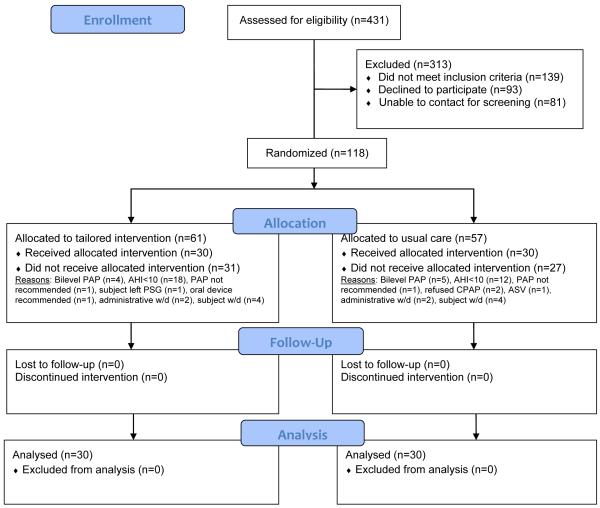
Figure 1
Figure 1. CONSORT Flowchart for SCIP-PA Trial
Notes. Abbreviations: PAP, Positive Airway Pressure; AHI, Apnea Hypopnea Index; PSG, polysomnogram; ASV, Auto-servo ventilation therapy; w/d, withdrawal.
Figure 2
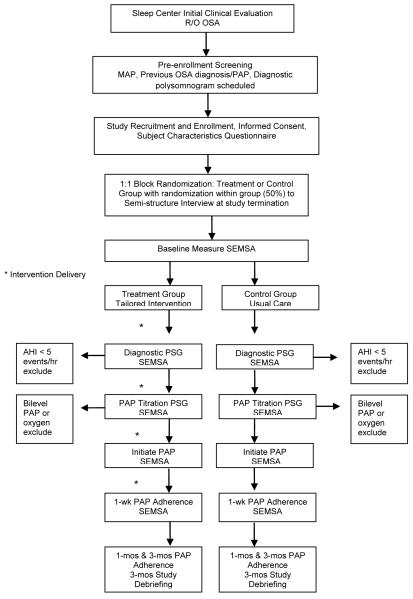
Figure 2. Study Protocol
Notes. Abbreviations: OSA, obstructive sleep apnea; MAP, Multivariate Apnea Prediction index; PAP, positive airway pressure; SEMSA, Self-efficacy measure in sleep apnea; PSG, polysomnogram; AHI, apnea hypopnea index; wk, week; mos, months
Figure 3
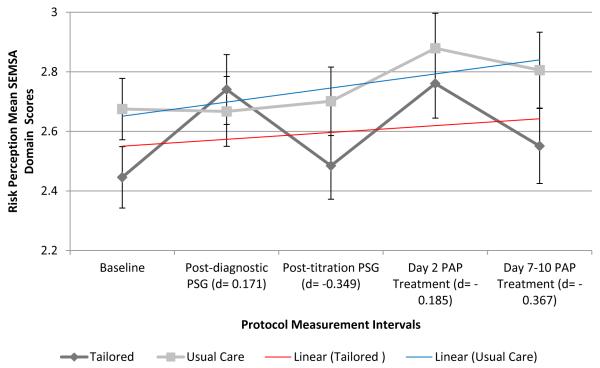
Figure 3. SEMSA Domain Scores Over Time by Group: Risk Perception (3a), Outcome Expectancies (3b), and Treatment Self-efficacy (3c)
Notes. SEMSA domain scores reported as group mean scores with standard errors by protocol measurement period. Effect sizes, Cohen’s d, between-group comparisons by SEMSA outcome at each protocol measurement interval. Linear trend lines by group, Blue = usual care; Red = tailored intervention. Abbreviations – SEMSA, Self-efficacy Measure in Sleep Apnea; PSG, polysomnogram; d, Cohen’s d effect size; PAP, Positive Airway Pressure
Figure 3
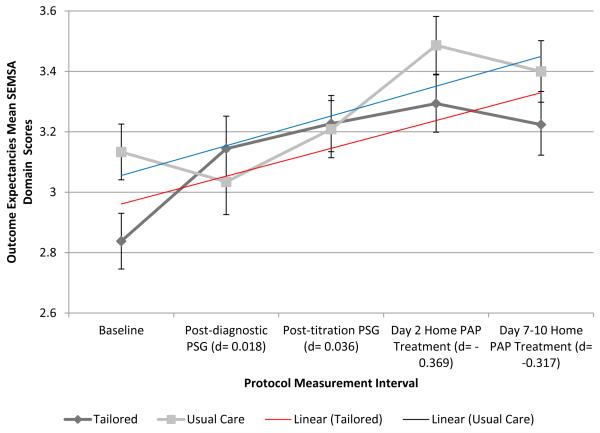
Figure 3. SEMSA Domain Scores Over Time by Group: Risk Perception (3a), Outcome Expectancies (3b), and Treatment Self-efficacy (3c)
Notes. SEMSA domain scores reported as group mean scores with standard errors by protocol measurement period. Effect sizes, Cohen’s d, between-group comparisons by SEMSA outcome at each protocol measurement interval. Linear trend lines by group, Blue = usual care; Red = tailored intervention. Abbreviations – SEMSA, Self-efficacy Measure in Sleep Apnea; PSG, polysomnogram; d, Cohen’s d effect size; PAP, Positive Airway Pressure
Figure 3
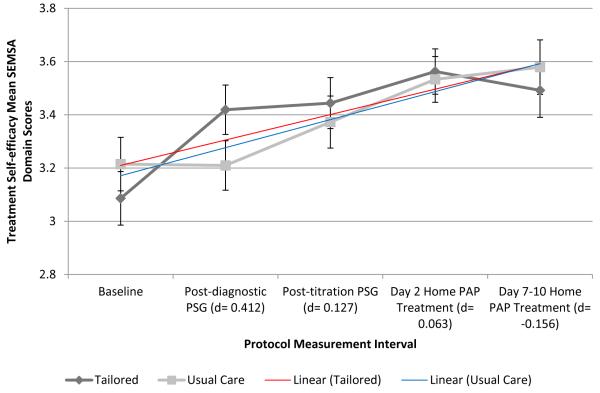
Figure 3. SEMSA Domain Scores Over Time by Group: Risk Perception (3a), Outcome Expectancies (3b), and Treatment Self-efficacy (3c)
Notes. SEMSA domain scores reported as group mean scores with standard errors by protocol measurement period. Effect sizes, Cohen’s d, between-group comparisons by SEMSA outcome at each protocol measurement interval. Linear trend lines by group, Blue = usual care; Red = tailored intervention. Abbreviations – SEMSA, Self-efficacy Measure in Sleep Apnea; PSG, polysomnogram; d, Cohen’s d effect size; PAP, Positive Airway Pressure
Figure 4
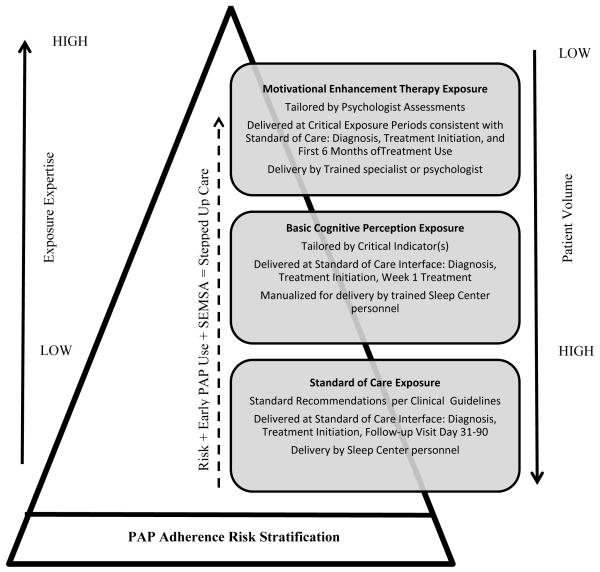
Figure 4. A Stepped Care Model for PAP Adherence
Notes. Abbreviations – PAP, positive airway pressure; SEMSA, Self-efficacy Measure in Sleep Apnea; Reprinted and adapted with permission from Espie CA (2009). “Stepped Care”: A health technology solution for delivering cognitive behavioral therapy as a first line insomnia treatment. Sleep 32(12): 1549-58.

References

    1. Aloia MS, Arnedt JT, Riggs RL, Hecht J, Borrelli B. Clinical Management of Poor Adherence to CPAP: Motivational Enhancement. Behavioral Sleep Medicine. 2004;2(4):205–222. doi: 10.1207/s15402010bsm0204_3. - DOI - PubMed
    1. Aloia MS, Arnedt JT, Stanchina M, Millman RP. How early in treatment is PAP adherence established? Revisiting night-to-night variability. Behavioral Sleep Medicine. 2007;5:229–240. - PubMed
    1. Aloia MS, Arnedt JT, Strand M, Millman RP, Borrelli B. Motivational enhancement to improve adherence to positive airway pressure in patients with obstructive sleep apnea: a randomized controlled trial. Sleep. 2013;36(11):1655–1662. doi: 10.5665/sleep.3120. - DOI - PMC - PubMed
    1. American Academy of Sleep Medicine Task Force Sleep-related breathing disorders in adults: Recommendations for syndrome definitions and measurement techniques in clinical research. Sleep. 1999;22:667–689. - PubMed
    1. Antic NA, Catcheside P, Buchan C, Hensley M, Naughton M, Rowland S, McEvoy RD. The effect of CPAP on normalizing daytime sleepiness, quality of life, and neurocognitive function in patients with moderate to severe OSA. Sleep. 2011;34:111–119. - PMC - PubMed

Publication types

LinkOut - more resources