


Treatment for social anxiety disorder alters functional connectivity in emotion regulation neural circuitry
- PMID: 28129555
- PMCID: PMC5330298
- DOI: 10.1016/j.pscychresns.2017.01.005
Treatment for social anxiety disorder alters functional connectivity in emotion regulation neural circuitry
Abstract
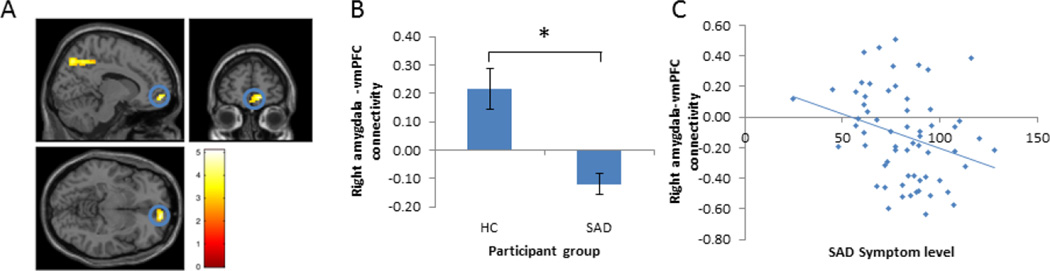
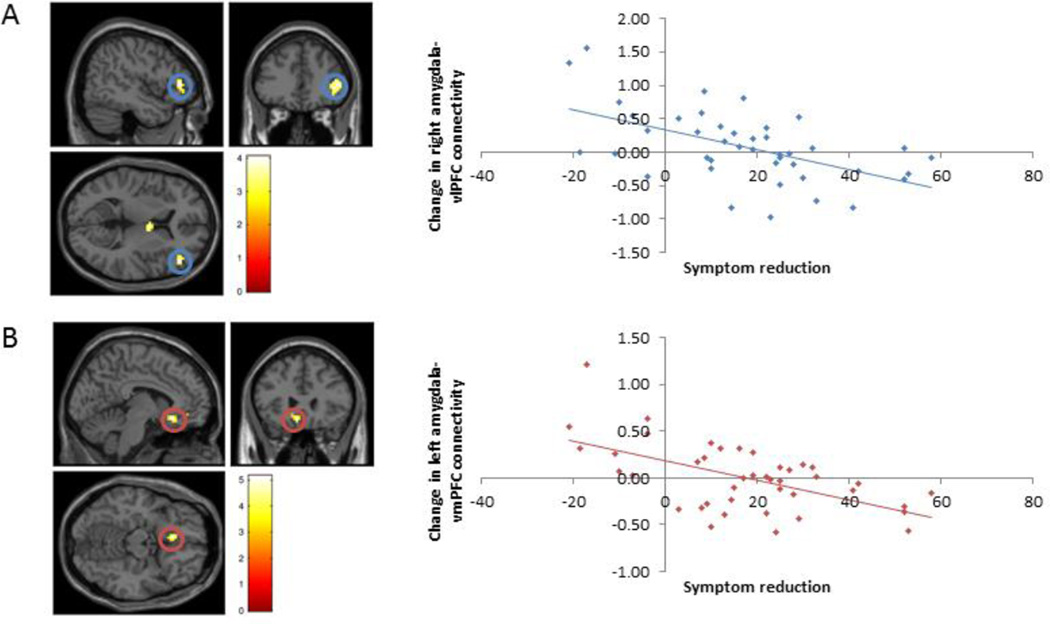
Social anxiety disorder (SAD) is characterized at a neurobiological level by disrupted activity in emotion regulation neural circuitry. Previous work has demonstrated amygdala hyperreactivity and disrupted prefrontal responses to social cues in individuals with SAD (Kim et al., 2011). While exposure-based psychological treatments effectively reduce SAD symptoms, not all individuals respond to treatment. Better understanding of the neural mechanisms involved offers the potential to improve treatment efficacy. In this study, we investigated functional connectivity in emotion regulation neural circuitry in a randomized controlled treatment trial for SAD. Participants with SAD underwent fMRI scanning while performing an implicit emotion regulation task prior to treatment (n=62). Following 12 weeks of cognitive behavioral therapy, acceptance and commitment therapy, or wait-list, participants completed a second scan (n=42). Psychophysiological interaction analyses using amygdala seed regions demonstrated differences between SAD and healthy control participants (HC; n=16) in right amygdala-vmPFC connectivity. SAD participants demonstrated more negative amygdala-to-vmPFC connectivity, compared to HC participants, an effect that was correlated with SAD symptom severity. Post-treatment symptom reduction was correlated with altered amygdala-to-vm/vlPFC connectivity, independent of treatment type. Greater symptom reduction was associated with more negative amygdala-to-vm/vlPFC connectivity. These findings suggest that effective psychological treatment for SAD enhances amygdala-prefrontal functional connectivity.
Keywords: ACT; Amygdala; CBT; FMRI; Prefrontal cortex; Psychophysiological interactions; Randomized controlled trial.
Copyright © 2017 Elsevier Ireland Ltd. All rights reserved.
Conflict of interest statement
The authors have no competing financial interests in relation to the work described and declare no conflict of interest.
Figures
References
-
- Andreatta M, Glotzbach-Schoon E, Mühlberger A, Schulz SM, Wiemer J, Pauli P. Initial and sustained brain responses to contextual conditioned anxiety in humans. cortex. 2015;63:352–363. - PubMed
-
- Baker SL, Heinrichs N, Kim H-J, Hofmann SG. The Liebowitz social anxiety scale as a self-report instrument: a preliminary psychometric analysis. Behaviour research and therapy. 2002;40:701–715. - PubMed
-
- Birbaumer N, Grodd W, Diedrich O, Klose U, Erb M, Lotze M, Schneider F, Weiss U, Flor H. fMRI reveals amygdala activation to human faces in social phobics. Neuroreport. 1998;9:1223–1226. - PubMed
-
- Brown TA, Barlow DH, Di Nardo PA. Anxiety Disorders Interview Schedule for DSM-IV (ADIS-IV): Client Interview Schedule. Graywind Publications Incorporated. 1994
Publication types
MeSH terms
Grants and funding
LinkOut - more resources
Full Text Sources
Other Literature Sources
