


Involvement of Fathers in Pediatric Obesity Treatment and Prevention Trials: A Systematic Review
- PMID: 28130430
- PMCID: PMC6200318
- DOI: 10.1542/peds.2016-2635
Involvement of Fathers in Pediatric Obesity Treatment and Prevention Trials: A Systematic Review
Abstract
Context: Despite their important influence on child health, it is assumed that fathers are less likely than mothers to participate in pediatric obesity treatment and prevention research.
Objective: This review investigated the involvement of fathers in obesity treatment and prevention programs targeting children and adolescents (0-18 years).
Data sources: A systematic review of English, peer-reviewed articles across 7 databases. Retrieved records included at least 1 search term from 2 groups: "participants" (eg, child*, parent*) and "outcomes": (eg, obes*, diet*).
Study selection: Randomized controlled trials (RCTs) assessing behavioral interventions to prevent or treat obesity in pediatric samples were eligible. Parents must have "actively participated" in the study.
Data extraction: Two authors independently extracted data using a predefined template.
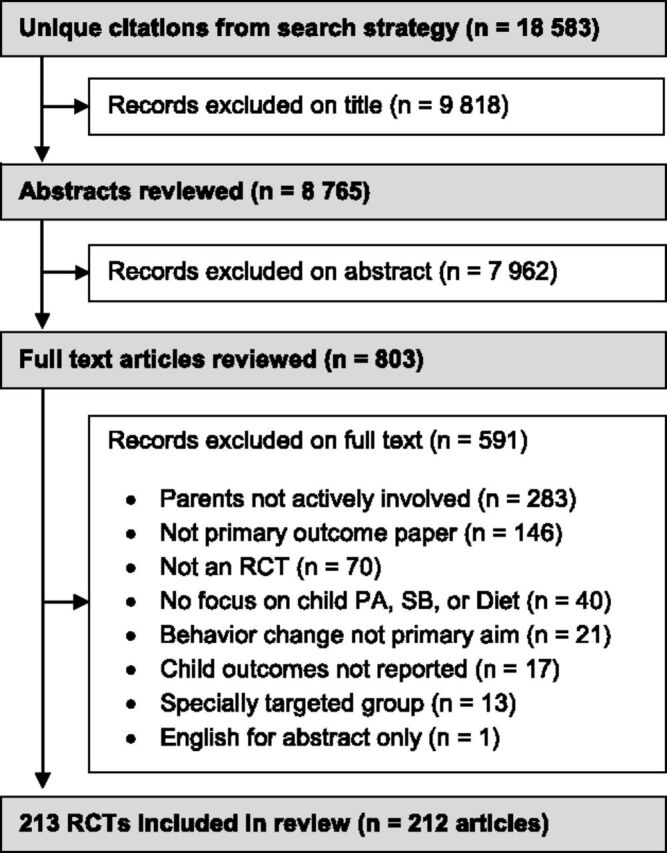
Results: The search retrieved 213 eligible RCTs. Of the RCTs that limited participation to 1 parent only (n = 80), fathers represented only 6% of parents. In RCTs in which participation was open to both parents (n = 133), 92% did not report objective data on father involvement. No study characteristics moderated the level of father involvement, with fathers underrepresented across all study types. Only 4 studies (2%) suggested that a lack of fathers was a possible limitation. Two studies (1%) reported explicit attempts to increase father involvement.
Limitations: The review was limited to RCTs published in English peer-reviewed journals over a 10-year period.
Conclusions: Existing pediatric obesity treatment or prevention programs with parent involvement have not engaged fathers. Innovative strategies are needed to make participation more accessible and engaging for fathers.
Copyright © 2017 by the American Academy of Pediatrics.
Conflict of interest statement
Figures
References
-
- Harriger JA, Thompson JK. Psychological consequences of obesity: weight bias and body image in overweight and obese youth. Int Rev Psychiatry. 2012;24(3):247–253 - PubMed
-
- Hallal PC, Andersen LB, Bull FC, Guthold R, Haskell W, Ekelund U; Lancet Physical Activity Series Working Group . Global physical activity levels: surveillance progress, pitfalls, and prospects. Lancet. 2012;380(9838):247–257 - PubMed
Publication types
MeSH terms
Grants and funding
LinkOut - more resources
Full Text Sources
Other Literature Sources
Medical
