


Computerised cognitive-behavioural therapy for depression in adolescents: feasibility results and 4-month outcomes of a UK randomised controlled trial
- PMID: 28132000
- PMCID: PMC5278287
- DOI: 10.1136/bmjopen-2016-012834
Computerised cognitive-behavioural therapy for depression in adolescents: feasibility results and 4-month outcomes of a UK randomised controlled trial
Abstract
Objectives: Computer-administered cognitive-behavioural therapy (CCBT) may be a promising treatment for adolescents with depression, particularly due to its increased availability and accessibility. The feasibility of delivering a randomised controlled trial (RCT) comparing a CCBT program (Stressbusters) with an attention control (self-help websites) for adolescent depression was evaluated.
Design: Single centre RCT feasibility study.
Setting: The trial was run within community and clinical settings in York, UK.
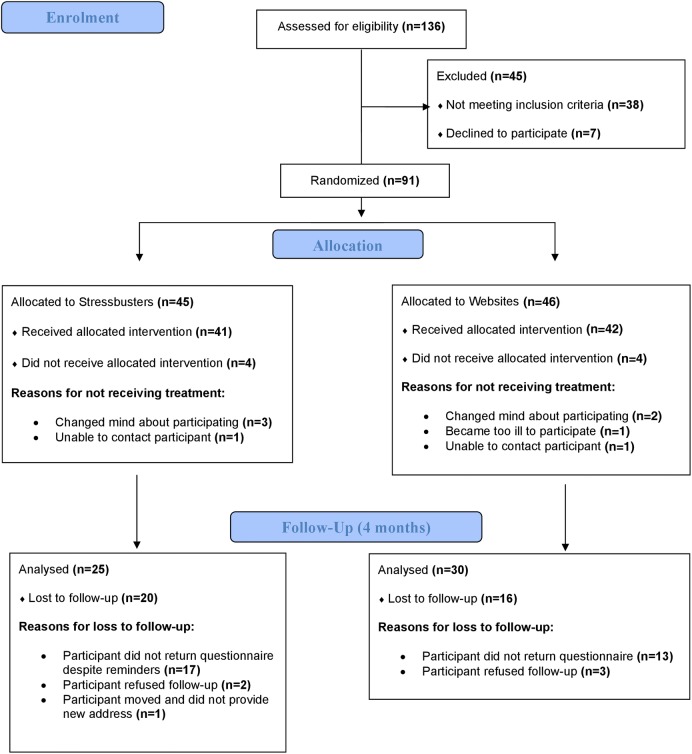
Participants: Adolescents (aged 12-18) with low mood/depression were assessed for eligibility, 91 of whom met the inclusion criteria and were consented and randomised to Stressbusters (n=45) or websites (n=46) using remote computerised single allocation. Those with comorbid physical illness were included but those with psychosis, active suicidality or postnatal depression were not.
Interventions: An eight-session CCBT program (Stressbusters) designed for use with adolescents with low mood/depression was compared with an attention control (accessing low mood self-help websites).
Primary and secondary outcome measures: Participants completed mood and quality of life measures and a service Use Questionnaire throughout completion of the trial and 4 months post intervention. Measures included the Beck Depression Inventory (BDI) (primary outcome measure), Mood and Feelings Questionnaire (MFQ), Spence Children's Anxiety Scale (SCAS), the EuroQol five dimensions questionnaire (youth) (EQ-5D-Y) and Health Utility Index Mark 2 (HUI-2). Changes in self-reported measures and completion rates were assessed by treatment group.
Results: From baseline to 4 months post intervention, BDI scores and MFQ scores decreased for the Stressbusters group but increased in the website group. Quality of life, as measured by the EQ-5D-Y, increased for both groups while costs at 4 months were similar to baseline. Good feasibility outcomes were found, suggesting the trial process to be feasible and acceptable for adolescents with depression.
Conclusions: With modifications, a fully powered RCT is achievable to investigate a promising treatment for adolescent depression in a climate where child mental health service resources are limited.
Trial registration number: ISRCTN31219579.
Keywords: Adolescents; Depression; Randomised Controlled Trial; computerised Cognitive Behaviour Therapy.
Published by the BMJ Publishing Group Limited. For permission to use (where not already granted under a licence) please go to http://www.bmj.com/company/products-services/rights-and-licensing/.
Conflict of interest statement
Conflicts of Interest: None declared.
Figures
References
-
- Evans DL, Beardslee W, Biederman J et al. Defining depression and bipolar disorder. In treating and preventing adolescent mental health disorders, what we know and what we don't know (ed DL Evans et al): 2005;4–27. New York: Oxford University Press; 10.1093/9780195173642.001.0001 - DOI
Publication types
MeSH terms
Associated data
Grants and funding
LinkOut - more resources
Full Text Sources
Other Literature Sources
Medical
Miscellaneous
