


The Juvenile Justice Behavioral Health Services Cascade: A new framework for measuring unmet substance use treatment services needs among adolescent offenders
- PMID: 28132705
- PMCID: PMC5298399
- DOI: 10.1016/j.jsat.2016.12.012
The Juvenile Justice Behavioral Health Services Cascade: A new framework for measuring unmet substance use treatment services needs among adolescent offenders
Abstract
Overview: Substance use and substance use disorders are highly prevalent among youth under juvenile justice (JJ) supervision, and related to delinquency, psychopathology, social problems, risky sex and sexually transmitted infections, and health problems. However, numerous gaps exist in the identification of behavioral health (BH) problems and in the subsequent referral, initiation and retention in treatment for youth in community justice settings. This reflects both organizational and systems factors, including coordination between justice and BH agencies.
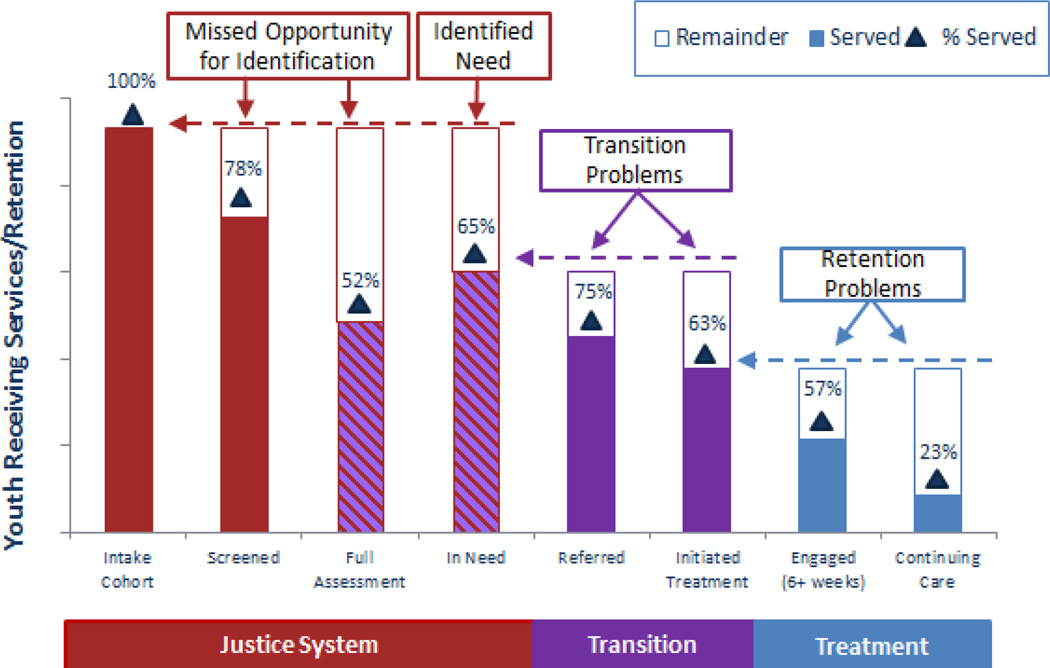
Methods and results: This paper presents a new framework, the Juvenile Justice Behavioral Health Services Cascade ("Cascade"), for measuring unmet substance use treatment needs to illustrate how the cascade approach can be useful in understanding service delivery issues and identifying strategies to improve treatment engagement and outcomes for youth under community JJ supervision. We discuss the organizational and systems barriers for linking delinquent youth to BH services, and explain how the Cascade can help understand and address these barriers. We provide a detailed description of the sequential steps and measures of the Cascade, and then offer an example of its application from the Juvenile Justice - Translational Research on Interventions for Adolescents in the Legal System project (JJ-TRIALS), a multi-site research cooperative funded by the National Institute on Drug Abuse.
Conclusion: As illustrated with substance abuse treatment, the Cascade has potential for informing and guiding efforts to improve behavioral health service linkages for adolescent offenders, developing and testing interventions and policies to improve interagency and cross-systems coordination, and informing the development of measures and interventions for improving the implementation of treatment in complex multisystem service settings. Clinical Trials Registration number - NCT02672150.
Keywords: Barriers to treatment access; Continuum of services; Delinquent youth; Evidence-based practices; Juvenile justice; Substance abuse treatment.
Copyright © 2017 Elsevier Inc. All rights reserved.
Figures
References
-
- American Society of Addiction Medicine. The ASAM criteria: Treatment criteria for addictive, substance-related, and co-occurring conditions. Chevy Chase, MD: Author; 2013.
-
- Barnes GM, Welte JW, Hoffman JH. Relationship of alcohol use to delinquency and illicit drug use in adolescents: Gender, age, and racial/ethnic differences. Journal of Drug Issues. 2002;32(1):153–178.
-
- Belenko S, Dembo R. Treating adolescent substance abuse problems in the juvenile drug court. International Journal of Law and Psychiatry. 2003;26:87–110. - PubMed
-
- Belenko S, Logan TK. Delivering effective treatment to adolescents: Improving the juvenile drug court model. Journal of Substance Abuse Treatment. 2003;25:189–211. - PubMed
Publication types
MeSH terms
Associated data
Grants and funding
LinkOut - more resources
Full Text Sources
Other Literature Sources
Medical
Research Materials
