


Young Transgender Women's Attitudes Toward HIV Pre-exposure Prophylaxis
- PMID: 28132744
- PMCID: PMC5401785
- DOI: 10.1016/j.jadohealth.2016.12.004
Young Transgender Women's Attitudes Toward HIV Pre-exposure Prophylaxis
Abstract
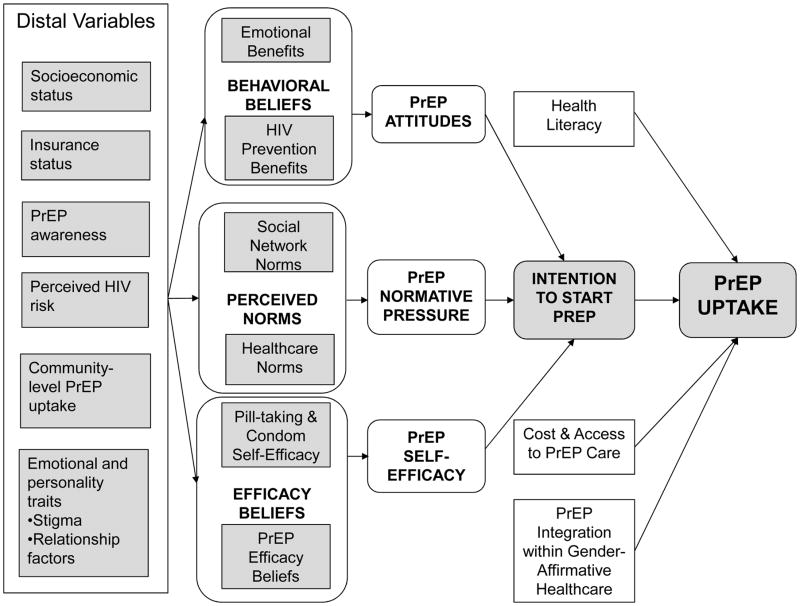
Purpose: Our primary aim was to explore themes regarding attitudes toward HIV pre-exposure prophylaxis (PrEP) among young transgender women (YTW), in order to develop a theoretical model of PrEP uptake in this population disproportionally affected by HIV.
Methods: Qualitative study nested within a mixed-method study characterizing barriers and facilitators to health services for YTW. Participants completed an in-depth interview exploring awareness of and attitudes toward PrEP. Key themes were identified using a grounded theory approach.
Results: Participants (n = 25) had a mean age of 21.2 years (standard deviation 2.2, range 17-24) and were predominately multiracial (36%) and of HIV-negative or unknown status (68%). Most participants (64%) reported prior knowledge of PrEP, and 28% reported current use or intent to use PrEP. Three major content themes that emerged were variability of PrEP awareness, barriers and facilitators to PrEP uptake, and emotional benefits of PrEP. Among participants without prior PrEP knowledge, participants reported frustration that PrEP information has not been widely disseminated to YTW, particularly by health care providers. Attitudes toward PrEP were overwhelmingly positive; however, concerns were raised regarding barriers including cost, stigma, and adherence challenges. Both HIV-positive and negative participants discussed emotional and relationship benefits of PrEP, which were felt to extend beyond HIV prevention alone.
Conclusions: A high proportion of YTW in this study had prior knowledge of PrEP, and attitudes toward PrEP were positive among participants. Our findings suggest several domains to be further explored in PrEP implementation research, including methods of facilitating PrEP dissemination and emotional motivation for PrEP uptake.
Keywords: HIV pre-exposure prophylaxis; HIV prevention; Qualitative research; Transgender women.
Copyright © 2016 Society for Adolescent Health and Medicine. Published by Elsevier Inc. All rights reserved.
Conflict of interest statement
Figures
References
-
- Department of Health and Human Services, editor. Panel on Antiretroviral Guidelines for Adults and Adolescents, Guidelines for the use of antiretroviral agents in HIV-1-infected adults and adolescents. 2016. pp. 1–288.
-
- U.S. Public Health Service. Pre-exposure Prophylaxis for the Prevention of HIV in the United States: A Clinical Practice Guideline. 2014. pp. 1–67.
MeSH terms
Grants and funding
LinkOut - more resources
Full Text Sources
Other Literature Sources
Medical
Miscellaneous
