


Immunologic characteristics of HIV-infected individuals who make broadly neutralizing antibodies
- PMID: 28133804
- PMCID: PMC5299500
- DOI: 10.1111/imr.12504
Immunologic characteristics of HIV-infected individuals who make broadly neutralizing antibodies
Abstract
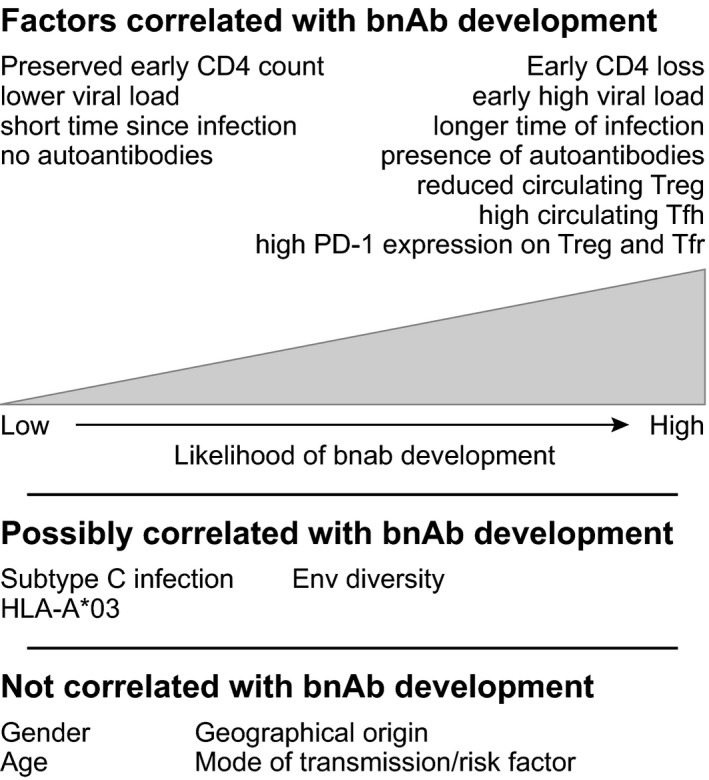
Induction of broadly neutralizing antibodies (bnAbs) capable of inhibiting infection with diverse variants of human immunodeficiency virus type 1 (HIV-1) is a key, as-yet-unachieved goal of prophylactic HIV-1 vaccine strategies. However, some HIV-infected individuals develop bnAbs after approximately 2-4 years of infection, enabling analysis of features of these antibodies and the immunological environment that enables their induction. Distinct subsets of CD4+ T cells play opposing roles in the regulation of humoral responses: T follicular helper (Tfh) cells support germinal center formation and provide help for affinity maturation and the development of memory B cells and plasma cells, while regulatory CD4+ (Treg) cells including T follicular regulatory (Tfr) cells inhibit the germinal center reaction to limit autoantibody production. BnAbs exhibit high somatic mutation frequencies, long third heavy-chain complementarity determining regions, and/or autoreactivity, suggesting that bnAb generation is likely to be highly dependent on the activity of CD4+ Tfh cells, and may be constrained by host tolerance controls. This review discusses what is known about the immunological environment during HIV-1 infection, in particular alterations in CD4+ Tfh, Treg, and Tfr populations and autoantibody generation, and how this is related to bnAb development, and considers the implications for HIV-1 vaccine design.
Keywords: CD4+ T follicular helper cell; CD4+ T follicular regulatory cell; autoantibody; broadly neutralizing antibody; human immunodeficiency virus; regulatory T cell.
© 2017 The Authors. Immunological Reviews published by John Wiley & Sons Ltd.
Figures
References
-
- UNAIDS . Prevention Gap Report. Geneva: World Health Organisation, 2016.
-
- Fauci AS, Marston HD. Ending AIDS—Is an HIV vaccine necessary? N Engl J Med. 2014;370:495–498. - PubMed
-
- Gilbert PB, Peterson ML, Follmann D, et al. Correlation between immunologic responses to a recombinant glycoprotein 120 vaccine and incidence of HIV‐1 infection in a phase 3 HIV‐1 preventive vaccine trial. J Infect Dis. 2005;191:666–677. - PubMed
Publication types
MeSH terms
Substances
Grants and funding
LinkOut - more resources
Full Text Sources
Other Literature Sources
Medical
Research Materials
