. 2017 Mar 9;60(5):1876-1891.
doi: 10.1021/acs.jmedchem.6b01645. Epub 2017 Feb 14.

Discovery of Potent and Selective Inhibitors for G9a-Like Protein (GLP) Lysine Methyltransferase

Affiliations

Discovery of Potent and Selective Inhibitors for G9a-Like Protein (GLP) Lysine Methyltransferase

Yan Xiong et al. J Med Chem. .

Abstract

G9a-like protein (GLP) and G9a are highly homologous protein lysine methyltransferases (PKMTs) sharing approximately 80% sequence identity in their catalytic domains. GLP and G9a form a heterodimer complex and catalyze mono- and dimethylation of histone H3 lysine 9 and nonhistone substrates. Although they are closely related, GLP and G9a possess distinct physiological and pathophysiological functions. Thus, GLP or G9a selective small-molecule inhibitors are useful tools to dissect their distinct biological functions. We previously reported potent and selective G9a/GLP dual inhibitors including UNC0638 and UNC0642. Here we report the discovery of potent and selective GLP inhibitors including 4 (MS0124) and 18 (MS012), which are >30-fold and 140-fold selective for GLP over G9a and other methyltransferases, respectively. The cocrystal structures of GLP and G9a in the complex with either 4 or 18 displayed virtually identical binding modes and interactions, highlighting the challenges in structure-based design of selective inhibitors for either enzyme.


Conflict of interest statement

The authors declare no competing financial interest.

Figures
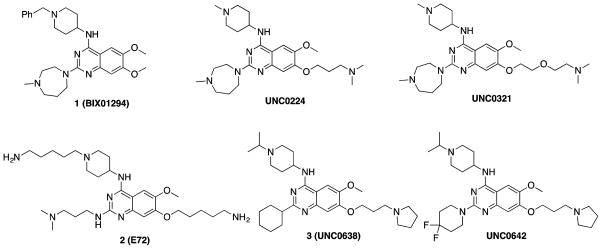
Figure 1
Figure 1
Structures of selected G9a/GLP inhibitors.
Figure 2
Figure 2
X-ray cocrystal structures of (A) GLP (green) (PDB 5TUZ) and (B) G9a (blue) (PDB 5TUY) in complex with 4 in the presence of SAM. Water molecule is illustrated as a red sphere. Main interactions are shown in yellow dashed lines. (C) Overlay of (A) and (B).
Figure 3
Figure 3
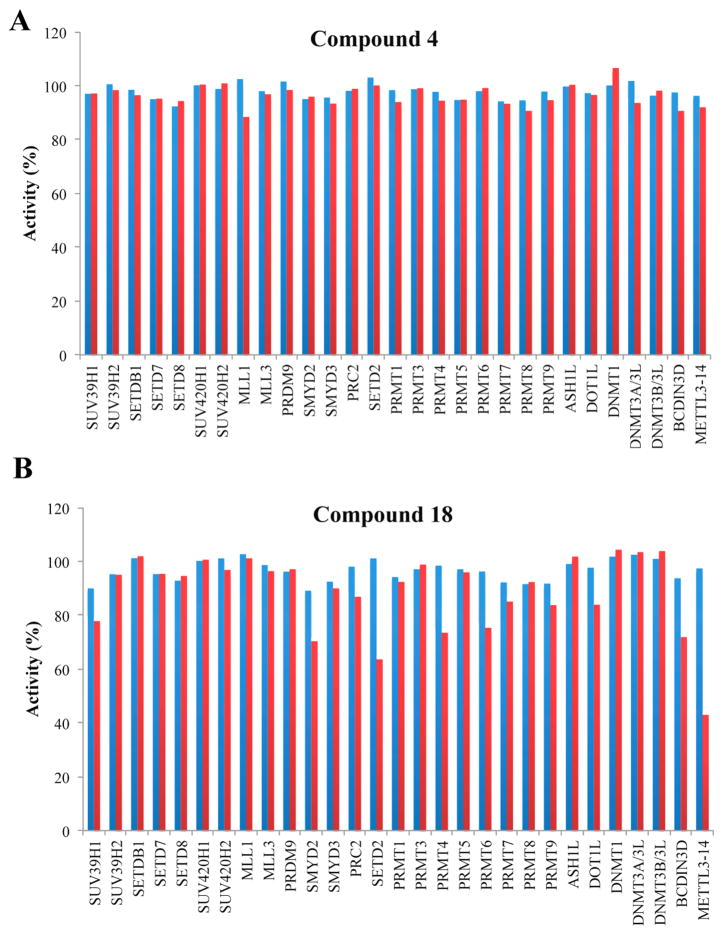
Selectivity of 4 and 18 against methyltransferases. Selectivity of 4 (A) and 18 (B) against a panel of 29 PKMTs, PRMTs, DNMTs, and RNMTs was determined at two compound concentrations of 1 μM (blue bars) and 10 μM (red bars).
Figure 4
Figure 4
Binding confirmation of 4 and 18. Isothermal titration calorimetry (ITC) was used to confirm binding of 4 to (A) GLP with a Kd of 40 ± 5 nM and to (B) G9a with a Kd of 445 ± 40 nM. Similarly, ITC was used to confirm the binding of 18 to (C) GLP with a Kd of 46 ± 15 nM and to (D) G9a with a Kd of 610 ± 68 nM. ITC experiments for GLP and G9a were performed in triplicate.
Figure 5
Figure 5
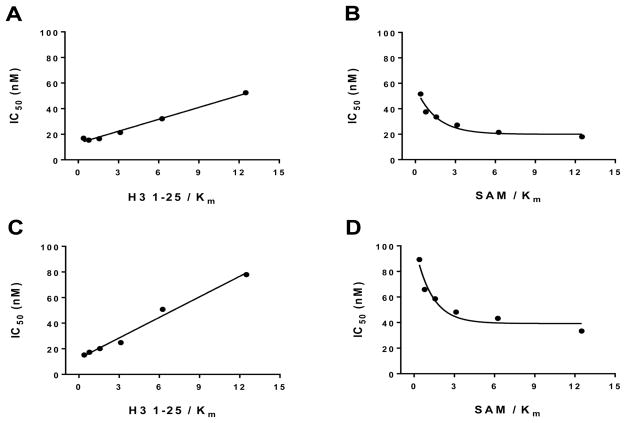
Mechanism of GLP inhibition by 4 and 18. Mechanism of inhibition of GLP activity by 4 and 18 was explored by IC50 determination at various peptide (A and C, respectively) or SAM (B and D, respectively) concentrations while the concentration of the other substrate was kept constant. Increase in peptide concentration in assays resulted in significant increase in IC50 values, indicating that both compounds are peptide competitive (A,C). Decrease in IC50 values upon increasing SAM concentration indicates that both compounds are SAM uncompetitive inhibitors (B,D).
Figure 6
Figure 6
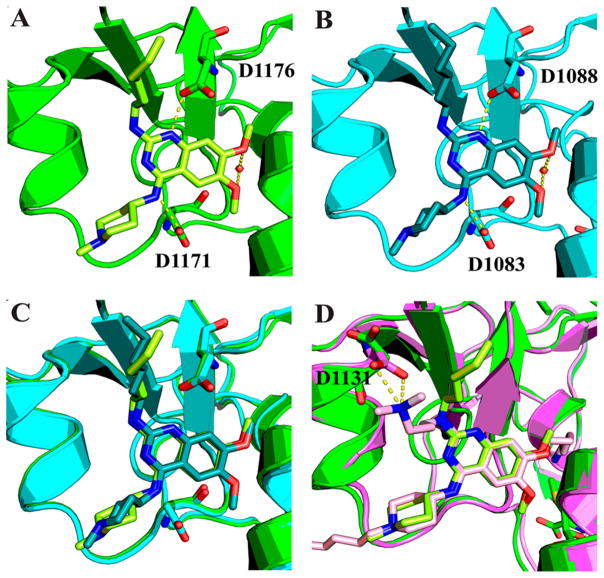
X-ray cocrystal structures of GLP and G9a in complex with 18. (A) Structure of GLP–SAM–18 (green) (PDB 5TTG). (B) Structure of G9a–SAM–18 (blue) (PDB 5TTF). Water molecule is illustrated as a red sphere. Main interactions are shown in yellow dashed lines. (C) Overlay of (A) and (B). (D) Overlay of (A) and GLP–SAH–2 (purple) (PDB 3MO5).
Scheme 1
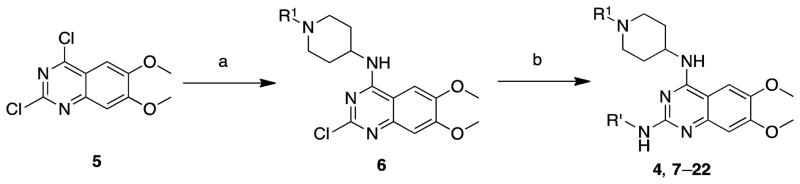
Scheme 1. Synthesis of 4 and 7–22a
aReagents and conditions: (a) 1-alkylpiperidin-4-ylamine, K2CO3, DMF, rt, 80–90%; (b) R′ amines, 4 N HCl in dixoane, i-PrOH, microwave, 160 °C, 75–85%.
Scheme 2
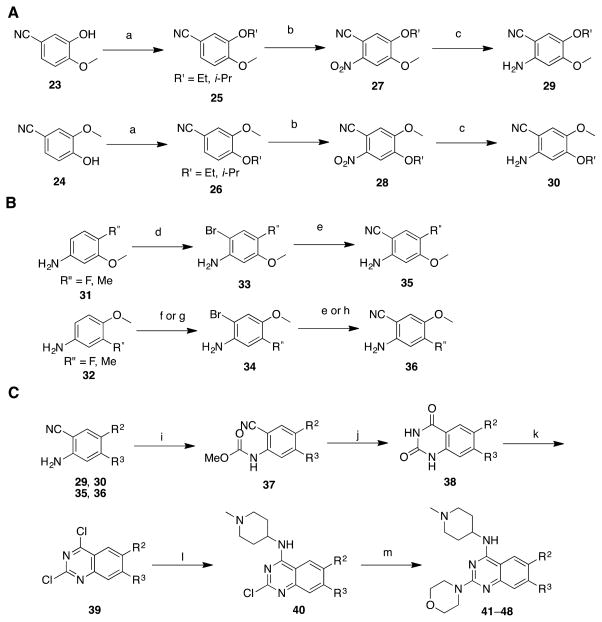
Scheme 2. Synthesis of 41–48a
aReagents and conditions: (a) EtI or i-PrBr, K2CO3, acetone, reflux; (b) HNO3, Ac2O, 0 °C to rt, 81–94% over 2 steps; (c) Fe dust, NH4OAc, H2O, reflux, 60–70%; (d) Bu4NBr3, ethyl acetate, 0 °C to rt, 80–90%; (e) Zn(CN)2, Pd(pph3)4, DMF, microwave, 130 °C, 50–72%; (f) Br2, Ac2O, 50 °C, 64%; then HCl, EtOH, 95%; (g) Br2, K2CO3, DCM, –15 °C, 70%; (h) CuCN, DMF, sealed tube, 160 °C, 56%; (i) ClCO2Me, DIEA, DCM/DMF, 0°C to rt; (j) H2O2, NaOH, H2O/MeOH, reflux; (k) PhNEt2, POCl3, reflux, 30–40% over 3 steps; (l) 1-methylpiperidin-4-amine, K2CO3, DMF, rt; (m) morpholine, 4 N HCl in dixoane, i-PrOH, microwave, 160 °C, 75–85% over 2 steps.
Scheme 3
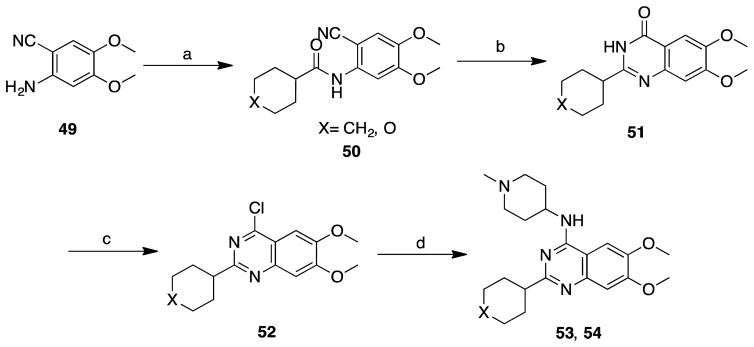
Scheme 3. Synthesis of 53 and 54a
aReagents and conditions: (a) acid chloride, DIEA, DCM/DMF, 0 °C to rt, 90–95%; (b) H2O2, NaOH, H2O/MeOH, reflux, 46–55% over 2 steps; (c) PhNEt2, POCl3, reflux, 46–55% over 2 steps; (d) 1-methylpiperidin-4-amine, DIEA, i-PrOH, microwave, 160 °C, 80–90%.

References

    1. Martin C, Zhang Y. The diverse functions of histone lysine methylation. Nat Rev Mol Cell Biol. 2005;6:838–849. - PubMed
    1. Kaniskan HU, Jin J. Chemical probes of histone lysine methyltransferases. ACS Chem Biol. 2015;10:40–50. - PMC - PubMed
    1. Kaniskan HU, Konze KD, Jin J. Selective inhibitors of protein methyltransferases. J Med Chem. 2015;58:1596–1629. - PMC - PubMed
    1. Benevento M, van de Molengraft M, van Westen R, van Bokhoven H, Kasri NN. The role of chromatin repressive marks in cognition and disease: A focus on the repressive complex GLP/G9a. Neurobiol Learn Mem. 2015;124:88–96. - PubMed
    1. Black JC, Van Rechem C, Whetstine JR. Histone lysine methylation dynamics: establishment, regulation, and biological impact. Mol Cell. 2012;48:491–507. - PMC - PubMed

Publication types

MeSH terms

Substances