


Cancer Susceptibility Gene Mutations in Individuals With Colorectal Cancer
- PMID: 28135145
- PMCID: PMC5455355
- DOI: 10.1200/JCO.2016.71.0012
Cancer Susceptibility Gene Mutations in Individuals With Colorectal Cancer
Abstract
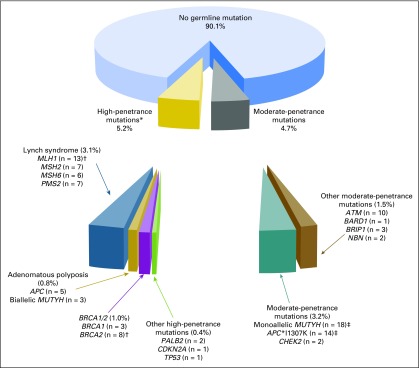
Purpose Hereditary factors play an important role in colorectal cancer (CRC) risk, yet the prevalence of germline cancer susceptibility gene mutations in patients with CRC unselected for high-risk features (eg, early age at diagnosis, personal/family history of cancer or polyps, tumor microsatellite instability [MSI], mismatch repair [MMR] deficiency) is unknown. Patients and Methods We recruited 1,058 participants who received CRC care in a clinic-based setting without preselection for age at diagnosis, personal/family history, or MSI/MMR results. All participants underwent germline testing for mutations in 25 genes associated with inherited cancer risk. Each gene was categorized as high penetrance or moderate penetrance on the basis of published estimates of the lifetime cancer risks conferred by pathogenic germline mutations in that gene. Results One hundred five (9.9%; 95% CI, 8.2% to 11.9%) of 1,058 participants carried one or more pathogenic mutations, including 33 (3.1%) with Lynch syndrome (LS). Twenty-eight (96.6%) of 29 available LS CRCs demonstrated abnormal MSI/MMR results. Seventy-four (7.0%) of 1,058 participants carried non-LS gene mutations, including 23 (2.2%) with mutations in high-penetrance genes (five APC, three biallelic MUTYH, 11 BRCA1/2, two PALB2, one CDKN2A, and one TP53), 15 of whom lacked clinical histories suggestive of their underlying mutation. Thirty-eight (3.6%) participants had moderate-penetrance CRC risk gene mutations (19 monoallelic MUTYH, 17 APC*I1307K, two CHEK2). Neither proband age at CRC diagnosis, family history of CRC, nor personal history of other cancers significantly predicted the presence of pathogenic mutations in non-LS genes. Conclusion Germline cancer susceptibility gene mutations are carried by 9.9% of patients with CRC. MSI/MMR testing reliably identifies LS probands, although 7.0% of patients with CRC carry non-LS mutations, including 1.0% with BRCA1/2 mutations.
Figures
Comment in
-
Frequency of Germline BRCA1/2 Mutations in Unselected Patients With Colorectal Cancer.J Clin Oncol. 2017 Aug 1;35(22):2588. doi: 10.1200/JCO.2017.72.7222. Epub 2017 May 16. J Clin Oncol. 2017. PMID: 28510492 No abstract available.
-
Reply to M.S. Daniels et al.J Clin Oncol. 2017 Aug 1;35(22):2588-2589. doi: 10.1200/JCO.2017.73.3840. Epub 2017 May 16. J Clin Oncol. 2017. PMID: 28510494 No abstract available.
References
-
- Ward RL, Hicks S, Hawkins NJ. Population-based molecular screening for Lynch syndrome: Implications for personalized medicine. J Clin Oncol. 2013;31:2554–2562. - PubMed
-
- Hampel H, Frankel WL, Martin E, et al. Screening for the Lynch syndrome (hereditary nonpolyposis colorectal cancer) N Engl J Med. 2005;352:1851–1860. - PubMed
MeSH terms
Substances
Grants and funding
LinkOut - more resources
Full Text Sources
Other Literature Sources
Medical
Research Materials
Miscellaneous
