Common Dimensional Reward Deficits Across Mood and Psychotic Disorders: A Connectome-Wide Association Study
- PMID: 28135847
- PMCID: PMC5495611
- DOI: 10.1176/appi.ajp.2016.16070774
Common Dimensional Reward Deficits Across Mood and Psychotic Disorders: A Connectome-Wide Association Study
Abstract
Objective: Anhedonia is central to multiple psychiatric disorders and causes substantial disability. A dimensional conceptualization posits that anhedonia severity is related to a transdiagnostic continuum of reward deficits in specific neural networks. Previous functional connectivity studies related to anhedonia have focused on case-control comparisons in specific disorders, using region-specific seed-based analyses. Here, the authors explore the entire functional connectome in relation to reward responsivity across a population of adults with heterogeneous psychopathology.
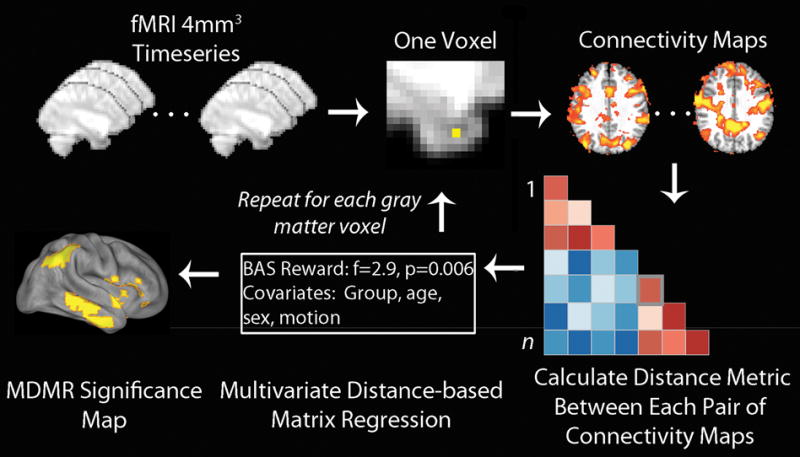
Method: In a sample of 225 adults from five diagnostic groups (major depressive disorder, N=32; bipolar disorder, N=50; schizophrenia, N=51; psychosis risk, N=39; and healthy control subjects, N=53), the authors conducted a connectome-wide analysis examining the relationship between a dimensional measure of reward responsivity (the reward sensitivity subscale of the Behavioral Activation Scale) and resting-state functional connectivity using multivariate distance-based matrix regression.
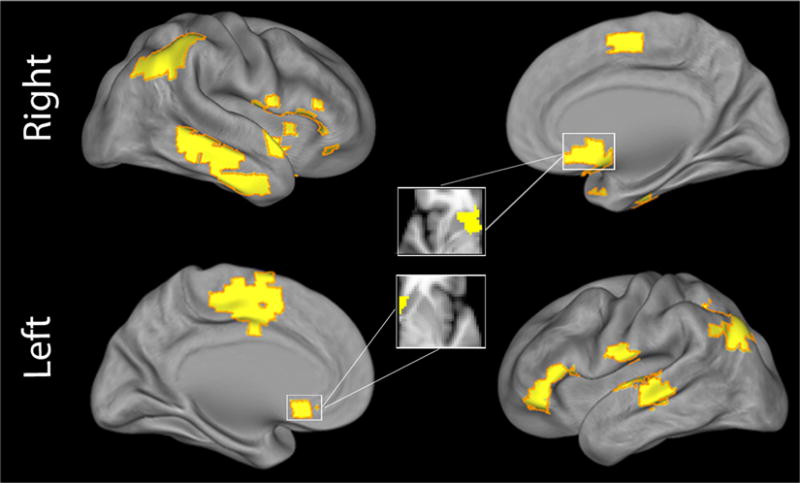
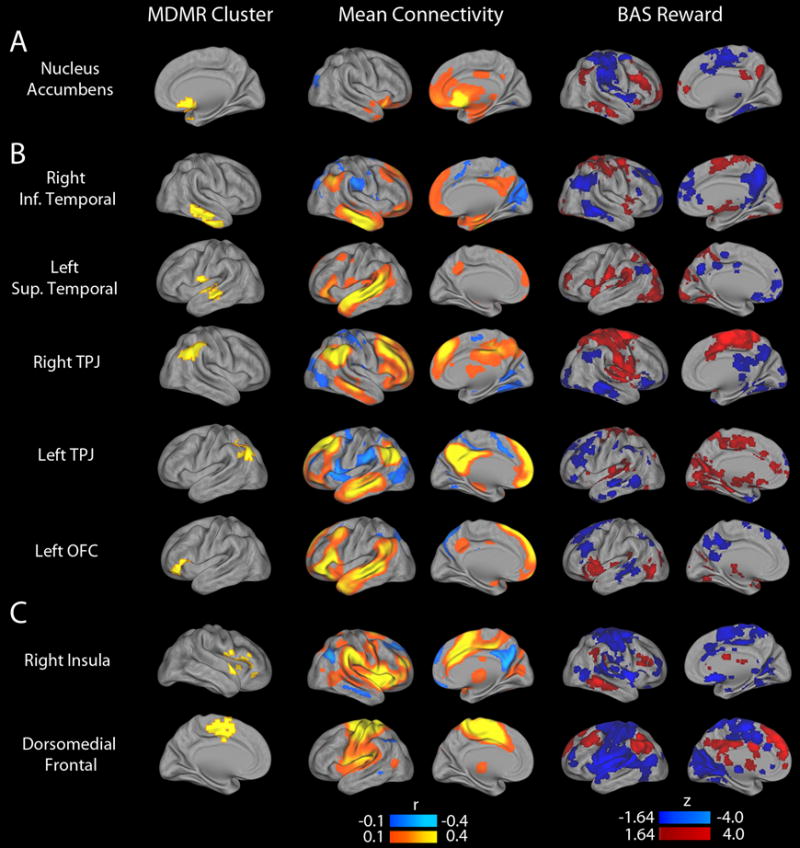
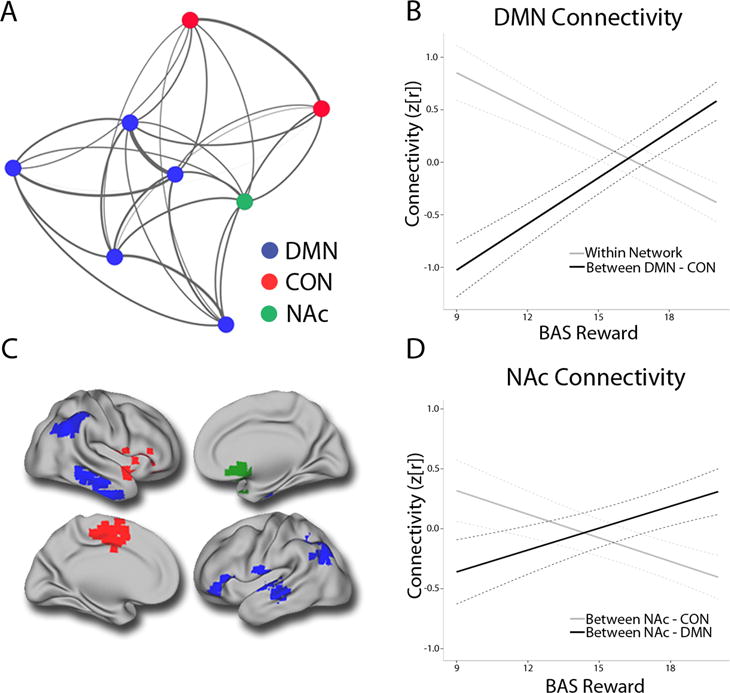
Results: The authors identified foci of dysconnectivity associated with reward responsivity in the nucleus accumbens, the default mode network, and the cingulo-opercular network. Follow-up analyses revealed dysconnectivity among specific large-scale functional networks and their connectivity with the nucleus accumbens. Reward deficits were associated with decreased connectivity between the nucleus accumbens and the default mode network and increased connectivity between the nucleus accumbens and the cingulo-opercular network. In addition, impaired reward responsivity was associated with default mode network hyperconnectivity and diminished connectivity between the default mode network and the cingulo-opercular network.
Conclusions: These results emphasize the centrality of the nucleus accumbens in the pathophysiology of reward deficits and suggest that dissociable patterns of connectivity among large-scale networks are critical to the neurobiology of reward dysfunction across clinical diagnostic categories.
Keywords: Anhedonia; Psychiatry; Resting State fMRI; Reward.
Conflict of interest statement
Figures
Comment in
-
The Neural Correlates of Transdiagnostic Dimensions of Psychopathology.Am J Psychiatry. 2017 Jul 1;174(7):613-615. doi: 10.1176/appi.ajp.2017.17030289. Am J Psychiatry. 2017. PMID: 28669209 No abstract available.
References
-
- Forte A, Baldessarini RJ, Tondo L, Vázquez GH, Pompili M, Girardi P. Long-term morbidity in bipolar-i, bipolar-ii, and unipolar major depressive disorders. Journal of Affective Disorders. 2015;178:71–78. - PubMed
-
- Wolf DH. Anhedonia in schizophrenia. Current psychiatry reports. 2006;8:322–328. - PubMed
-
- Insel T, Cuthbert B, Garvey M, Heinssen R, Pine DS, et al. Research domain criteria (rdoc): Toward a new classification framework for research on mental disorders. The American Journal of Psychiatry. 2010;167:748–751. - PubMed
Publication types
MeSH terms
Grants and funding
LinkOut - more resources
Full Text Sources
Other Literature Sources
Medical