Review
. 2017 Jan 30;16(1):10.
doi: 10.1186/s12943-016-0577-4.

Induction of metastasis, cancer stem cell phenotype, and oncogenic metabolism in cancer cells by ionizing radiation

Affiliations
Review

Induction of metastasis, cancer stem cell phenotype, and oncogenic metabolism in cancer cells by ionizing radiation

Su Yeon Lee et al. Mol Cancer. .

Abstract

Radiation therapy is one of the major tools of cancer treatment, and is widely used for a variety of malignant tumours. Radiotherapy causes DNA damage directly by ionization or indirectly via the generation of reactive oxygen species (ROS), thereby destroying cancer cells. However, ionizing radiation (IR) paradoxically promotes metastasis and invasion of cancer cells by inducing the epithelial-mesenchymal transition (EMT). Metastasis is a major obstacle to successful cancer therapy, and is closely linked to the rates of morbidity and mortality of many cancers. ROS have been shown to play important roles in mediating the biological effects of IR. ROS have been implicated in IR-induced EMT, via activation of several EMT transcription factors-including Snail, HIF-1, ZEB1, and STAT3-that are activated by signalling pathways, including those of TGF-β, Wnt, Hedgehog, Notch, G-CSF, EGFR/PI3K/Akt, and MAPK. Cancer cells that undergo EMT have been shown to acquire stemness and undergo metabolic changes, although these points are debated. IR is known to induce cancer stem cell (CSC) properties, including dedifferentiation and self-renewal, and to promote oncogenic metabolism by activating these EMT-inducing pathways. Much accumulated evidence has shown that metabolic alterations in cancer cells are closely associated with the EMT and CSC phenotypes; specifically, the IR-induced oncogenic metabolism seems to be required for acquisition of the EMT and CSC phenotypes. IR can also elicit various changes in the tumour microenvironment (TME) that may affect invasion and metastasis. EMT, CSC, and oncogenic metabolism are involved in radioresistance; targeting them may improve the efficacy of radiotherapy, preventing tumour recurrence and metastasis. This study focuses on the molecular mechanisms of IR-induced EMT, CSCs, oncogenic metabolism, and alterations in the TME. We discuss how IR-induced EMT/CSC/oncogenic metabolism may promote resistance to radiotherapy; we also review efforts to develop therapeutic approaches to eliminate these IR-induced adverse effects.

Keywords: Cancer stem cells; Epithelial-mesenchymal transition; Metastasis; Oncogenic metabolism; Radioresistance; Radiotherapy; Reactive oxygen species; Snail; Tumour microenvironment.


Figures
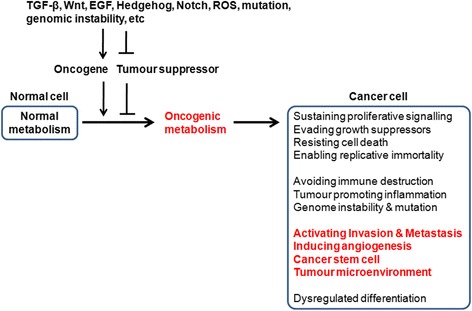
Fig. 1
Fig. 1
Epithelial-mesenchymal transition (EMT), metastasis, cancer stem cells (CSCs), and oncogenic metabolism. Cancer cells can acquire multiple capabilities, including sustained proliferation, evasion of growth suppression, cell death resistance, replicative immortality, evasion of immune destruction, tumour-promoting inflammation, activation of invasion and metastasis, induction of angiogenesis, genome instability, and alteration of metabolism. Deregulation of differentiation, acquisition of stem cell phenotypes, and their tumour microenvironment are also important aspects of tumourigenesis. Several signal pathways (such as those of TGF-β, Wnt, EGF, Hedgehog, Notch, and ROS) and mutation/genomic instability are closely associated with tumourigenesis and tumour progression. These signals could activate oncogenes and inactivate tumour suppressors. Activation of oncogenes, or loss of tumour suppressors, can drive tumour progression, particularly via metabolic reprogramming. Metabolic reprogramming may be required for malignant transformation and tumour development, including invasion and metastasis, CSC phenotype, and TME
Fig. 2
Fig. 2
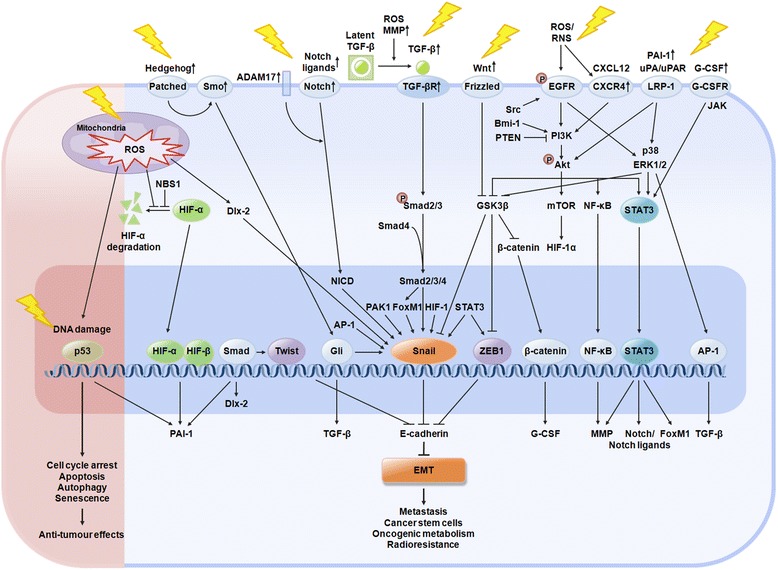
Signalling pathways of IR-induced EMT, metastasis, CSCs, and oncogenic metabolism. Ionizing radiation (IR) causes DNA damage directly, by ionization, or indirectly, by the production of reactive oxygen species (ROS) in tumours. In response to DNA damage, p53 is activated and it exerts the therapeutic effects of IR: induction of cell cycle arrest, apoptosis, autophagy, or senescence. However, IR is also known to enhance the metastatic potential of cancer cells by inducing EMT. IR-induced EMT is mediated by transcription factors (including Snail, HIF-1, ZEB1, Twist, and STAT3) that are activated by signalling pathways (including those of TGF-β, Wnt, Hedgehog, Notch, G-CSF, EGFR/PI3K/Akt, CXCL12/CXCR4, PAI-1, and MAPK). ROS are implicated in IR-induced EMT via the activation of these transcription factors and signalling pathways. Cancer cells that undergo EMT also acquire stemness and oncogenic metabolisms. In addition, EMT, CSCs, and oncogenic metabolism are known to contribute to the radioresistance of cancer cells
Fig. 3
Fig. 3
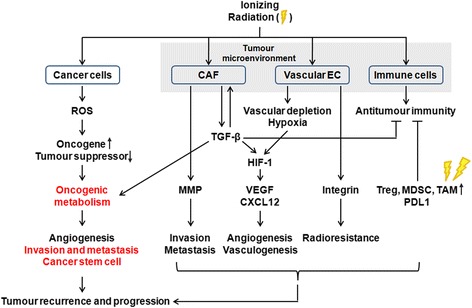
IR-induced side effects on cancer cells and the tumour microenvironment (TME). Radiotherapy has the paradoxical side-effect of increasing tumour aggressiveness. IR promotes ROS production in cancer cells, which may induce the activation of oncogenes and the inactivation of tumour suppressors, which further promote oncogenic metabolism. Metabolic alterations are involved in tumour progression, and include growth, invasion, metastasis, and the acquisition of the CSC phenotype, thereby contributing to tumour recurrence and distant metastasis. Given that IR induces EMT and CSC properties in cancer cells, it is possible that IR-induced oncogenic metabolism is required for the acquisition of the EMT and CSC phenotypes. IR can also elicit various changes in the TME, such as: 1) the emergence of cancer-associated fibroblasts (CAFs), activity-mediated extracellular matrix (ECM) remodelling, and fibrosis, 2) cycling hypoxia, and 3) an inflammatory response. IR activates cancer-associated fibroblasts (CAFs) to promote the release of growth factors, including transforming growth factor-β (TGF-β), and extracellular matrix (ECM) modulators, including matrix metalloproteinase (MMP). TGF-β directly affects tumour cells and CAFs, enhances tumour immune escape, and activates hypoxia-inducible factor-1 (HIF-1) signalling. MMPs degrade the ECM, facilitating tumour invasion and metastasis. IR can also cause damage to the vascular endothelial cells (EC), leading to hypoxia that further promotes HIF-1 signalling. HIF-1 increases the expression of vascular endothelial growth factor (VEGF) and chemokine (C-X-C motif) ligand 12 (CXCL12), both of which induce angiogenesis and vasculogenesis. IR also upregulates integrins on ECs that enhance survival and confer radioresistance. Although IR activates an antitumour immune response, this signalling is frequently suppressed by tumour escape mechanisms (such as programmed cell death protein 1 ligand 1 [PDL1] signalling) and by suppressive immune cells (regulatory T cells [Treg], myeloid-derived suppressor cells [MDSC], and tumour-associated macrophages [TAM]), which are relatively less radiosensitive than other lymphocyte subsets. These IR-mediated changes in the TME may constitute additional adverse effects of IR on the patient by promoting angiogenesis, invasion, metastasis, and radioresistance

References

    1. Bartelink H, Horiot JC, Poortmans P, Struikmans H, Van den Bogaert W, Barillot I, et al. Recurrence rates after treatment of breast cancer with standard radiotherapy with or without additional radiation. N Engl J Med. 2001;345(19):1378–87. doi: 10.1056/NEJMoa010874. - DOI - PubMed
    1. Bernier J, Hall EJ, Giaccia A. Radiation oncology: a century of achievements. Nat Rev Cancer. 2004;4(9):737–47. doi: 10.1038/nrc1451. - DOI - PubMed
    1. Delaney G, Jacob S, Featherstone C, Barton M. The role of radiotherapy in cancer treatment: estimating optimal utilization from a review of evidence-based clinical guidelines. Cancer. 2005;104(6):1129–37. doi: 10.1002/cncr.21324. - DOI - PubMed
    1. Huber SM, Butz L, Stegen B, Klumpp D, Braun N, Ruth P, et al. Ionizing radiation, ion transports, and radioresistance of cancer cells. Front Physiol. 2013;4:212. doi: 10.3389/fphys.2013.00212. - DOI - PMC - PubMed
    1. Hubenak JR, Zhang Q, Branch CD, Kronowitz SJ. Mechanisms of injury to normal tissue after radiotherapy: a review. Plast Reconstr Surg. 2014;133(1):49e–56e. doi: 10.1097/01.prs.0000440818.23647.0b. - DOI - PMC - PubMed

Publication types

Substances