Review
. 2017 Feb 1;28(3):370-380.
doi: 10.1091/mbc.E16-10-0739.

Many roads to symmetry breaking: molecular mechanisms and theoretical models of yeast cell polarity

Affiliations
Review

Many roads to symmetry breaking: molecular mechanisms and theoretical models of yeast cell polarity

Andrew B Goryachev et al. Mol Biol Cell. .

Abstract

Mathematical modeling has been instrumental in identifying common principles of cell polarity across diverse systems. These principles include positive feedback loops that are required to destabilize a spatially uniform state of the cell. The conserved small G-protein Cdc42 is a master regulator of eukaryotic cellular polarization. Here we discuss recent developments in studies of Cdc42 polarization in budding and fission yeasts and demonstrate that models describing symmetry-breaking polarization can be classified into six minimal classes based on the structure of positive feedback loops that activate and localize Cdc42. Owing to their generic system-independent nature, these model classes are also likely to be relevant for the G-protein-based symmetry-breaking systems of higher eukaryotes. We review experimental evidence pro et contra different theoretically plausible models and conclude that several parallel and non-mutually exclusive mechanisms are likely involved in cellular polarization of yeasts. This potential redundancy needs to be taken into consideration when interpreting the results of recent cell-rewiring studies.


Figures

FIGURE 1:
FIGURE 1:
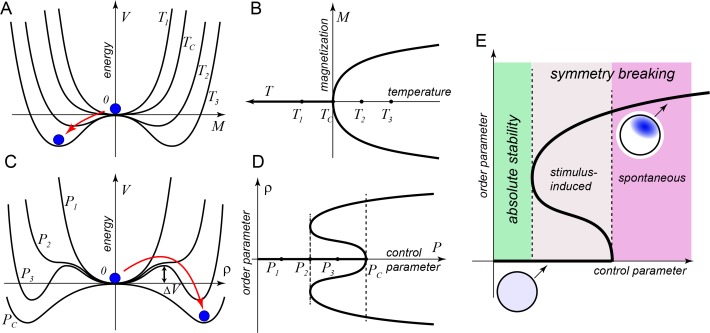
Symmetry breaking in physics and biology. (A, B) Transition of paramagnetic to ferromagnetic state as a prototypical example of symmetry breaking. (A) Symmetric state M = 0 changes from the energy minimum to a local maximum at the Curie temperature. (B) At the transition point, the system selects one of two equivalent branches. (C, D) A system in which the symmetric state ρ = 0 remains locally stable after asymmetric states are born. (C) The system can be forced out of the symmetric state if the energy barrier is exceeded. (D) Multistable parameter region corresponds to an energy function with three minima. (E) Symmetry breaking in a biological system far from thermodynamic equilibrium. Nonzero order parameter corresponds to the emergence of spatial structure. Spatially homogeneous and polarized states of the system are shown schematically as uniform and patterned spherical cells, respectively.
FIGURE 2:
FIGURE 2:
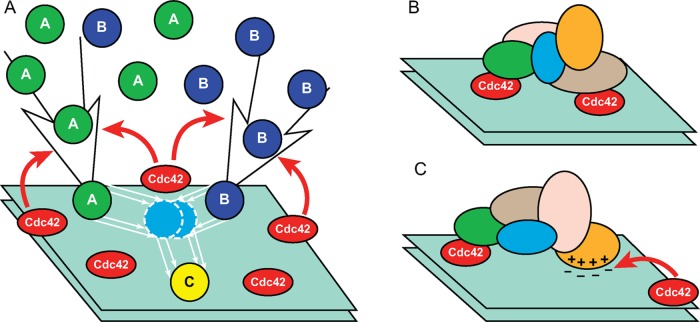
Sources of nonlinearity in the Cdc42 polarity module. (A) If reaction A + B → C takes place on the membrane and both A and B are recruited downstream of Cdc42 activity, the rate of production of C is proportional to the square of Cdc42-GTP concentration. (B) The membrane concentration of a protein complex that interacts with the membrane via two independent Cdc42 effectors (or one bivalent effector) is proportional to the square of Cdc42-GTP concentration. (C) Similar to B, but in this case, one of the complex subunits interacts with negatively charged phospholipids whose accumulation is downstream of Cdc42 activity.
FIGURE 3:
FIGURE 3:
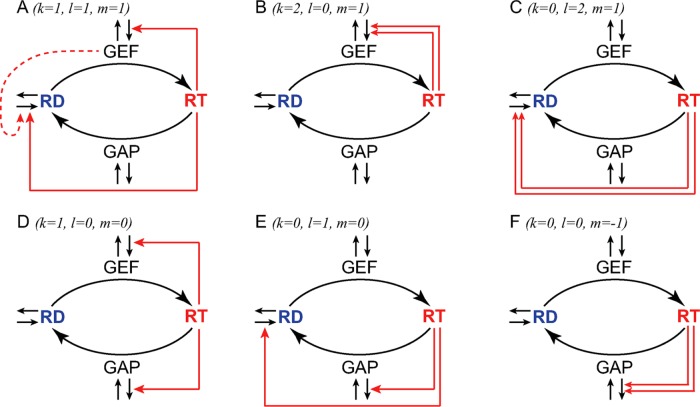
Six classes of Cdc42 polarization models with spontaneous symmetry breaking. Feedback loops connecting the active form of Cdc42 (RT) to its regulators and the recruitment of inactive Cdc42 (RD) are shown by red arrows. Double red arrows indicate nonlinear positive feedback. See text for detailed discussion.

References

    1. Adamo JE, Moskow JJ, Gladfelter AS, Viterbo D, Lew DJ, Brennwald PJ. Yeast Cdc42 functions at a late step in exocytosis, specifically during polarized growth of the emerging bud. J Cell Biol. 2001;155:581–592. - PMC - PubMed
    1. Adams AE, Johnson DI, Longnecker RM, Sloat BF, Pringle JR. CDC42 and CDC43, two additional genes involved in budding and the establishment of cell polarity in the yeast Saccharomyces cerevisiae. J Cell Biol. 1990;111:131–142. - PMC - PubMed
    1. Altschuler SJ, Angenent SB, Wang Y, Wu LF. On the spontaneous emergence of cell polarity. Nature. 2008;454:886–889. - PMC - PubMed
    1. Atkins BD, Yoshida S, Pellman D. Symmetry breaking: scaffold plays matchmaker for polarity signaling proteins. Curr Biol. 2008;18:R1130–R1132. - PubMed
    1. Ayscough KR, Stryker J, Pokala N, Sanders M, Crews P, Drubin DG. High rates of actin filament turnover in budding yeast and roles for actin in establishment and maintenance of cell polarity revealed using the actin inhibitor latrunculin-A. J Cell Biol. 1997;137:399–416. - PMC - PubMed

MeSH terms

Substances

LinkOut - more resources