


Review
doi: 10.1161/CIRCULATIONAHA.116.024258.
Next-Generation Sequencing in Cardiovascular Disease: Present Clinical Applications and the Horizon of Precision Medicine
Affiliations
- PMID: 28137961
- PMCID: PMC5310819
- DOI: 10.1161/CIRCULATIONAHA.116.024258
Item in Clipboard
Review
Next-Generation Sequencing in Cardiovascular Disease: Present Clinical Applications and the Horizon of Precision Medicine
Circulation.
.
No abstract available
Keywords: genetic heart disease; genetic testing; genetics; human.
Conflict of interest statement
Conflict of Interest Disclosures: E.A.A. is a co-founder of, and an advisor at, Personalis Inc.
Figures
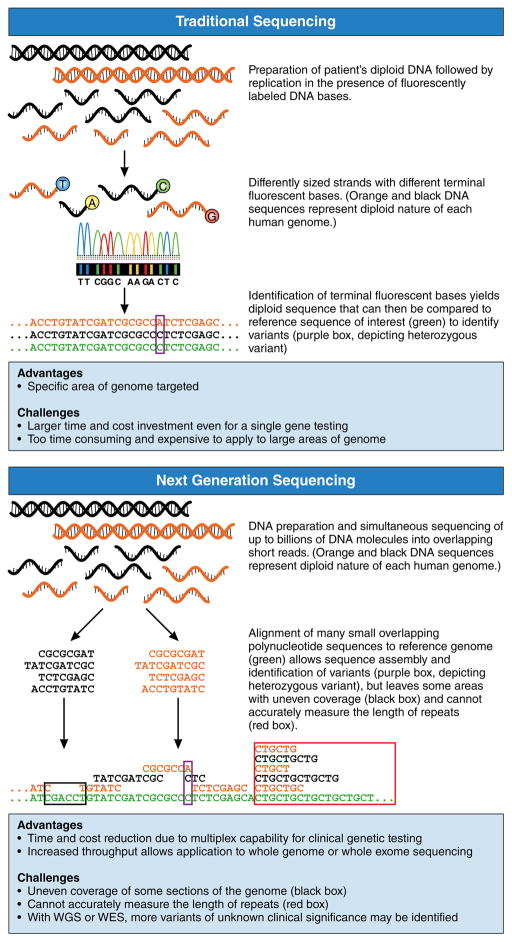
In traditional sequencing, DNA is replicated in the presence of fluorescently labeled bases, yielding differently sized strands with different terminal bases. These terminal bases are identified in order to assemble the entire sequence and compare it to the reference genome. In NGS, DNA is simultaneously sequenced into billions of overlapping short reads that are then assembled by alignment to the reference genome. Here, each diploid genome is represented by black and orange copies. Green sequence represents reference genome. Purple boxes illustrate heterozygous variants, the black box illustrates the problem of uneven coverage and the red box indicates the inability of short reads to accurately sequence large areas of repeated sequence.
References
-
- Sturm AC, Hershberger RE. Genetic testing in cardiovascular medicine: current landscape and future horizons. Curr Opin Cardiol. 2013;28:317–325. - PubMed
-
- Yang Y, Muzny DM, Xia F, Niu Z, Person R, Ding Y, Ward P, Braxton A, Wang M, Buhay C, Veeraraghavan N, Hawes A, Chiang T, Leduc M, Beuten J, Zhang J, He W, Scull J, Willis A, Landsverk M, Craigen WJ, Bekheirnia MR, Stray-Pedersen A, Liu P, Wen S, Alcaraz W, Cui H, Walkiewicz M, Reid J, Bainbridge M, Patel A, Boerwinkle E, Beaudet AL, Lupski JR, Plon SE, Gibbs RA, Eng CM. Molecular findings among patients referred for clinical whole-exome sequencing. JAMA. 2014;312:1870–1879. - PMC - PubMed
-
- Ashley EA. Towards precision medicine. Nat Rev Genet. 2016;17:507–522. - PubMed
-
- Ashley EA, Butte AJ, Wheeler MT, Chen R, Klein TE, Dewey FE, Dudley JT, Ormond KE, Pavlovic A, Morgan AA, Pushkarev D, Neff NF, Hudgins L, Gong L, Hodges LM, Berlin DS, Thorn CF, Sangkuhl K, Hebert JM, Woon M, Sagreiya H, Whaley R, Knowles JW, Chou MF, Thakuria JV, Rosenbaum AM, Zaranek AW, Church GM, Greely HT, Quake SR, Altman RB. Clinical assessment incorporating a personal genome. The Lancet. 2010;375:1525–1535. - PMC - PubMed
Publication types
MeSH terms
Grants and funding
LinkOut - more resources
Full Text Sources
Other Literature Sources
