The Normalization of Brain ¹⁸F-fluorodeoxy-D-glucose Positron Emission Tomography Hypometabolism following Electroconvulsive Therapy in a 55-year-old Woman with Treatment-resistant Late Onset Depression: A Case Report
- PMID: 28138119
- PMCID: PMC5290710
- DOI: 10.9758/cpn.2017.15.1.82
The Normalization of Brain ¹⁸F-fluorodeoxy-D-glucose Positron Emission Tomography Hypometabolism following Electroconvulsive Therapy in a 55-year-old Woman with Treatment-resistant Late Onset Depression: A Case Report
Abstract
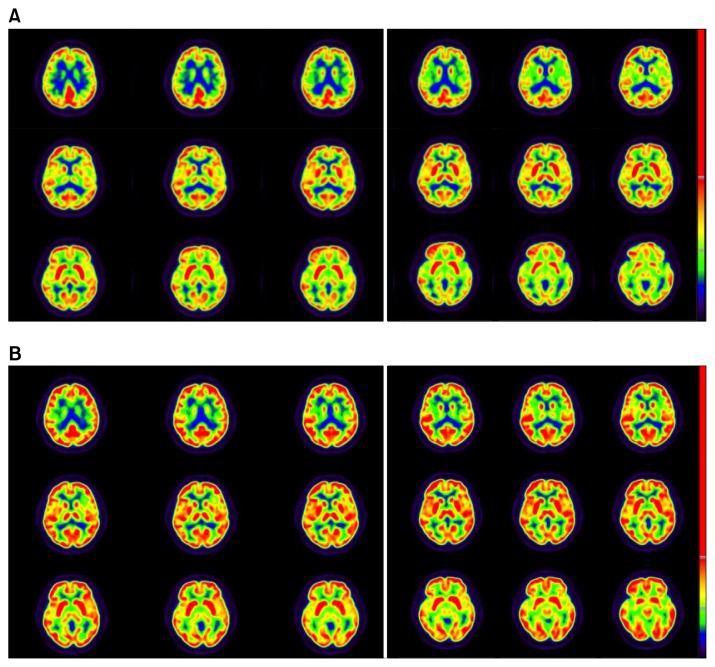
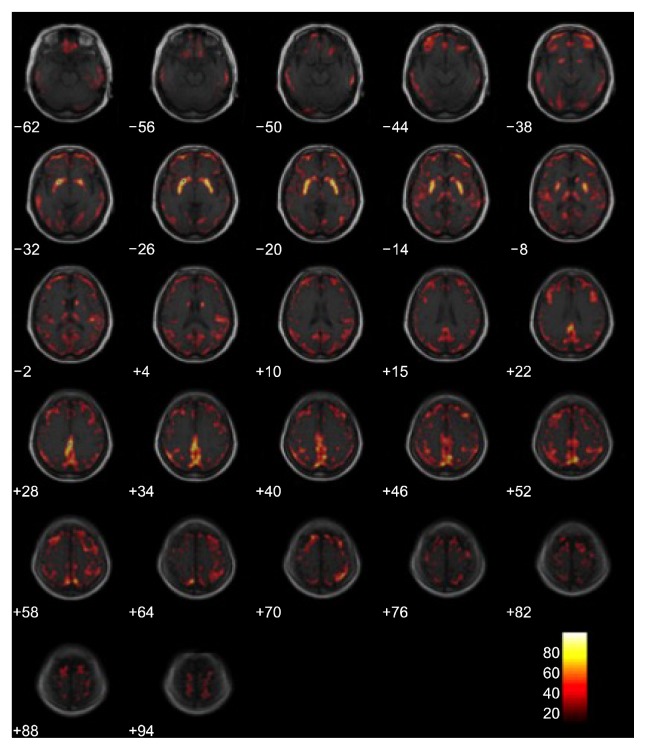
Major depressive disorder, especially in later life, has heterogeneous clinical characteristics and treatment responses. Symptomatically, psychomotor retardation, lack of energy, and apathy tends to be more common in people with late-onset depression (LOD). Despite recent advances in psychopharmacologic treatments, 20% to 30% of patients with mood disorders experience inadequate responses to medication, often resulting in a trial of electroconvulsive therapy (ECT). However, the therapeutic mechanism of ECT is still unclear. By using ¹⁸F-fluorodeoxy-D-glucose positron emission tomography-computed tomography (¹⁸F-FDG PET/CT), we can obtain the status of brain metabolism in patients with neuropsychiatric disorders and changes during psychiatric treatment course. The object of this case report is evaluating the effect of ECT on brain metabolism in treatment-refractory LOD by PET/CT and understanding the mode of action of ECT. In this case report, we presented a 55-year-old female patient who suffered psychotic depression that was resistant to pharmacological treatment. Several antidepressants and atypical antipsychotics were applied but there was no improvement in her symptoms. The patient presented not only depressed mood and behaviors but also deficit in cognitive functions. We found decreased diffuse cerebral metabolism in her brain ¹⁸F-FDG PET/CT image. ECT resulted in amelioration of the patients' symptoms and another brain PET imaging 7 weeks after the last ECT course showed that her brain metabolism was normalized.
Keywords: Depression; Electroconvulsive therapy; Fluorodeoxyglucose F18; Positron emission tomography.
Figures
Similar articles
-
Bifrontal electroconvulsive therapy leads to improvement of cerebral glucose hypometabolism in frontotemporal dementia with comorbid psychotic depression - a case report.BMC Psychiatry. 2023 Apr 20;23(1):279. doi: 10.1186/s12888-023-04759-z. BMC Psychiatry. 2023. PMID: 37081424 Free PMC article.
-
Reversal of cerebral glucose hypometabolism on positron emission tomography with electroconvulsive therapy in an elderly patient with a psychotic episode.Psychogeriatrics. 2016 Nov;16(6):376-381. doi: 10.1111/psyg.12174. Epub 2016 Jan 12. Psychogeriatrics. 2016. PMID: 26756319
-
Complete normalization of severe brain 18F-FDG hypometabolism following electroconvulsive therapy in a major depressive episode.Clin Nucl Med. 2013 Sep;38(9):735-6. doi: 10.1097/RLU.0b013e31829b9bd9. Clin Nucl Med. 2013. PMID: 23816946
-
Changes in brain metabolism after ECT-positron emission tomography in the assessment of changes in glucose metabolism subsequent to electroconvulsive therapy--lessons, limitations and future applications.J Affect Disord. 2008 Feb;106(1-2):203-8. doi: 10.1016/j.jad.2007.06.009. Epub 2007 Jul 26. J Affect Disord. 2008. PMID: 17662472 Review.
-
Neuronuclear assessment of patients with epilepsy.Semin Nucl Med. 2008 Jul;38(4):227-39. doi: 10.1053/j.semnuclmed.2008.02.004. Semin Nucl Med. 2008. PMID: 18514079 Review.
Cited by
-
Depressive Pseudodementia with Reversible AD-like Brain Hypometabolism: A Case Report and a Review of the Literature.J Pers Med. 2022 Oct 6;12(10):1665. doi: 10.3390/jpm12101665. J Pers Med. 2022. PMID: 36294804 Free PMC article.
-
Current progress in neuroimaging research for the treatment of major depression with electroconvulsive therapy.World J Psychiatry. 2022 Jan 19;12(1):128-139. doi: 10.5498/wjp.v12.i1.128. eCollection 2022 Jan 19. World J Psychiatry. 2022. PMID: 35111584 Free PMC article. Review.
-
Advances and Barriers for Clinical Neuroimaging in Late-Life Mood and Anxiety Disorders.Curr Psychiatry Rep. 2018 Mar 1;20(1):7. doi: 10.1007/s11920-018-0870-6. Curr Psychiatry Rep. 2018. PMID: 29492705 Review.
-
Neuroimaging study of electroconvulsive therapy for depression.Front Psychiatry. 2023 Jun 9;14:1170625. doi: 10.3389/fpsyt.2023.1170625. eCollection 2023. Front Psychiatry. 2023. PMID: 37363178 Free PMC article. Review.
References
Publication types
LinkOut - more resources
Full Text Sources
Other Literature Sources