


Head injury serum markers for assessing response to trauma: Design of the HeadSMART study
- PMID: 28140672
- PMCID: PMC6438171
- DOI: 10.1080/02699052.2016.1231344
Head injury serum markers for assessing response to trauma: Design of the HeadSMART study
Abstract
Background: Accurate diagnosis and risk stratification of traumatic brain injury (TBI) at time of presentation remains a clinical challenge. The Head Injury Serum Markers for Assessing Response to Trauma study (HeadSMART) aims to examine blood-based biomarkers for diagnosing and determining prognosis in TBI.
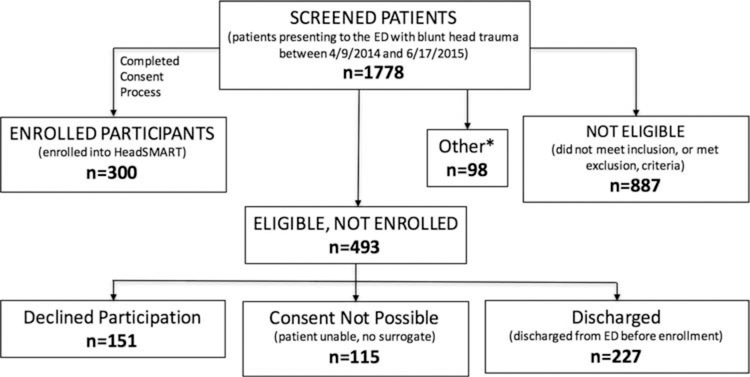
Methods: HeadSMART is a 6-month prospective cohort study comparing emergency department patients evaluated for TBI (exposure group) to (1) emergency department patients evaluated for traumatic injury without head trauma and (2) healthy persons. Study methods and characteristics of the first 300 exposure participants are discussed.
Results: Of the first 300 participants in the exposure arm, 70% met the American Congress of Rehabilitation Medicine criteria for TBI, with the majority (80.1%) classified as mild TBI. The majority of subjects in the exposure arm had Glasgow Coma Scale scores of 13-15 (98.0%), normal head computed tomography (81.3%) and no prior history of concussion (71.7%).
Conclusion: With systematic phenotyping, HeadSMART will facilitate diagnosis and risk-stratification of the heterogeneous group of individuals currently diagnosed with TBI.
Keywords: TBI; Traumatic brain injury; biomarkers; blunt head trauma.
Figures
References
-
- Centers for Disease Control and Prevention (CDC) National Center for Health Statistics. 2010. \,; 2010 National Hospital Ambulatory Medical Care Survey (NHAMCS), 2010.
-
- Centers for Disease Control and Prevention(CDC) NCfIPaC. 2003. Report to Congress on mild traumatic brain injury in the United States: steps to prevent a serious public health problem. Atlanta, GA: Centers for Disease Control and Prevention.
-
- Kim E, Lauterbach EC, Reeve A, Arciniegas DB, Coburn KL, Mendez MF, Rummans TA, Coffey EC, Research ACo. 2007. Neuropsychiatric complications of traumatic brain injury: a critical review of the literature (a report by the ANPA Committee on Research). J Neuropsychiatry Clin Neurosci 19(2):106–27. - PubMed
-
- Rao V, Koliatsos V, Ahmed F, Lyketsos C, Kortte K. 2015. Neuropsychiatric disturbances associated with traumatic brain injury: a practical approach to evaluation and management. Semin Neurol 35(1):64–82. - PubMed
MeSH terms
Substances
Grants and funding
LinkOut - more resources
Full Text Sources
Other Literature Sources
Medical
Miscellaneous
