


Identifying subgroups of patients using latent class analysis: should we use a single-stage or a two-stage approach? A methodological study using a cohort of patients with low back pain
- PMID: 28143458
- PMCID: PMC5286735
- DOI: 10.1186/s12891-017-1411-x
Identifying subgroups of patients using latent class analysis: should we use a single-stage or a two-stage approach? A methodological study using a cohort of patients with low back pain
Abstract
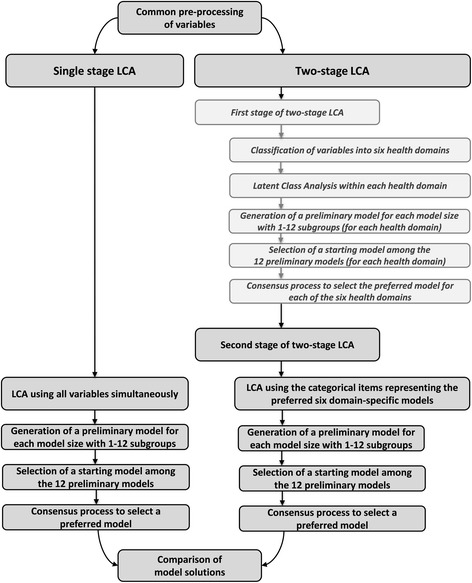
Background: Heterogeneity in patients with low back pain (LBP) is well recognised and different approaches to subgrouping have been proposed. Latent Class Analysis (LCA) is a statistical technique that is increasingly being used to identify subgroups based on patient characteristics. However, as LBP is a complex multi-domain condition, the optimal approach when using LCA is unknown. Therefore, this paper describes the exploration of two approaches to LCA that may help improve the identification of clinically relevant and interpretable LBP subgroups.
Methods: From 928 LBP patients consulting a chiropractor, baseline data were used as input to the statistical subgrouping. In a single-stage LCA, all variables were modelled simultaneously to identify patient subgroups. In a two-stage LCA, we used the latent class membership from our previously published LCA within each of six domains of health (activity, contextual factors, pain, participation, physical impairment and psychology) (first stage) as the variables entered into the second stage of the two-stage LCA to identify patient subgroups. The description of the results of the single-stage and two-stage LCA was based on a combination of statistical performance measures, qualitative evaluation of clinical interpretability (face validity) and a subgroup membership comparison.
Results: For the single-stage LCA, a model solution with seven patient subgroups was preferred, and for the two-stage LCA, a nine patient subgroup model. Both approaches identified similar, but not identical, patient subgroups characterised by (i) mild intermittent LBP, (ii) recent severe LBP and activity limitations, (iii) very recent severe LBP with both activity and participation limitations, (iv) work-related LBP, (v) LBP and several negative consequences and (vi) LBP with nerve root involvement.
Conclusions: Both approaches identified clinically interpretable patient subgroups. The potential importance of these subgroups needs to be investigated by exploring whether they can be identified in other cohorts and by examining their possible association with patient outcomes. This may inform the selection of a preferred LCA approach.
Keywords: Classification; Data mining; Latent class analysis; Low back pain; Subgrouping.
Figures

 = Features: Two identified representing two to 16 variables with a distinct scoring pattern. Brief conceptual description of the single-stage patient subgroups based on variables from the activity domain: SS 1: High degree of disability, low degree of walking distance limitations, can work. SS 2: Very low degree of disability, can work. SS 3: High degree of disability. SS 4: Moderate degree of disability, household challenges. SS 5: Moderate degree of disability, low degree of walking distance limitations. SS 6: High degree of disability. SS 7: Moderate degree of disability, walking (speed) limitations. b Single-stage patient subgroups based on variables from the contextual factors domain. Abbreviations: BMI = Body Mass Index. SS = single-stage patient subgroup.
  = Features: Five identified representing one variable each with a slightly distinct scoring pattern. Brief conceptual description of the single-stage patient subgroups based on variables from the contextual factors domain was not considered appropriate as contextual factors did not contribute to the interpretation. c Single-stage patient subgroups based on variables from the pain domain. Abbreviations: LBP = low back pain. SS = single-stage patient subgroup.
  = Features: Eight identified representing one to three variables with a distinct scoring pattern. Brief conceptual description of the single-stage patient subgroups based on variables from the pain domain. SS 1: Recent LBP with high degree of back pain severity. SS 2: Intermittent LBP with moderate degree of back pain severity. SS 3: Recent LBP with high degree of back pain severity, worsened by physical activity. SS 4: Persistent LBP with high degree of back pain severity and shoulder/neck pain. SS 5: Recent LBP with high degree of back pain severity and low degree of leg pain severity. SS 6: Recent LBP with very high back pain severity and moderate degree of leg pain severity, worsened by physical activity. SS 7: Dominating leg pain, high degree of leg pain severity, no paraspinal pain onset. d Single-stage patient subgroups based on variables from the participation domain. Abbreviations: SS = single-stage patient subgroup.
  = Features: Three identified representing one to four variables with a distinct scoring pattern. Brief conceptual description of the single-stage patient subgroups based on variables from the participation domain: SS 1: Moderate degree of social participation limitations. SS 2: Low degree of participation limitations. SS 3: High degree of social participation limitations, moderate degree of work issues. SS 4: Moderate degree of participation limitations. SS 5: High degree of work issues and physical workload. SS 6: High degree of participation limitations and physical workload. SS 7: Moderate degree of participation limitations. e Single-stage patient subgroups based on variables from the physical impairment domain. Abbreviations: AROM = active range of motion. LBP = low back pain. SI = sacroiliac. SS = single-stage patient subgroup.
  = Features: None, but five conceptually related items were identified. Brief conceptual description of the single-stage patient subgroups based on variables from the physical impairment domain: SS 1: LBP on flexion, extension and side glide, painful back muscles. SS 2: Low degree of pain on AROM, painful buttock and leg muscles. SS 3: LBP on AROM. SS 4: LBP on flexion, extension and side glide, painful back, buttock and leg muscles. SS 5: LBP on flexion, extension and side glide, painful back muscles. SS 6: LBP and leg pain on AROM, SI joint pain, painful buttock and leg muscles. SS 7: Leg pain on AROM, neurological signs, pain on extension/rotation, trigger points. f Single-stage patient subgroups based on variables from the psychology domain. Abbreviation: SS = single-stage patient subgroup.
  = Features: Five identified representing two to 10 variables with a distinct scoring pattern. Brief conceptual description of the single-stage patient subgroups based on variables from the psychology domain. SS 1: Sleep issues. SS 2: The uncomplicated psychological profile. SS 3: Pain-related concerns and sleep issues. SS 4: Psychologically affected without pain-related concerns. SS 5: Pain-related concerns and negative recovery beliefs. SS 6: The complicated psychological profile. SS 7: Sleep issues and catastrophizing
References
Publication types
MeSH terms
LinkOut - more resources
Full Text Sources
Other Literature Sources
Research Materials
Miscellaneous
