


Burden of cervical cancer and role of screening in India
- PMID: 28144096
- PMCID: PMC5234166
- DOI: 10.4103/0971-5851.195751
Burden of cervical cancer and role of screening in India
Abstract
Background: Cervical cancer is a major cause of cancer mortality in women and more than a quarter of its global burden is contributed by developing countries. In India, in spite of alarmingly high figures, there is no nationwide government-sponsored screening program. This study was conducted to assess the burden of cervical cancer in India and review the performance characteristics of available cervical cancer screening tools, so as to provide evidence-based recommendations for application of most practically suited screening test to be used in resource-poor field settings.
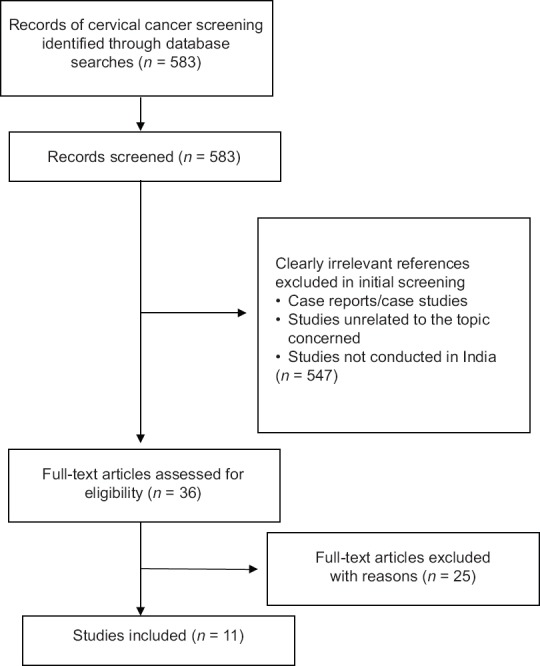
Materials and methods: MEDLINE and Web of Science electronic database were searched from January 1990 to December 2015, using the keywords such as "cervical cancer", "screening", "early detection", "cervical cytology" and "visual inspection", and their corresponding MeSH terms in combination with Boolean operators "OR, AND." Two authors independently selected studies that are published in English and conducted in India. A total of 11 studies were found to be relevant and eligible to be included in the present study.
Results: In India, cervical cancer contributes to approximately 6-29% of all cancers in women. The age-adjusted incidence rate of cervical cancer varies widely among registries; highest is 23.07/100,000 in Mizoram state and the lowest is 4.91/100,000 in Dibrugarh district. The pooled estimates of sensitivity and specificity of visual inspection with acetic acid (VIA), magnified VIA, visual inspection with Lugol's iodine (VILI), cytology (Pap smear), and human papillomavirus DNA were found to be 67.65% and 84.32%, 65.36% and 85.76%, 78.27% and 87.10%, 62.11% and 93.51%, and 77.81% and 91.54%, respectively.
Conclusions: In developing countries because of lack of necessary infrastructure and quality control, high-quality cytology screening may not be feasible for wide-scale implementation. Hence, cervical cancer screening program based on visual screening test such as VIA/VILI should be adopted as an integral part of primary health-care setup in resource-poor countries like India.
Keywords: Cervical cancer; cytology; human papillomavirus DNA; screening; visual inspection.
Conflict of interest statement
There are no conflicts of interest.
Figures
References
-
- Ferlay J, Soerjomataram I, Ervik M, Forman D, Bray F, Dixit R, et al. GLOBOCAN 2012, Cancer Incidence and Mortality Worldwide in 2012. Lyon, France: International Agency for Research on Cancer; 2012. [Last accessed on 2015 Dec 03]. Available from: http://www.globocan.iarc.fr .
-
- Institute for Health Metrics and Evaluation. The Challenge Ahead: Progress in Breast and Cervical Cancer. Institute of Health Metrics and Evaluation. 2011. [Last accessed on 2016 Jan 21]. Available from: http://www.healthmetricsandevaluation.org/publications/policyreport/chal... .
-
- Morrison AS. Screening in Chronic Disease. 2nd ed. New York: Oxford University Press; 1992. Introduction; pp. 3–42.
-
- Three-Year Report of Population Based Cancer Registries 2012-2014. Bengaluru: National Centre for Disease Informatics and Research National Cancer Registry Program (ICMR); 2016. Mar, Incidence, Distribution, Trends in Incidence Rates and Projections of Burden of Cancer; pp. 1–15.
LinkOut - more resources
Full Text Sources
Other Literature Sources
Research Materials
