


Cranberry juice concentrate does not significantly decrease the incidence of acquired bacteriuria in female hip fracture patients receiving urine catheter: a double-blind randomized trial
- PMID: 28144131
- PMCID: PMC5245868
- DOI: 10.2147/CIA.S113597
Cranberry juice concentrate does not significantly decrease the incidence of acquired bacteriuria in female hip fracture patients receiving urine catheter: a double-blind randomized trial
Abstract
Background: Urinary tract infection (UTI) is a common complication among patients with hip fractures. Receiving an indwelling urinary catheter is a risk factor for developing UTIs. Treatment of symptomatic UTIs with antibiotics is expensive and can result in the development of antimicrobial resistance. Cranberries are thought to prevent UTI. There is no previous research on this potential effect in patients with hip fracture who receive urinary catheters.
Aim: The aim of this study is to investigate whether intake of cranberry juice concentrate pre-operatively decreases the incidence of postoperative UTIs in hip fracture patients that received a urinary catheter.
Design: This study employed a randomized, placebo-controlled double-blind trial.
Method: Female patients, aged 60 years and older, with hip fracture (n=227) were randomized to receive cranberry or placebo capsules daily, from admission, until 5 days postoperatively. Urine cultures were obtained at admission, 5 and 14 days postoperatively. In addition, Euro Qual five Dimensions assessments were performed and patients were screened for UTI symptoms.
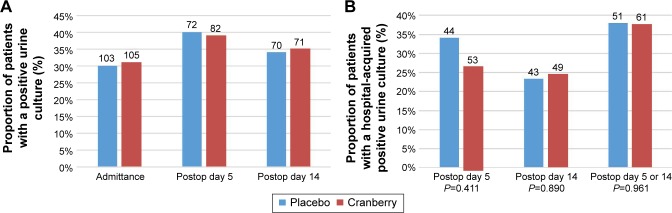
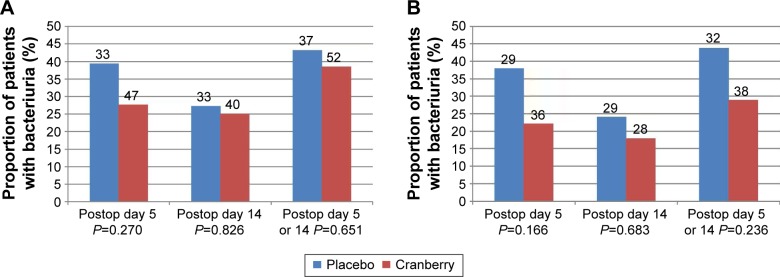
Result: In the intention-to-treat analysis, there was no difference between the groups in the proportion of patients with hospital-acquired postoperative positive urine cultures at any time point. When limiting the analysis to patients that ingested at least 80% of the prescribed capsules, 13 of 33 (39%) in the placebo group and 13 of 47 (28%) in the cranberry group (P=0.270) had a positive urine culture at 5 days postoperatively. However, this difference was not statistically significant (P=0.270).
Conclusion: Cranberry concentrate does not seem to effectively prevent UTIs in female patients with hip fracture and indwelling urinary catheter.
Keywords: elderly; hospital; preventive; randomized controlled trial; urinary tract infection; urine culture.
Conflict of interest statement
The authors report no conflicts of interest in this work.
Figures
References
-
- Lundstrom M, Olofsson B, Stenvall M, et al. Postoperative delirium in old patients with femoral neck fracture: a randomized intervention study. Aging Clin Exp Res. 2007;19(3):178–186. - PubMed
-
- Poh KS, Lingaraj K. Complications and their risk factors following hip fracture surgery. J Orthop Surg (Hong Kong) 2013;21(2):154–157. - PubMed
-
- Kamel HK. The frequency and factors linked to a urinary tract infection coding in patients undergoing hip fracture surgery. J Am Med Dir Assoc. 2005;6(5):316–320. - PubMed
Publication types
MeSH terms
Substances
LinkOut - more resources
Full Text Sources
Other Literature Sources
Medical
