Studying Vertical Microbiome Transmission from Mothers to Infants by Strain-Level Metagenomic Profiling
- PMID: 28144631
- PMCID: PMC5264247
- DOI: 10.1128/mSystems.00164-16
Studying Vertical Microbiome Transmission from Mothers to Infants by Strain-Level Metagenomic Profiling
Abstract
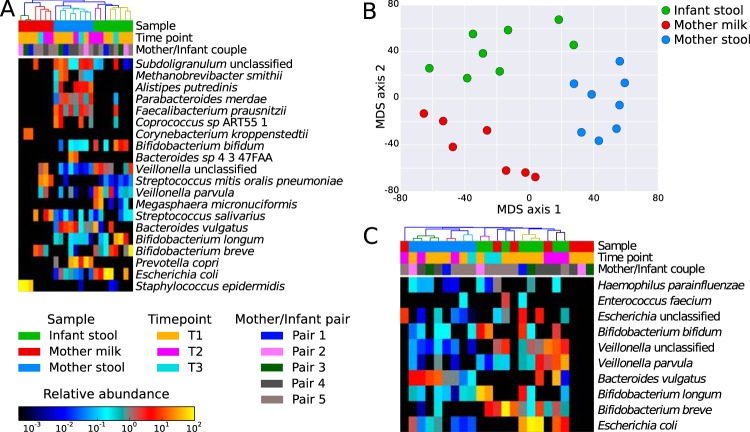
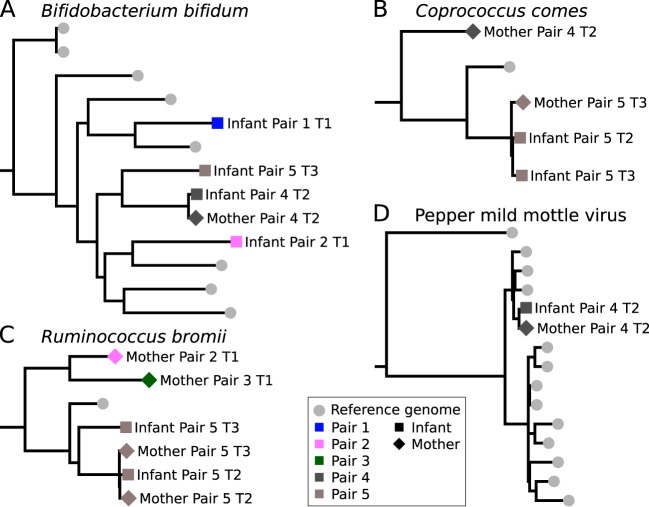
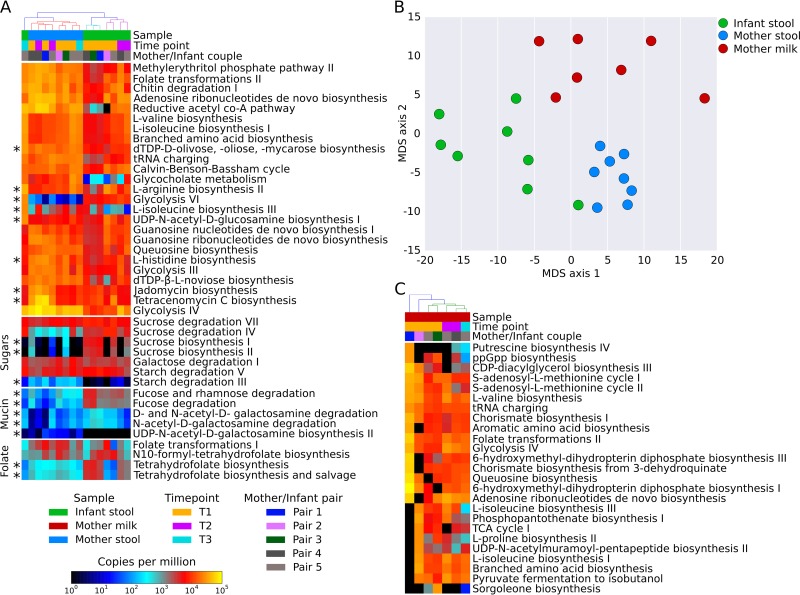
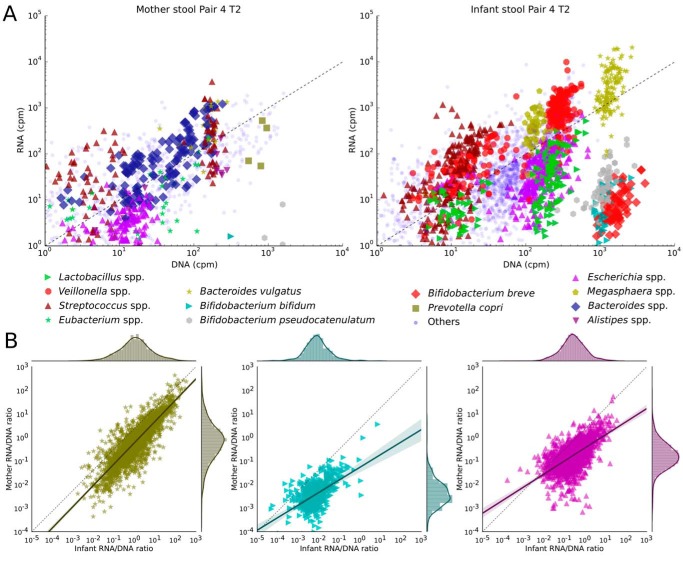
The gut microbiome becomes shaped in the first days of life and continues to increase its diversity during the first months. Links between the configuration of the infant gut microbiome and infant health are being shown, but a comprehensive strain-level assessment of microbes vertically transmitted from mother to infant is still missing. We collected fecal and breast milk samples from multiple mother-infant pairs during the first year of life and applied shotgun metagenomic sequencing followed by computational strain-level profiling. We observed that several specific strains, including those of Bifidobacterium bifidum, Coprococcus comes, and Ruminococcus bromii, were present in samples from the same mother-infant pair, while being clearly distinct from those carried by other pairs, which is indicative of vertical transmission. We further applied metatranscriptomics to study the in vivo gene expression of vertically transmitted microbes and found that transmitted strains of Bacteroides and Bifidobacterium species were transcriptionally active in the guts of both adult and infant. By combining longitudinal microbiome sampling and newly developed computational tools for strain-level microbiome analysis, we demonstrated that it is possible to track the vertical transmission of microbial strains from mother to infants and to characterize their transcriptional activity. Our work provides the foundation for larger-scale surveys to identify the routes of vertical microbial transmission and its influence on postinfancy microbiome development. IMPORTANCE Early infant exposure is important in the acquisition and ultimate development of a healthy infant microbiome. There is increasing support for the idea that the maternal microbial reservoir is a key route of microbial transmission, and yet much is inferred from the observation of shared species in mother and infant. The presence of common species, per se, does not necessarily equate to vertical transmission, as species exhibit considerable strain heterogeneity. It is therefore imperative to assess whether shared microbes belong to the same genetic variant (i.e., strain) to support the hypothesis of vertical transmission. Here we demonstrate the potential of shotgun metagenomics and strain-level profiling to identify vertical transmission events. Combining these data with metatranscriptomics, we show that it is possible not only to identify and track the fate of microbes in the early infant microbiome but also to investigate the actively transcribing members of the community. These approaches will ultimately provide important insights into the acquisition, development, and community dynamics of the infant microbiome.
Keywords: infant microbiome; metagenomics; microbial ecology; microbial genomics; vertical microbiome transmission.
Figures
References
-
- Qin J, Li R, Raes J, Arumugam M, Burgdorf KS, Manichanh C, Nielsen T, Pons N, Levenez F, Yamada T, Mende DR, Li J, Xu J, Li S, Li D, Cao J, Wang B, Liang H, Zheng H, Xie Y, Tap J, Lepage P, Bertalan M, Batto JM, Hansen T, Le Paslier D, Linneberg A, Nielsen HB, Pelletier E, Renault P, Sicheritz-Ponten T, Turner K, Zhu H, Yu C, Li S, Jian M, Zhou Y, Li Y, Zhang X, Li S, Qin N, Yang H, Wang J, Brunak S, Dore J, Guarner F, Kristiansen K, Pedersen O, Parkhill J, Weissenbach J; Meta HIT Consortium, Bork P, Ehrlich SD, Wang J. 2010. A human gut microbial gene catalogue established by metagenomic sequencing. Nature 464:59–65. doi: 10.1038/nature08821. - DOI - PMC - PubMed
LinkOut - more resources
Full Text Sources
Other Literature Sources
Medical