


Treatment of Bipolar Depression with Deep TMS: Results from a Double-Blind, Randomized, Parallel Group, Sham-Controlled Clinical Trial
- PMID: 28145409
- PMCID: PMC5686495
- DOI: 10.1038/npp.2017.26
Treatment of Bipolar Depression with Deep TMS: Results from a Double-Blind, Randomized, Parallel Group, Sham-Controlled Clinical Trial
Abstract
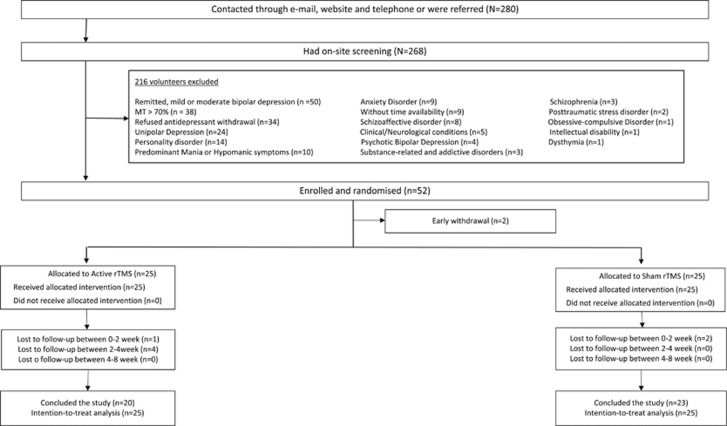
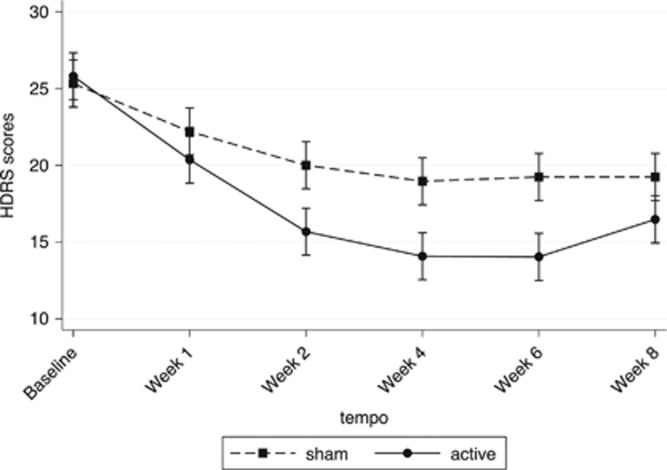
Bipolar depression (BD) is a highly prevalent condition with limited therapeutic options. Deep (H1-coil) transcranial magnetic stimulation (dTMS) is a novel TMS modality with established efficacy for unipolar depression. We conducted a randomized sham-controlled trial to evaluate the efficacy and safety of dTMS in treatment-resistant BD patients. Patients received 20 sessions of active or sham dTMS over the left dorsolateral prefrontal cortex (H1-coil, 55 18 Hz 2 s 120% MT trains). The primary outcome was changes in the 17-item Hamilton Depression Rating Scale (HDRS-17) from baseline to endpoint (week 4). Secondary outcomes were changes from baseline to the end of the follow-up phase (week 8), and response and remission rates. Safety was assessed using a dTMS adverse effects questionnaire and the Young Mania Rating Scale to assess treatment-emergent mania switch (TEMS). Out of 50 patients, 43 finished the trial. There were 2 and 5 dropouts in the sham and active groups, respectively. Active dTMS was superior to sham at end point (difference favoring dTMS=4.88; 95% CI 0.43 to 9.32, p=0.03) but not at follow-up. There was also a trend for greater response rates in the active (48%) vs sham (24%) groups (OR=2.92; 95% CI=0.87 to 9.78, p=0.08). Remission rates were not statistically different. No TEMS episodes were observed. Deep TMS is a potentially effective and well-tolerated add-on therapy in resistant bipolar depressed patients receiving adequate pharmacotherapy.
Figures
References
-
- Berlim MT, van den Eynde F, Tovar-Perdomo S, Daskalakis ZJ (2014). Response, remission and drop-out rates following high-frequency repetitive transcranial magnetic stimulation (rTMS) for treating major depression: a systematic review and meta-analysis of randomized, double-blind and sham-controlled trials. Psychol Med 44: 225–239. - PubMed
-
- Bersani FS, Minichino A, Enticott PG, Mazzarini L, Khan N, Antonacci G et al (2013). Deep transcranial magnetic stimulation as a treatment for psychiatric disorders: a comprehensive review. Eur Psychiatry 28: 30–39. - PubMed
-
- Carpenter LL, Janicak PG, Aaronson ST, Boyadjis T, Brock DG, Cook IA et al (2012). Transcranial magnetic stimulation (TMS) for major depression: a multisite, naturalistic, observational study of acute treatment outcomes in clinical practice. Depress Anxiety 29: 587–596. - PubMed
-
- Castelein S, de Kort SJ, van der Moolen AE, Houtjes W, Roodbol PF, van Meijel B et al (2014). Good clinical practice and the maintenance of ethical standards in medical research: advice for junior researchers working in mental health care. Tijdschr Psychiatr 56: 533–538. - PubMed
Publication types
MeSH terms
Substances
LinkOut - more resources
Full Text Sources
Other Literature Sources
Medical
