


Evaluation of copy-number variants as modifiers of breast and ovarian cancer risk for BRCA1 pathogenic variant carriers
- PMID: 28145423
- PMCID: PMC5386423
- DOI: 10.1038/ejhg.2016.203
Evaluation of copy-number variants as modifiers of breast and ovarian cancer risk for BRCA1 pathogenic variant carriers
Erratum in
-
Correction: Evaluation of copy-number variants as modifiers of breast and ovarian cancer risk for BRCA1 pathogenic variant carriers.Eur J Hum Genet. 2019 Jan;27(1):167-168. doi: 10.1038/s41431-018-0216-1. Eur J Hum Genet. 2019. PMID: 30135485 Free PMC article.
Abstract
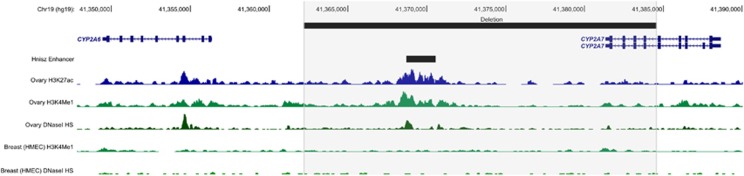
Genome-wide studies of patients carrying pathogenic variants (mutations) in BRCA1 or BRCA2 have reported strong associations between single-nucleotide polymorphisms (SNPs) and cancer risk. To conduct the first genome-wide association analysis of copy-number variants (CNVs) with breast or ovarian cancer risk in a cohort of 2500 BRCA1 pathogenic variant carriers, CNV discovery was performed using multiple calling algorithms and Illumina 610k SNP array data from a previously published genome-wide association study. Our analysis, which focused on functionally disruptive genomic deletions overlapping gene regions, identified a number of loci associated with risk of breast or ovarian cancer for BRCA1 pathogenic variant carriers. Despite only including putative deletions called by at least two or more algorithms, detection of selected CNVs by ancillary molecular technologies only confirmed 40% of predicted common (>1% allele frequency) variants. These include four loci that were associated (unadjusted P<0.05) with breast cancer (GTF2H2, ZNF385B, NAALADL2 and PSG5), and two loci associated with ovarian cancer (CYP2A7 and OR2A1). An interesting finding from this study was an association of a validated CNV deletion at the CYP2A7 locus (19q13.2) with decreased ovarian cancer risk (relative risk=0.50, P=0.007). Genomic analysis found this deletion coincides with a region displaying strong regulatory potential in ovarian tissue, but not in breast epithelial cells. This study highlighted the need to verify CNVs in vitro, but also provides evidence that experimentally validated CNVs (with plausible biological consequences) can modify risk of breast or ovarian cancer in BRCA1 pathogenic variant carriers.
Conflict of interest statement
The authors declare no conflict of interest.
Figures
References
-
- Mavaddat N, Peock S, Frost D et al: Cancer risks for BRCA1 and BRCA2 mutation carriers: results from prospective analysis of EMBRACE. J Natl Cancer Inst 2013; 105: 812–822. - PubMed
-
- Milne RL, Antoniou AC: Genetic modifiers of cancer risk for BRCA1 and BRCA2 mutation carriers. Ann Oncol 2011; 22: i11–i17. - PubMed
Publication types
MeSH terms
Substances
Grants and funding
- R01 CA140323/CA/NCI NIH HHS/United States
- R01 CA176785/CA/NCI NIH HHS/United States
- RC4 CA153828/CA/NCI NIH HHS/United States
- UM1 CA164920/CA/NCI NIH HHS/United States
- P30 CA168524/CA/NCI NIH HHS/United States
- 20861/CRUK_/Cancer Research UK/United Kingdom
- U01 CA116167/CA/NCI NIH HHS/United States
- R01 CA083855/CA/NCI NIH HHS/United States
- R01 CA102776/CA/NCI NIH HHS/United States
- R01 CA192393/CA/NCI NIH HHS/United States
- P30 CA006927/CA/NCI NIH HHS/United States
- P30 CA051008/CA/NCI NIH HHS/United States
- R01 CA116167/CA/NCI NIH HHS/United States
- P50 CA116201/CA/NCI NIH HHS/United States
- U01 CA113916/CA/NCI NIH HHS/United States
LinkOut - more resources
Full Text Sources
Other Literature Sources
Medical
Molecular Biology Databases
Miscellaneous
