doi: 10.1121/1.4973907.
Using electromagnetic articulography with a tongue lateral sensor to discriminate manner of articulation
Affiliations
- PMID: 28147568
- PMCID: PMC5724616
- DOI: 10.1121/1.4973907
Item in Clipboard
Using electromagnetic articulography with a tongue lateral sensor to discriminate manner of articulation
J Acoust Soc Am.
2017 Jan.
Abstract
This study examined the contributions of the tongue tip (TT), tongue body (TB), and tongue lateral (TL) sensors in the electromagnetic articulography (EMA) measurement of American English alveolar consonants. Thirteen adults produced /ɹ/, /l/, /z/, and /d/ in /ɑCɑ/ syllables while being recorded with an EMA system. According to statistical analysis of sensor movement and the results of a machine classification experiment, the TT sensor contributed most to consonant differences, followed by TB. The TL sensor played a complementary role, particularly for distinguishing /z/.
Figures
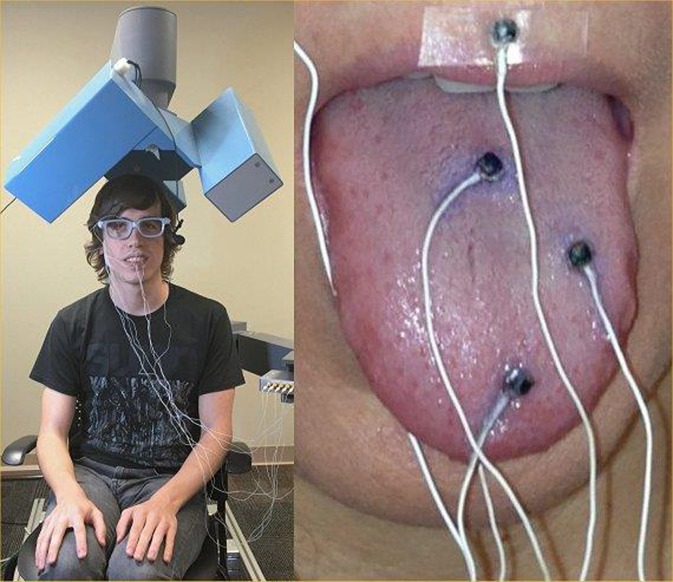
(Color online) EMA recording system (left) and close-up showing tongue midline and lateral sensors. Sensors were also attached to the UL and LL. Reference sensors attached to a pair of glasses were used to eliminate head movement and to establish a local reference plane.

(Color online) Representative examples of averaged 3D motion paths of the TT, TB, and TL sensors for ten repetitions of ra, la, za, and da spoken by two talkers. Distances are in mm. The ra patterns (boldest lines) differ qualitatively between the two talkers, suggesting more of a bunched pattern in (a) than in (b).

Example of data selection for CV portions of kinematic signal (based on acoustic consonant onset and offset) and for the /ɡ/ of g ame. Vertical lines on the acoustic waveform (top panel) indicate onset and offset cutoffs that correspond with TT and TB vertical movement peaks (shown below).
References
-
- Shadle C., Proctor M. I., and Iskarous K., “ An MRI study of the effect of vowel context on English fricatives,” in Proceedings of the Joint Meeting of the Acoustical Society of America and European Acoustics Association, Paris, France, pp. 5099–5104 (2008). 10.1121/1.2935246 - DOI
-
- Delattre P. and Freeman D. C., “ A dialect study of American r's by x-ray motion picture,” Linguistics 6, 29–68 (1968). 10.1515/ling.1968.6.44.29 - DOI
-
- Westbury J. R., Hashi M., and Lindstrom M. J., “ Differences among speakers in lingual articulation for American English /ɹ/,” Speech Commun. 26, 203–226 (1998). 10.1016/S0167-6393(98)00058-2 - DOI
Publication types
MeSH terms
Grants and funding
LinkOut - more resources
Full Text Sources
Other Literature Sources
Research Materials