


Morbidity and mortality among very preterm singletons following fertility treatment in Australia and New Zealand, a population cohort study
- PMID: 28148237
- PMCID: PMC5288897
- DOI: 10.1186/s12884-017-1235-6
Morbidity and mortality among very preterm singletons following fertility treatment in Australia and New Zealand, a population cohort study
Abstract
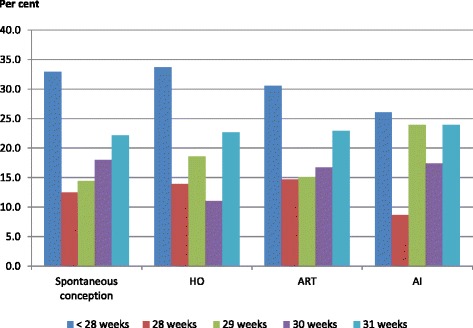
Background: Due to high rates of multiple birth and preterm birth following fertility treatment, the rates of mortality and morbidity among births following fertility treatment were higher than those conceived spontaneously. However, it is unclear whether the rates of adverse neonatal outcomes remain higher for very preterm (<32 weeks gestational age) singletons born after fertility treatment. This study aims to compare adverse neonatal outcomes among very preterm singletons born after fertility treatment including assisted reproductive technology (ART) hyper-ovulution (HO) and artificial insemination (AI) to those following spontaneous conception.
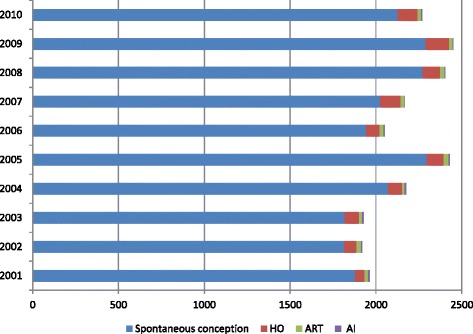
Methods: The population cohort study included 24069 liveborn very preterm singletons who were admitted to Neonatal Intensive Care Unit (NICU) in Australia and New Zealand from 2000 to 2010. The in-hospital neonatal mortality and morbidity among 21753 liveborn very preterm singletons were compared by maternal mode of conceptions: spontaneous conception, HO, ART and AI. Univariate and multivariate binary logistic regression analysis was used to examine the association between mode of conception and various outcome factors. Odds ratio (OR) and adjusted odds ratio (AOR) and 95% confidence interval (CI) were calculated.
Results: The rate of small for gestational age was significantly higher in HO group (AOR 1.52, 95% CI 1.02-2.67) and AI group (AOR 2.98, 95% CI 1.53-5.81) than spontaneous group. The rate of birth defect was significantly higher in ART group (AOR 1.71, 95% CI 1.36-2.16) and AI group (AOR 3.01, 95% CI 1.47-6.19) compared to spontaneous group. Singletons following ART had 43% increased odds of necrotizing enterocolitis (AOR 1.43, 95% CI 1.04-1.97) and 71% increased odds of major surgery (AOR 1.71, 95% CI 1.37-2.13) compared to singletons conceived spontaneously. Other birth and NICU outcomes were not different among the comparison groups.
Conclusions: Compared to the spontaneous conception group, risk of congenital abnormality significantly increases after ART and AI; the risk of morbidities increases after ART, HO and AI. Preconception planning should include comprehensive information about the benefits and risks of fertility treatment on the neonatal outcomes.
Keywords: Artificial insemination; Assisted reproductive technology; Hyper-ovulation; Preterm birth; Very preterm birth.
Figures
References
-
- Hilder LZZ, Parker M, Jahan S, Chambers GM. 014. Australia’s mothers and babies 2012. Perinatal statistics series no. 30. Cat. no. PER 69. Canberra: AIHW; 2014.
-
- Blencowe H, Cousens S, Oestergaard MZ, Chou D, Moller AB, Narwal R, et al. National, regional, and worldwide estimates of preterm birth rates in the year 2010 with time trends since 1990 for selected countries: a systematic analysis and implications. Lancet. 2012;379(9832):2162–2172. doi: 10.1016/S0140-6736(12)60820-4. - DOI - PubMed
-
- Chow SSW. Report of the Australian and New Zealand Neonatal Network 2012. Sydney: ANZNN; 2014.
Publication types
MeSH terms
LinkOut - more resources
Full Text Sources
Other Literature Sources
Medical
