


Lower Limb Neuromuscular Asymmetry in Volleyball and Basketball Players
- PMID: 28149351
- PMCID: PMC5260648
- DOI: 10.1515/hukin-2015-0150
Lower Limb Neuromuscular Asymmetry in Volleyball and Basketball Players
Abstract
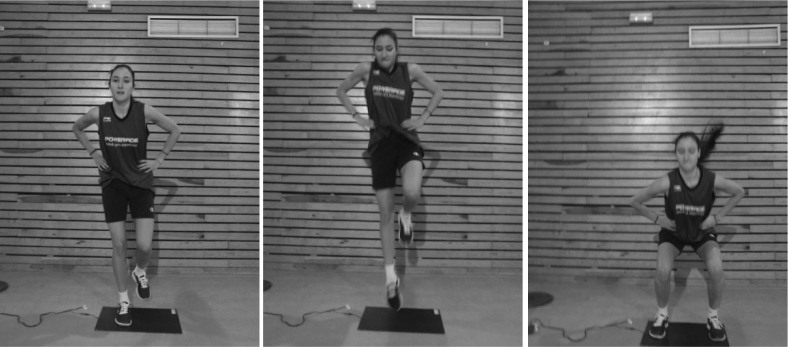
The primary objective of the present study was to evaluate the agreement between the dominant leg (DL) (determined subjectively) and the stronger leg (SL) (determined via a functional test) in a group of basketball and volleyball players. The secondary objective was to calculate lower limb neuromuscular asymmetry when comparing the DL vs the non-dominant leg (NDL) and the SL vs the weaker (WL) leg in the whole group and when differentiating by sex. Seventy-nine male and female volleyball and basketball players (age: 23.7 ± 4.5 years) performed three single-leg vertical countermovement jumps (SLVCJ) on a contact mat. Vertical jump height and an inter-limb asymmetry index (ASI) were determined. Only 32 (40%) of the subjects had a concordance between the perception of their dominant leg and the limb reaching the highest jump height. Using the DL as the discriminating variable, significant (p<0.05) inter-limb differences were found in the total group of players. When comparing between sexes, significant differences (p<0.05) arose in the female group only. With regard to the WL vs. the SL, significant (p<0.05) differences were noted in the whole group and when stratified into males and females. The mean ASI ranged from 9.31% (males) to 12.84% (females) and from 10.49% (males) to 14.26% (females), when comparing the DL vs. the NDL and the SL vs. the WL, respectively. Subjective expression of leg dominance cannot be used as a predictor of limb jump performance. Vertical jump asymmetry of 10-15% exists and this can be considered as a reference value for male and female basketball and volleyball players.
Keywords: alpinist expedition; imbalances; power; team sport games; unilateral.
Figures
References
-
- Blustein SM, D’Amico JC. Limb length discrepancy. Identification, clinical significance and management. J Am Podiatr Med Assoc. 1985;75(4):200–6. - PubMed
-
- Bosco C, Luhtanen P, Komi PV. A simple method for measurement of mechanical power in jumping. Eur J Appl Physiol. 1983;50(2):273–82. - PubMed
-
- Carpes FP, Mota CB, Faria IE. On the bilateral asymmetry during running and cycling - a review considering leg preference. Phys Ther Sport. 2010;11(4):136–42. - PubMed
-
- Ceroni D, Martin XE, Delhumeau C, Farpour-Lambert NJ.. Bilateral and gender differences during single-legged vertical jump performance in healthy teenagers. J Strength Cond Res. 2012;26(2):452–7. - PubMed
-
- De Blas X, Padullés J, López J, Guerra-Balic M. Creation and Validation of Chronojump-Boscosystem: A Free Tool to Measure Vertical Jumps. Int J Sport Sci. 2012;VIII(30):334–56.
LinkOut - more resources
Full Text Sources
Other Literature Sources
Medical