


Highly sensitive detection of a HER2 12-base pair duplicated insertion mutation in lung cancer using the Eprobe-PCR method
- PMID: 28152008
- PMCID: PMC5289711
- DOI: 10.1371/journal.pone.0171225
Highly sensitive detection of a HER2 12-base pair duplicated insertion mutation in lung cancer using the Eprobe-PCR method
Abstract
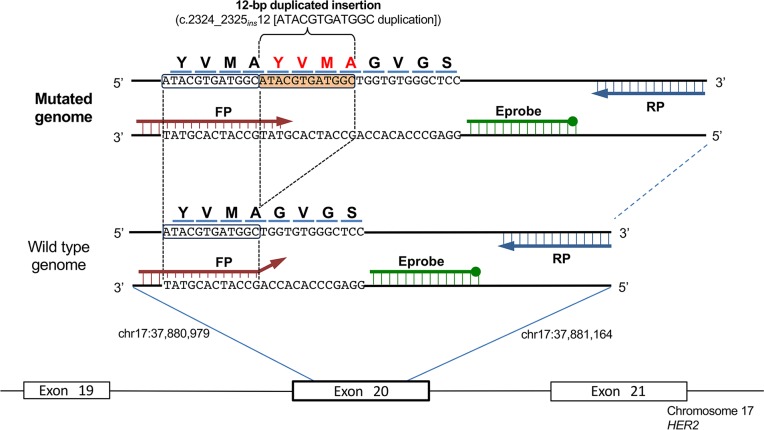
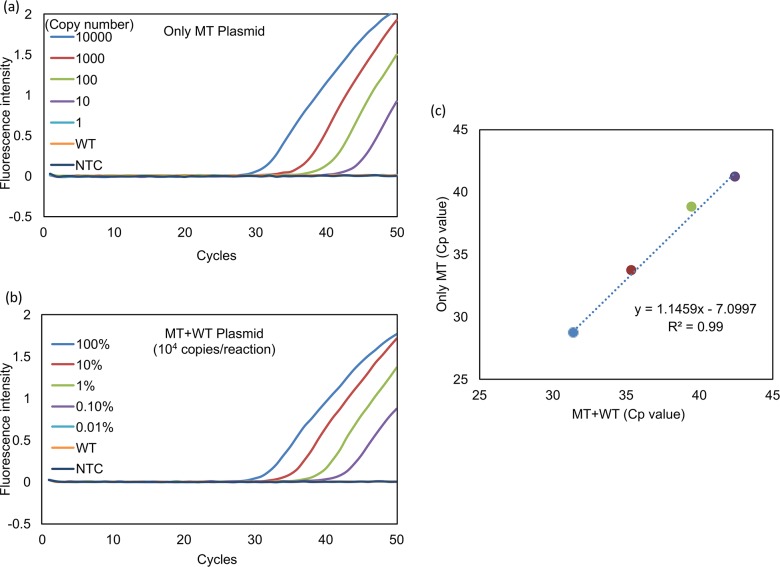
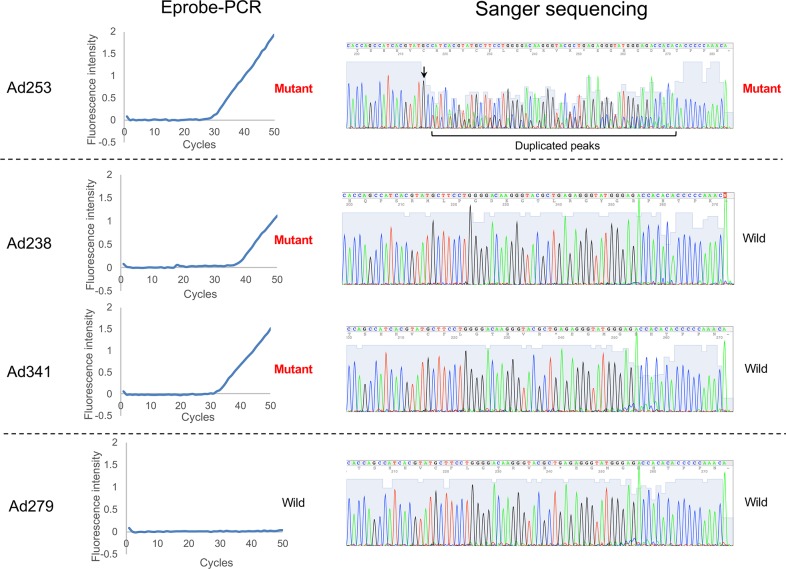
Somatic mutation in human epidermal growth factor receptor-related 2 gene (HER2) is one of the driver mutations in lung cancer. HER2 mutations are found in about 2% of lung adenocarcinomas (ADCs). Previous reports have been based mainly on diagnostic screening by Sanger sequencing or next-generation sequencing (NGS); however, these methods are time-consuming and complicated. We developed a rapid, simple, sensitive mutation detection assay for detecting HER2 12 base pair-duplicated insertion mutation based on the Eprobe-mediated PCR method (Eprobe-PCR) and validated the sensitivity of this assay system for clinical diagnostics. We examined 635 tumor samples and analyzed HER2 mutations using the Eprobe-PCR method, NGS, and Sanger sequencing. In a serial dilution study, the Eprobe-PCR was able to detect mutant plasmid DNA when its concentration was reduced to 0.1% by mixing with wild-type DNA. We also confirmed amplification of the mutated plasmid DNA with only 10 copies per reaction. In ADCs, Eprobe-PCR detected the HER2 mutation in 2.02% (9/446), while Sanger sequencing detected it in 1.57% (7/446). Eprobe-PCR was able to detect the mutation in two samples that were undetectable by Sanger sequencing. All non-ADC samples were wild-type. There were no discrepancies between frozen and formalin-fixed paraffin-embedded tissues in the nine samples. HER2 mutations detected by NGS data validated the high sensitivity of the method. Therefore, this new technique can lead to precise molecular-targeted therapies.
Conflict of interest statement
We have the following interests: YK is an inventor of Japanese Patent Application 2012-158229 (”Nucleic acid probe, design method of nucleic acid probe, and detection method for target sequence”, WO 2014/013954 A1). Tatsuo Ichihara (TI) and Yasumasa Mitani (YM) are employed by K.K. DNAFORM. There are no further patents, products in development or marketed products to declare. This does not alter the authors' adherence to all the PLOS ONE policies on sharing data and materials.
Figures
References
-
- Maemondo M, Minegishi Y, Inoue A, Kobayashi K, Harada M, Okinaga S, et al. First-line gefitinib in patients aged 75 or older with advanced non-small cell lung cancer harboring epidermal growth factor receptor mutations: NEJ 003 study. J Thorac Oncol. 2012;7: 1417–1422. 10.1097/JTO.0b013e318260de8b - DOI - PubMed
-
- Arcila ME, Chaft JE, Nafa K, Roy-Chowdhuri S, Lau C, Zaidinski M, et al. Prevalence, Clinicopathologic Associations, and Molecular Spectrum of ERBB2 (HER2) Tyrosine Kinase Mutations in Lung Adenocarcinomas. Clinical Cancer Research. 2012;18: 4910–4918. 10.1158/1078-0432.CCR-12-0912 - DOI - PMC - PubMed
MeSH terms
LinkOut - more resources
Full Text Sources
Other Literature Sources
Medical
Research Materials
Miscellaneous
