


Bringing state-of-the-art diagnostics to vulnerable populations: The use of a mobile screening unit in active case finding for tuberculosis in Palawan, the Philippines
- PMID: 28152082
- PMCID: PMC5289556
- DOI: 10.1371/journal.pone.0171310
Bringing state-of-the-art diagnostics to vulnerable populations: The use of a mobile screening unit in active case finding for tuberculosis in Palawan, the Philippines
Abstract
Background: Globally, case detection of tuberculosis (TB) has stabilized in recent years. Active case finding (ACF) has regained an increased attention as a complementary strategy to fill the case detection gap. In the Philippines, the DetecTB project implemented an innovative ACF strategy that offered a one-stop diagnostic service with a mobile unit equipped with enhanced diagnostic tools including chest X-ray (CXR) and Xpert®MTB/RIF (Xpert). The project targeted the rural poor, the urban poor, prison inmates, indigenous population and high school students.
Methods: This is a retrospective review of TB screening data from 25,103 individuals. A descriptive analysis was carried out to compare screening and treatment outcomes across target populations. Univariate and multivariate analyses were performed to identify predictors of TB for each population. The composition of bacteriologically-confirmed cases by smear and symptom status was further investigated.
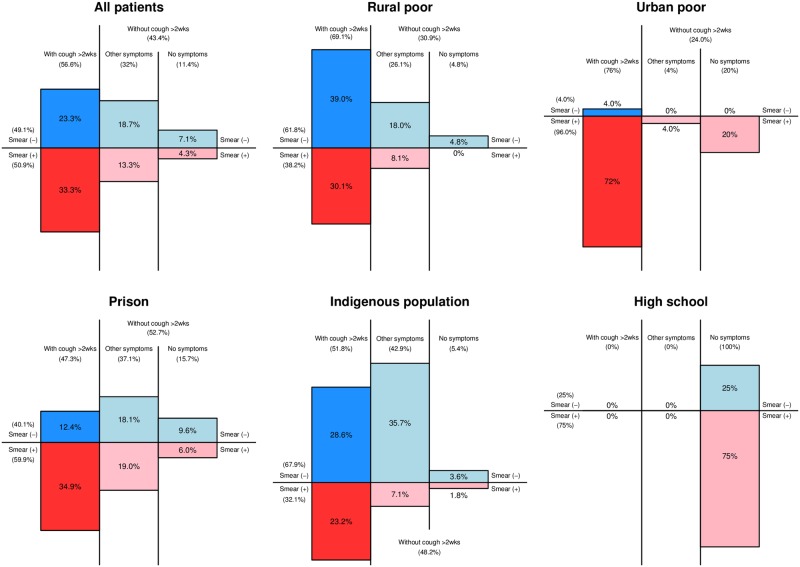
Results: The highest yield with lowest number needed to screen (NNS) was found in prison (6.2%, NNS: 16), followed by indigenous population (2.9%, NNS: 34), the rural poor (2.2%, NNS: 45), the urban poor (2.1%, NNS: 48), and high school (0.2%, NNS: 495). The treatment success rate for all populations was high with 89.5% in rifampicin-susceptible patients and 83.3% in rifampicin-resistant patients. A relatively higher loss to follow-up rate was observed in indigenous population (7.5%) and the rural poor (6.4%). Only cough more than two weeks showed a significant association with TB diagnosis in all target populations (Adjusted Odds Ratio ranging from 1.71 to 6.73) while other symptoms and demographic factors varied in their strength of association. The urban poor had the highest proportion of smear-positive patients with cough more than two weeks (72.0%). The proportion of smear-negative (Xpert-positive) patients without cough more than two weeks was the highest in indigenous population (39.3%), followed by prison inmates (27.7%), and the rural poor (22.8%).
Conclusions: The innovative ACF strategy using mobile unit yielded a substantial number of TB patients and achieved successful treatment outcomes. TB screening in prison, indigenous population, and urban and rural poor communities was found to be effective. The combined use of CXR and Xpert largely contributed to increased case detection.
Conflict of interest statement
The authors have declared that no competing interests exist.
Figures
References
-
- World Health Organization. Global Tuberculosis Report. Geneva; 2016.
-
- Böttger EC, Springer B. Tuberculosis: drug resistance, fitness, and strategies for global control. Eur J Pediatr. Springer-Verlag; 2007;167: 141–148. - PubMed
MeSH terms
Grants and funding
LinkOut - more resources
Full Text Sources
Other Literature Sources
Miscellaneous
