


Association between lymph node yield and survival among patients undergoing radical nephroureterectomy for urothelial carcinoma of the upper tract
- PMID: 28152158
- PMCID: PMC5419853
- DOI: 10.1002/cncr.30516
Association between lymph node yield and survival among patients undergoing radical nephroureterectomy for urothelial carcinoma of the upper tract
Abstract
Background: Prior studies examining the value of lymph node (LN) dissection (LND) in patients with urothelial carcinoma of the upper urinary tract (UTUC) have produced conflicting results. The objective of the current study was to assess the relationship between LN yield and survival among patients undergoing radical nephroureterectomy (RNU).
Methods: The National Cancer Data Base was used to identify patients with non-metastatic UTUC who were treated with RNU between 2004 and 2012. The association between LN yield and overall survival (OS) was assessed using Cox proportional hazards regression, with adjustment for patient, tumor, and facility characteristics.
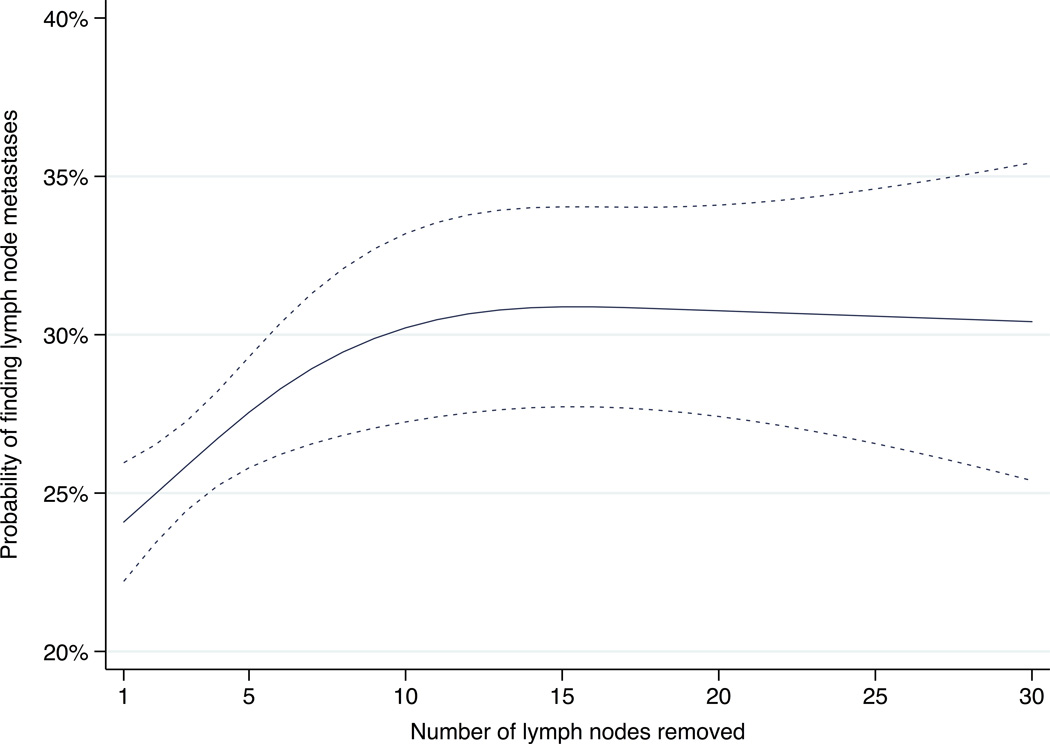
Results: Of the 14,472 patients, 2926 (20%) underwent LND. The median yield was 2 LNs (interquartile range 1-6 LNs). Among the entire cohort and the LN-negative (pN0) subgroup, a higher LN yield was associated with lower all-cause mortality (multivariable hazard ratio [HR] 0.94 per 5 LNs removed, 95% confidence interval [95% CI] 0.89-1.00 [P = .034] for the entire cohort and HR 0.86, 95% CI 0.79-0.94 [P = .001] for the pN0 subgroup). Among patients with positive LNs (pN+), there was no association noted between LN yield and OS; however, positive and negative LN counts were found to be independent predictors of OS (HR 1.27 per 5 positive LNs, 95% CI 1.16-1.39 [P<.001] and HR 0.90 per 5 negative LNs, 95% CI 0.82-1.00 [P = .049]).
Conclusions: In this large, contemporary cohort of patients with UTUC, LND was found to be used infrequently despite evidence that a higher LN yield is associated with lower all-cause mortality. Cancer 2017;123:1741-1750. © 2017 American Cancer Society.
Keywords: kidney; lymph node dissection; nephrectomy; transitional cell carcinoma; ureter.
© 2017 American Cancer Society.
Conflict of interest statement
Figures

Comment in
-
Re: Association Between Lymph Node Yield and Survival Among Patients Undergoing Radical Nephroureterectomy for Urothelial Carcinoma of the Upper Tract.Eur Urol. 2018 May;73(5):811-812. doi: 10.1016/j.eururo.2017.12.003. Epub 2017 Dec 14. Eur Urol. 2018. PMID: 29249290 No abstract available.
References
-
- Xylinas E, Rink M, Margulis V, et al. Prediction of true nodal status in patients with pathological lymph node negative upper tract urothelial carcinoma at radical nephroureterectomy. J Urol. 2013;189:468–473. - PubMed
-
- Roscigno M, Cozzarini C, Bertini R, et al. Prognostic value of lymph node dissection in patients with muscle-invasive transitional cell carcinoma of the upper urinary tract. Eur Urol. 2008;53:794–802. - PubMed
-
- Bruins HM, Veskimae E, Hernandez V, et al. The impact of the extent of lymphadenectomy on oncologic outcomes in patients undergoing radical cystectomy for bladder cancer: a systematic review. Eur Urol. 2014;66:1065–1077. - PubMed
-
- Roscigno M, Shariat SF, Margulis V, et al. The extent of lymphadenectomy seems to be associated with better survival in patients with nonmetastatic upper-tract urothelial carcinoma: how many lymph nodes should be removed? Eur Urol. 2009;56:512–518. - PubMed
Publication types
MeSH terms
Grants and funding
LinkOut - more resources
Full Text Sources
Other Literature Sources
Medical
