


Synthetic metabolism: metabolic engineering meets enzyme design
- PMID: 28152442
- PMCID: PMC7610756
- DOI: 10.1016/j.cbpa.2016.12.023
Synthetic metabolism: metabolic engineering meets enzyme design
Abstract
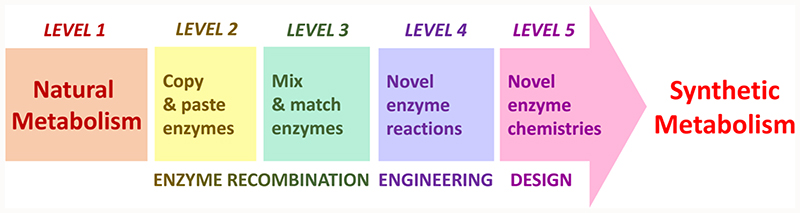
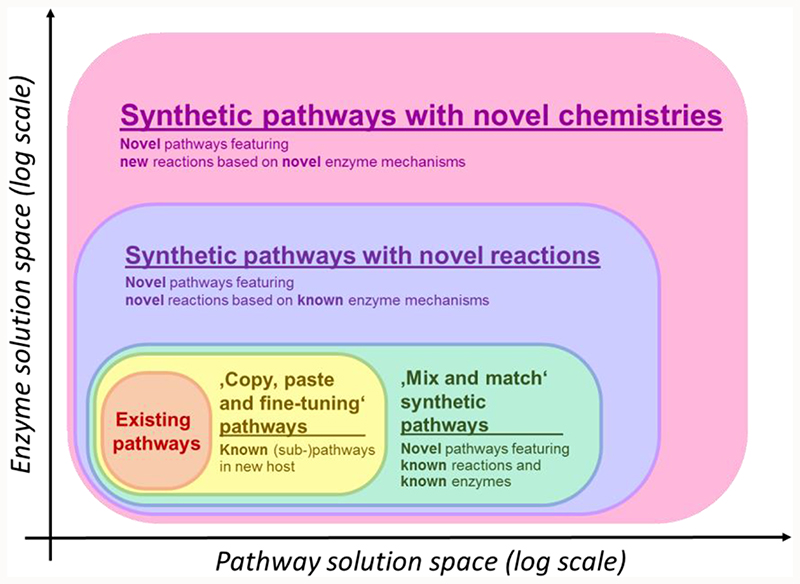
Metabolic engineering aims at modifying the endogenous metabolic network of an organism to harness it for a useful biotechnological task, for example, production of a value-added compound. Several levels of metabolic engineering can be defined and are the topic of this review. Basic 'copy, paste and fine-tuning' approaches are limited to the structure of naturally existing pathways. 'Mix and match' approaches freely recombine the repertoire of existing enzymes to create synthetic metabolic networks that are able to outcompete naturally evolved pathways or redirect flux toward non-natural products. The space of possible metabolic solution can be further increased through approaches including 'new enzyme reactions', which are engineered on the basis of known enzyme mechanisms. Finally, by considering completely 'novel enzyme chemistries' with de novo enzyme design, the limits of nature can be breached to derive the most advanced form of synthetic pathways. We discuss the challenges and promises associated with these different metabolic engineering approaches and illuminate how enzyme engineering is expected to take a prime role in synthetic metabolic engineering for biotechnology, chemical industry and agriculture of the future.
Copyright © 2017 The Authors. Published by Elsevier Ltd.. All rights reserved.
Figures
References
-
- Wöhler F. Ueber künstliche Bildung des Harnstoffs. Ann Phys Chem. 1828;88:253–256.
-
- Nicolaou KC, Vourloumis D, Winssinger N, Baran PS. The Art and Science of Total Synthesis at the Dawn of the Twenty-First Century. Angew Chem Int Ed Engl. 2000;39:44–122. - PubMed
-
- Woolston BM, Edgar S, Stephanopoulos G. Metabolic engineering: past and future. Annu Rev Chem Biomol Eng. 2013;4:259–288. - PubMed
Publication types
MeSH terms
Substances
Grants and funding
LinkOut - more resources
Full Text Sources
Other Literature Sources
