


Insomnia and Risk of Cardiovascular Disease
- PMID: 28153671
- PMCID: PMC5577359
- DOI: 10.1016/j.chest.2017.01.026
Insomnia and Risk of Cardiovascular Disease
Abstract
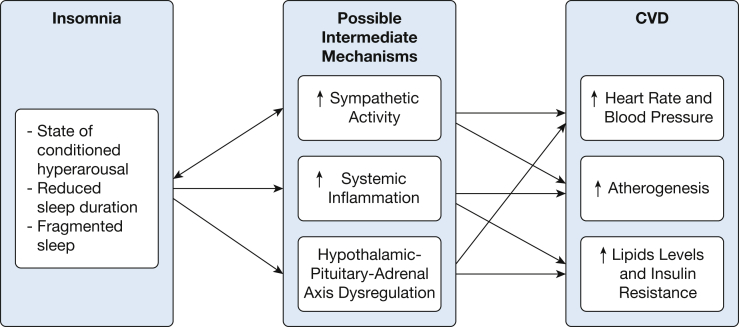
Insomnia is the most prevalent sleep disorder in the United States and has high comorbidity with a number of cardiovascular diseases (CVDs). In the past decade, a number of observational studies have demonstrated an association between insomnia and incident cardiovascular disease (CVD) morbidity and mortality, including hypertension (HTN), coronary heart disease (CHD), and heart failure (HF). Despite some inconsistencies in the literature, likely due to variations in how insomnia is defined and measured, the existing data suggest that insomnia, especially when accompanied by short sleep duration, is associated with increased risk for HTN, CHD and recurrent acute coronary syndrome, and HF. Purported mechanisms likely relate to dysregulation of the hypothalamic-pituitary axis, increased sympathetic nervous system activity, and increased inflammation. This paper reviews the most recent studies of insomnia and CVD and the potential pathophysiological mechanisms underlying this relationship and highlights the need for randomized trials to further elucidate the nature of the relationship between insomnia and CVD.
Keywords: cardiovascular disease; insomnia; sleep medicine.
Copyright © 2017 American College of Chest Physicians. Published by Elsevier Inc. All rights reserved.
Figures
References
-
- Roth T., Coulouvrat C., Hajak G. Prevalence and perceived health associated with insomnia based on DSM-IV-TR; International Statistical Classification of Diseases and Related Health Problems, Tenth Revision; and Research Diagnostic Criteria/International Classification of Sleep Disorders, Second Edition criteria: results from the America Insomnia Survey. Biol Psychiatry. 2011;69(6):592–600. - PubMed
-
- Pearson N.J., Johnson L.L., Nahin R.L. Insomnia, trouble sleeping, and complementary and alternative medicine: Analysis of the 2002 national health interview survey data. Arch Intern Med. 2006;166(16):1775–1782. - PubMed
-
- Edinger J.D., Bonnet M.H., Bootzin R.R. Derivation of research diagnostic criteria for insomnia: report of an American Academy of Sleep Medicine Work Group. Sleep. 2004;27(8):1567–1596. - PubMed
Publication types
MeSH terms
Substances
Grants and funding
LinkOut - more resources
Full Text Sources
Other Literature Sources
Medical
Research Materials
Miscellaneous
