


Ki-67 as a prognostic marker according to breast cancer molecular subtype
- PMID: 28154782
- PMCID: PMC5250608
- DOI: 10.20892/j.issn.2095-3941.2016.0066
Ki-67 as a prognostic marker according to breast cancer molecular subtype
Abstract
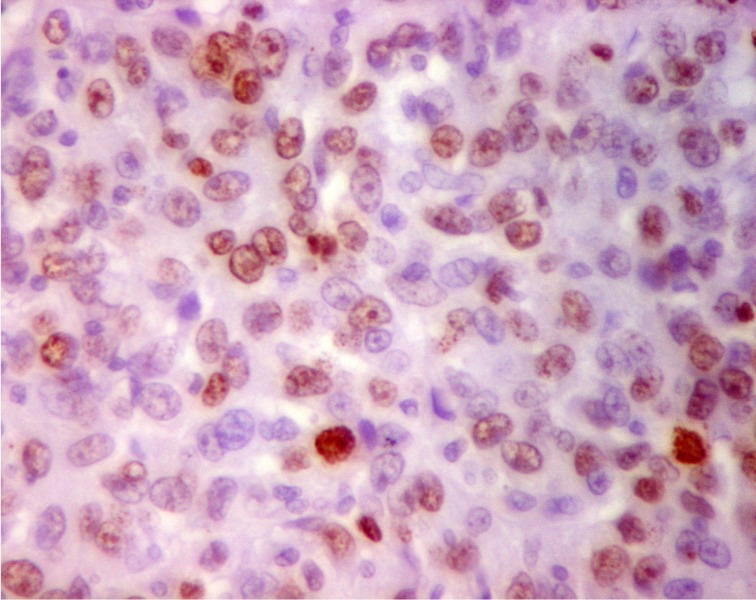
Objective: Ki-67 plays an important function in cell division, but its exact role is still unknown. Moreover, few works regarding its overall function were published. The present study evaluated the clinical significance of Ki-67 index as a prognostic marker and predictor of recurrence in different molecular subtypes of breast cancer. The relationship of Ki-67 index with different clinicopathological factors was also analyzed.
Methods: Ki-67 index was measured in 107 cases of primary breast cancer from 2010-2012. These patients were evaluated for estrogen receptor, progesterone receptor, and HER2. Ki-67 was divided according to percentage levels: < 15% and > 15%. Follow-up ranged from 32 months up to 6 years.
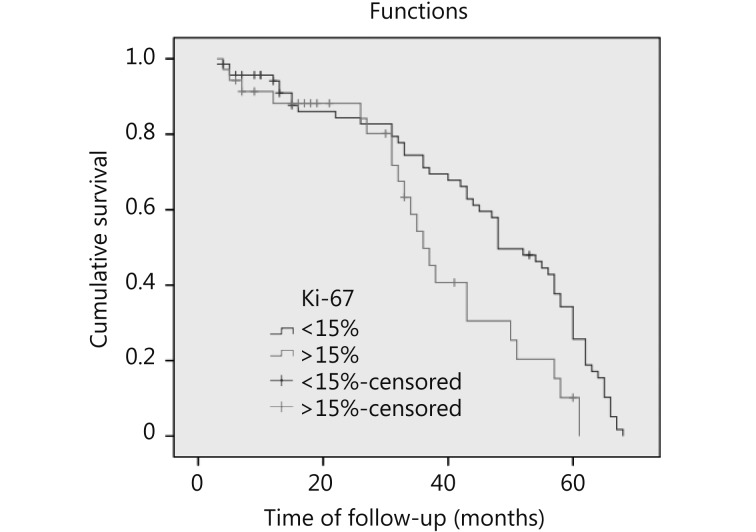
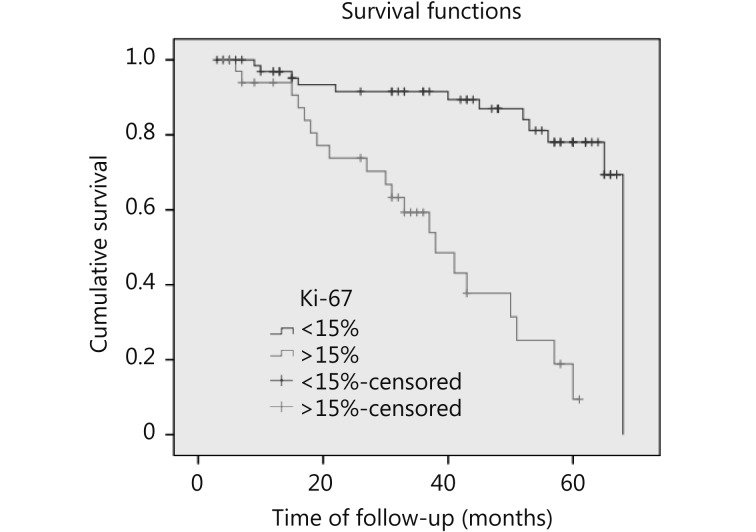
Results: Approximately 44, 23, 15, and 25 cases were grouped as luminal A, luminal B, HER2 subtype, and triple-negative (TN), respectively. No luminal A patients showed Ki-67 level higher than 15%, and their recurrence was 20%. In luminal B group, Ki-67 level higher than 15% was observed in 69% of patients, and recurrence was 39%. In HER2 subtype, Ki-67 was higher than 15% in 34% of cases, and recurrence was 40%. In triple-negative cases, Ki-67 was higher than 15% in 60% of cases, and recurrence was detected in 32% of patients. Patients with Ki-67 less than 15% displayed better overall survival than those with Ki-67 higher than 15% (P = 0.01). Patients with Ki-67 higher than 15% exhibited higher incidence of metastasis and recurrence than those with Ki-67 less than 15% (P = 0.000).
Conclusions: Ki-67 may be considered as a valuable biomarker in breast cancer patients.
Keywords: Ki-67; breast cancer; molecular subtypes; prognostic.
Figures
References
-
- Carey LA, Perou CM, Livasy CA, Dressler LG, Cowan D, Conway K, et al. Race, breast cancer subtypes, and survival in the carolina breast cancer study. JAMA. 2006;295:2492–502. - PubMed
-
- Perou CM, Sørlie T, Eisen MB, van de Rijn M, Jeffrey SS, Rees CA, et al. Molecular portraits of human breast tumours. Nature. 2000;406:747–52. - PubMed
-
- Blows FM, Driver KE, Schmidt MK, Broeks A, van Leeuwen FE, Wesseling J, et al. Subtyping of breast cancer by immunohistochemistry to investigate a relationship between subtype and short and long term survival: a collaborative analysis of data for 10,159 cases from 12 studies. PLoS Med. 2010;7:e1000279. - PMC - PubMed
LinkOut - more resources
Full Text Sources
Other Literature Sources
Research Materials
Miscellaneous