Review
. 2017:2017:5604891.
doi: 10.1155/2017/5604891. Epub 2017 Jan 5.

Targeting O-Acetyl-GD2 Ganglioside for Cancer Immunotherapy

Affiliations
Review

Targeting O-Acetyl-GD2 Ganglioside for Cancer Immunotherapy

Julien Fleurence et al. J Immunol Res. 2017.

Abstract

Target selection is a key feature in cancer immunotherapy, a promising field in cancer research. In this respect, gangliosides, a broad family of structurally related glycolipids, were suggested as potential targets for cancer immunotherapy based on their higher abundance in tumors when compared with the matched normal tissues. GD2 is the first ganglioside proven to be an effective target antigen for cancer immunotherapy with the regulatory approval of dinutuximab, a chimeric anti-GD2 therapeutic antibody. Although the therapeutic efficacy of anti-GD2 monoclonal antibodies is well documented, neuropathic pain may limit its application. O-Acetyl-GD2, the O-acetylated-derivative of GD2, has recently received attention as novel antigen to target GD2-positive cancers. The present paper examines the role of O-acetyl-GD2 in tumor biology as well as the available preclinical data of anti-O-acetyl-GD2 monoclonal antibodies. A discussion on the relevance of O-acetyl-GD2 in chimeric antigen receptor T cell therapy development is also included.


Conflict of interest statement

Competing InterestsStéphane Birklé is coinventor on pending patent applications that relate to the use of ganglioside O-acetyl-GD2 as therapeutic target for cancer immunotherapy. The work that led to the characterization of O-acetyl-GD2 as therapeutic target was conducted at the University of Nantes and was licensed by the spin-off company OGD2 Pharma SAS that Stéphane Birklé is a cofunder. At present, Denis Cochonneau is an employee at OGD2 Pharma SAS.

Figures
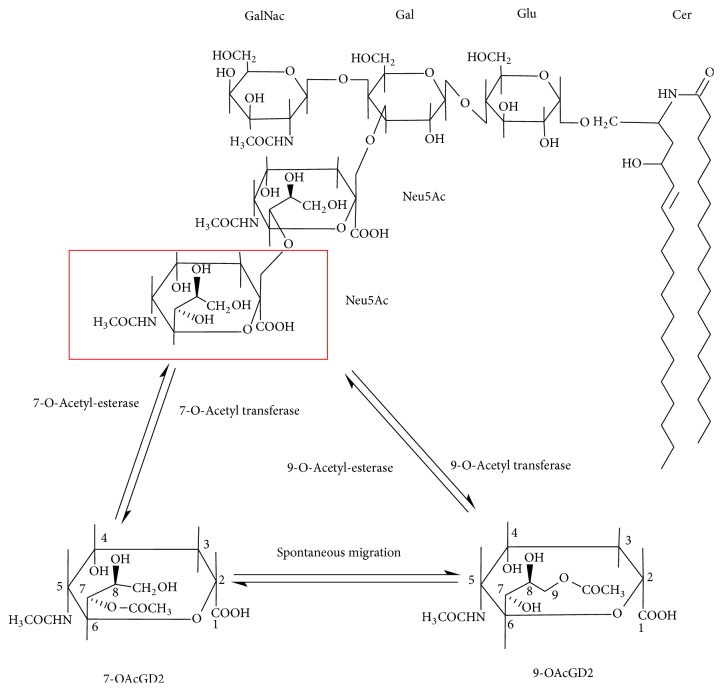
Figure 1
Figure 1
Structure of 9-O-acetyl-GD2. O-acetylated GD2 is constituted by a ceramide chain, which is anchored into plasma membrane, and a hydrophile chain. Oligosaccharide chain and O-acetylation are oriented to extracellular matrix. O-acetyl-GD2 is formed by the addition of an O-acetyl ester to the external sialic acid residue by a 9(7)-O-acetyl transferase. O-Acetyl esters located at the C7 position are mobile and can spontaneously migrate to the C9 position. They can be removed by 9(7)-acetyl esterases. Cer, ceramide; Gal, galactose; GalNAc, N-acetylgalactosamine; Neu5Ac, N-acetylneuraminic acid.
Figure 2
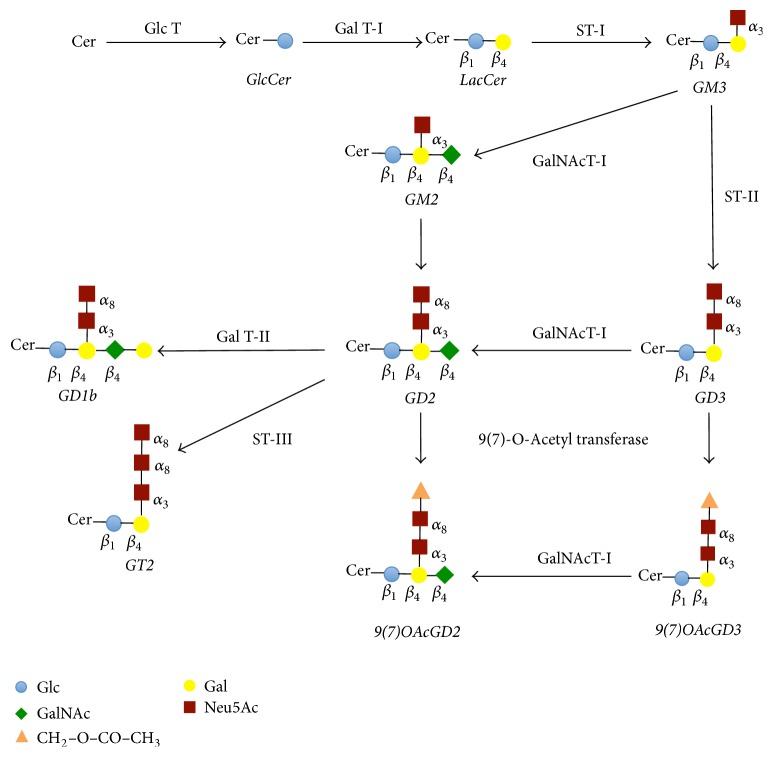
Figure 2
Schematic representation of the main pathway of O-acetyl-GD2 ganglioside biosynthesis. GD2 ganglioside is synthesized by the action of N-acetyl-galactosyltransferase I, which transfers N-acetyl-galactosaminyl residue from UDP-N-acetyl-galactosamine to GD3 [66]. GD2 can be also formed by the action of alpha 2–8 sialyltransferase II, which transfers a sialic acid residue from CMP-sialic acid to GM2 [66]. After synthesis, GD2 can be converted into either GD1b or GT2. GD1b is formed by the action of galactosyltransferase II that transfers a galactose residue from UDP-galactose to GD2. GT2 is synthesized by the action of sialyltransferase III that transfers a sialic acid residue from CMP-sialic acid to GD2. Then, the O-acetyl group addition occurs in a postsynthetic fashion [66]. Thus, O-acetyl-GD2 can be synthesized either by the action of sialate-O-acetyltransferase, which transfers the O-acetyl group to GD2, or by the action of N-acetyl-galactosyltransferase I, which transfers N-acetyl-galactosaminyl residue from UDP-N-acetyl-galactosamine to O-acetyl-GD3. Cer, ceramide; GlcCer, glucosylceramide; LacCer, lactosylceramide; Gal, galactose; Glc, glucose; GalNAc, N-acetylgalactosamine; Neu5Ac, N-acetylneuraminic acid; Glc T, glucosyltransferase; Gal T, galactosyltransferase; ST, sialyltransferase; GalNacT, N-acetyl-galactosaminyltransferase; CASD 1, Cas 1 domain containing 9(7)-O-acetyl transferase.
Figure 3
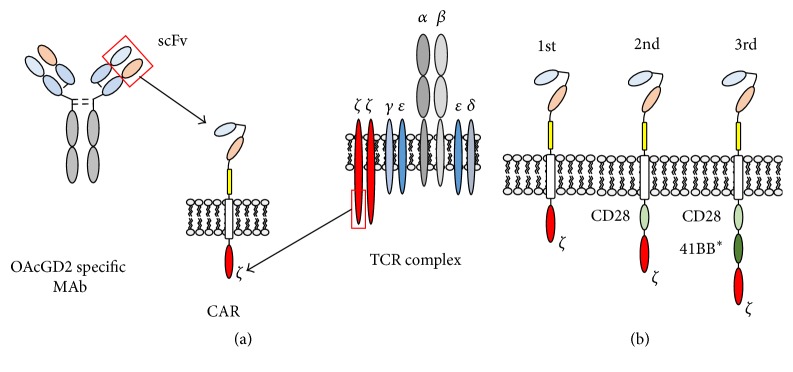
Figure 3
Structure of O-acetyl-GD2 CAR examples. (a) An O-acetyl-GD2-specific mAb derived scFv is linked through a spacer and a transmembrane domain to the T cell receptor (TCR) complex CD3ζ chain intracellular signaling domain. (b) Additional costimulatory endodomains are shown in 2nd- and 3rd-generation CARs derived from CD28 or CD28 and 41BB, respectively. 41BB may be exchanged to other domains such as OX40 or ICOS.

References

    1. Yu A. L., Gilman A. L., Ozkaynak M. F., et al. Anti-GD2 antibody with GM-CSF, interleukin-2, and isotretinoin for neuroblastoma. New England Journal of Medicine. 2010;363(14):1324–1334. doi: 10.1056/NEJMoa0911123. - DOI - PMC - PubMed
    1. Svennerholm L. Composition of gangliosides from human brain. Nature. 1956;177(4507):524–525. doi: 10.1038/177524b0. - DOI - PubMed
    1. Yu R. K., Tsai Y.-T., Ariga T., Yanagisawa M. Structures, biosynthesis, and functions of gangliosides-an overview. Journal of Oleo Science. 2011;60(10):537–544. doi: 10.5650/jos.60.537. - DOI - PMC - PubMed
    1. Yu R. K., Ynagisawa M., Ariga T. Comprehensive Glycoscience. Oxford, UK: Elsevier; 2007. Glycosphingolipid structures; pp. 73–122.
    1. Cheresh D. A., Reisfeld R. A., Varki A. P. O-Acetylation of disialoganglioside GD3 by human melanoma cells creates a unique antigenic determinant. Science. 1984;225(4664):844–846. doi: 10.1126/science.6206564. - DOI - PubMed

MeSH terms