


Outcomes and financial implications of intra-articular distal radius fractures: a comparative study of open reduction internal fixation (ORIF) with volar locking plates versus nonoperative management
- PMID: 28155059
- PMCID: PMC5585087
- DOI: 10.1007/s10195-016-0441-8
Outcomes and financial implications of intra-articular distal radius fractures: a comparative study of open reduction internal fixation (ORIF) with volar locking plates versus nonoperative management
Abstract
Background: To evaluate the functional and radiographic outcomes, as well as the treatment costs, of closed displaced intra-articular distal radius fractures treated with either open reduction internal fixation (ORIF) with volar locking plates or nonoperative treatment with plaster cast immobilisation.
Materials and methods: A total of 60 patients (32 receiving ORIF, 28 receiving nonoperative treatment) with closed intra-articular distal radius fractures were included. The mean age was 52.1 and 57.4, respectively. Functional and radiographic assessments were carried out at 12 months post-injury. Patients' treatment costs, median salaries and lengths of medical leave were obtained.
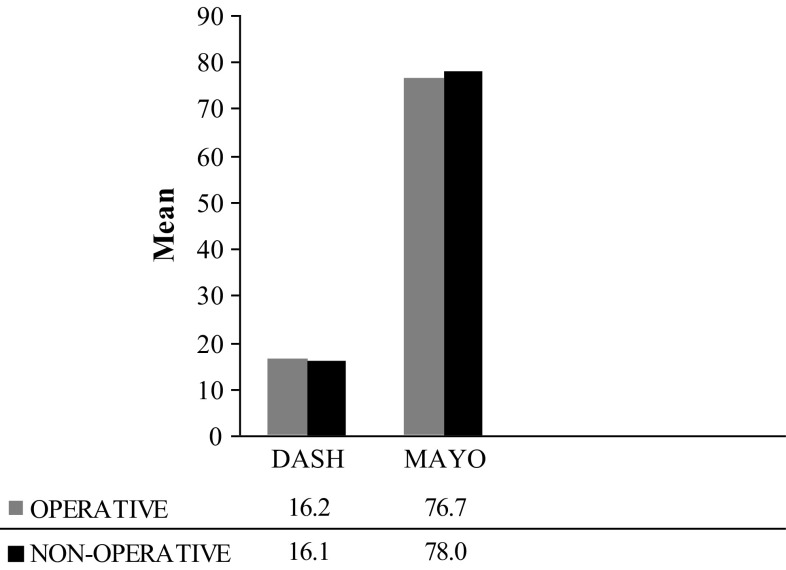
Results: DASH and MAYO wrist score in the ORIF group did not differ significantly from those in the nonoperative group. Apart from superior ulnar deviation in the ORIF group (p = 0.0096), differences in the range of motion of the injured wrists were not significant. Similarly, there were no significant differences in grip strength and visual analog scale for pain. Volar tilt (p = 0.0399), radial height (p = 0.0087), radial inclination (p = 0.0051) and articular step-off (p = 0.0002) were all significantly superior in the ORIF group. There was a 37-fold difference in mean treatment costs between ORIF (SGD 7951.23) and nonoperative treatment (SGD 230.52).
Conclusion: Our study shows no difference in overall functional outcomes at 12 months for closed displaced intra-articular distal radius fractures treated with either ORIF with volar locking plates or plaster cast immobilisation, and this is independent of radiographic outcome. A longer follow-up, nevertheless, is needed to determine whether the development of post-traumatic arthritis will have an effect on function. The vast difference in treatment costs should be taken into consideration when deciding on the treatment option.
Level of evidence: Level 3.
Keywords: Adult; Cast; Fracture fixation; Health care costs; Intra-articular fractures; Radius fractures; Range of motion; Surgical; Wrist joint.
Conflict of interest statement
Conflict of interest
There are no conflicts of interest to disclose.
Patient consent
All patients gave their informed consent prior to being included into the study.
Ethical approval
All procedures involving human participants were in accordance with the 1964 Helsinki Declaration and its later amendments. The study was approved by the Research Ethics Committee; Domain Specific Review Board (DSRB), reference number: 2012/00645.
Funding
None.
Figures


References
Publication types
MeSH terms
LinkOut - more resources
Full Text Sources
Other Literature Sources
Medical
Research Materials
Miscellaneous
