


Pilot study of a culturally adapted psychoeducation (CaPE) intervention for bipolar disorder in Pakistan
- PMID: 28155203
- PMCID: PMC5307423
- DOI: 10.1186/s40345-017-0074-8
Pilot study of a culturally adapted psychoeducation (CaPE) intervention for bipolar disorder in Pakistan
Abstract
Background: Despite the use of maintenance medication, recurrence rates in bipolar affective disorder (BPAD) are high. To date, there are no clinical trials that have investigated the use of psychological interventions in bipolar disorder in Pakistan.
Aim: The purpose of the study was to assess the feasibility and acceptability of a culturally adapted bipolar psychoeducation programme (CaPE) in Pakistan.
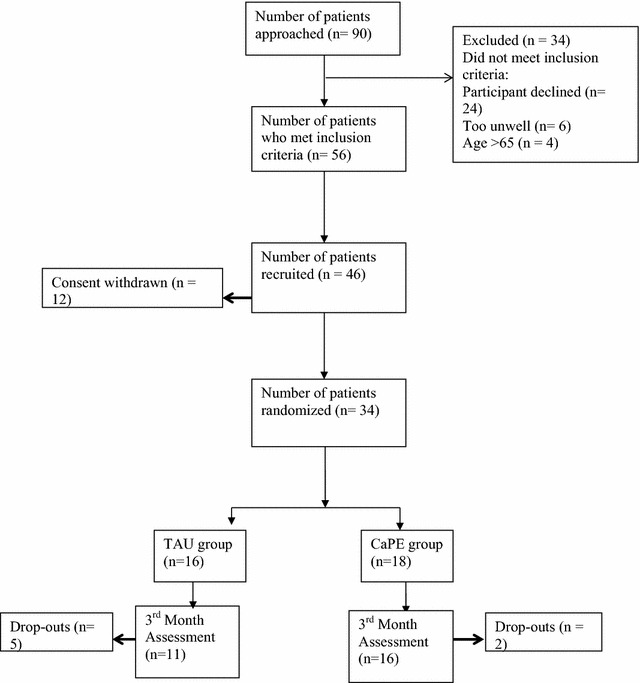
Methods: Thirty-four euthymic bipolar I and II outpatients were randomized to either 12 weekly sessions of individual psychoeducation plus Treatment As Usual (Intervention) or Treatment As Usual (TAU) (Control). Outcomes were assessed using the Young Mania Rating Scale (YMRS), Beck Depression Inventory (BDI), EuroQoL (EQ-5D), Bipolar Knowledge and Attitudes and Questionnaire (BKAQ), and a self-reported measure of medication adherence (Morisky Medication Adherence Scale-4 items, MMAS-4). Effect sizes were derived from baseline adjusted standardized regression coefficients.
Results: Retention in the study was good, 80% of patients in the TAU follow-up assessment and 100% of patients in the CaPE group attended all 12 sessions. Patient satisfaction was higher in the CaPE group relative to control (ES = 1.41). Further, there were large effect sizes shown for CaPE versus TAU for medication adherence (MMAS-4: ES = 0.81), knowledge and attitudes towards bipolar (BKAQ: ES = 0.68), mania (YMRS: ES = 1.18), depression (BDI: ES = 1.17) and quality of life measures (EQ-5D: ES ⇒ 0.88).
Conclusions: Culturally adapted psychoeducation intervention is acceptable and feasible, and can be effective in improving mood symptoms and knowledge and attitudes to BPAD when compared with TAU. Larger scale studies are needed to confirm our findings.
Trial registration: Clinicaltrials.gov identifier NCT02210390.
Keywords: Bipolar disorder; Cultural psychiatry; Pakistan; Psychoeducation.
Figures
References
Associated data
LinkOut - more resources
Full Text Sources
Other Literature Sources
Medical
Research Materials
