


Learning across languages: bilingual experience supports dual language statistical word segmentation
- PMID: 28156032
- PMCID: PMC6594691
- DOI: 10.1111/desc.12548
Learning across languages: bilingual experience supports dual language statistical word segmentation
Abstract
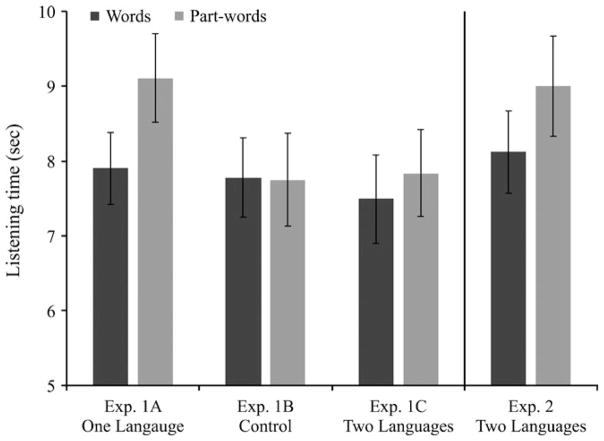
Bilingual acquisition presents learning challenges beyond those found in monolingual environments, including the need to segment speech in two languages. Infants may use statistical cues, such as syllable-level transitional probabilities, to segment words from fluent speech. In the present study we assessed monolingual and bilingual 14-month-olds' abilities to segment two artificial languages using transitional probability cues. In Experiment 1, monolingual infants successfully segmented the speech streams when the languages were presented individually. However, monolinguals did not segment the same language stimuli when they were presented together in interleaved segments, mimicking the language switches inherent to bilingual speech. To assess the effect of real-world bilingual experience on dual language speech segmentation, Experiment 2 tested infants with regular exposure to two languages using the same interleaved language stimuli as Experiment 1. The bilingual infants in Experiment 2 successfully segmented the languages, indicating that early exposure to two languages supports infants' abilities to segment dual language speech using transitional probability cues. These findings support the notion that early bilingual exposure prepares infants to navigate challenging aspects of dual language environments as they begin to acquire two languages.
© 2017 John Wiley & Sons Ltd.
Figures
References
-
- Adesope OO, Lavin T, Thompson T, Ungerleider C. A systematic review and meta-analysis of the cognitive correlates of bilingualism. Review of Educational Research. 2010;80:207–245.
-
- Akhtar N, Menjivar JA. Cognitive and linguistic correlates of early exposure to more than one language. In: Janette BB, editor. Advances in child development and behavior. Vol. 42. Greenwich, CT: JAI Press; 2012. pp. 41–78. - PubMed
-
- Aslin RN, Saffran JR, Newport EL. Computation of conditional probability statistics by 8-month-old infants. Psychological Science. 1998;9:321–324.
-
- Aslin RN, Woodward JZ, LaMendola NP, Bever TG. Models of word segmentation in fluent maternal speech to infants. In: Morgan JL, Demuth K, editors. Signal to syntax: Bootstrapping from speech to grammar in early acquisition. Mahway, NJ: Erlbaum; 1996. pp. 117–134.
Publication types
MeSH terms
Grants and funding
LinkOut - more resources
Full Text Sources
Other Literature Sources
