. 2017 Feb 3:7:41864.
doi: 10.1038/srep41864.

The citrus flavanone naringenin impairs dengue virus replication in human cells

Affiliations

The citrus flavanone naringenin impairs dengue virus replication in human cells

Sandra Frabasile et al. Sci Rep. .

Erratum in

Abstract

Dengue is one of the most significant health problems in tropical and sub-tropical regions throughout the world. Nearly 390 million cases are reported each year. Although a vaccine was recently approved in certain countries, an anti-dengue virus drug is still needed. Fruits and vegetables may be sources of compounds with medicinal properties, such as flavonoids. This study demonstrates the anti-dengue virus activity of the citrus flavanone naringenin, a class of flavonoid. Naringenin prevented infection with four dengue virus serotypes in Huh7.5 cells. Additionally, experiments employing subgenomic RepDV-1 and RepDV-3 replicon systems confirmed the ability of naringenin to inhibit dengue virus replication. Antiviral activity was observed even when naringenin was used to treat Huh7.5 cells 24 h after dengue virus exposure. Finally, naringenin anti-dengue virus activity was demonstrated in primary human monocytes infected with dengue virus sertoype-4, supporting the potential use of naringenin to control dengue virus replication. In conclusion, naringenin is a suitable candidate molecule for the development of specific dengue virus treatments.


Conflict of interest statement

The authors declare no competing financial interests.

Figures
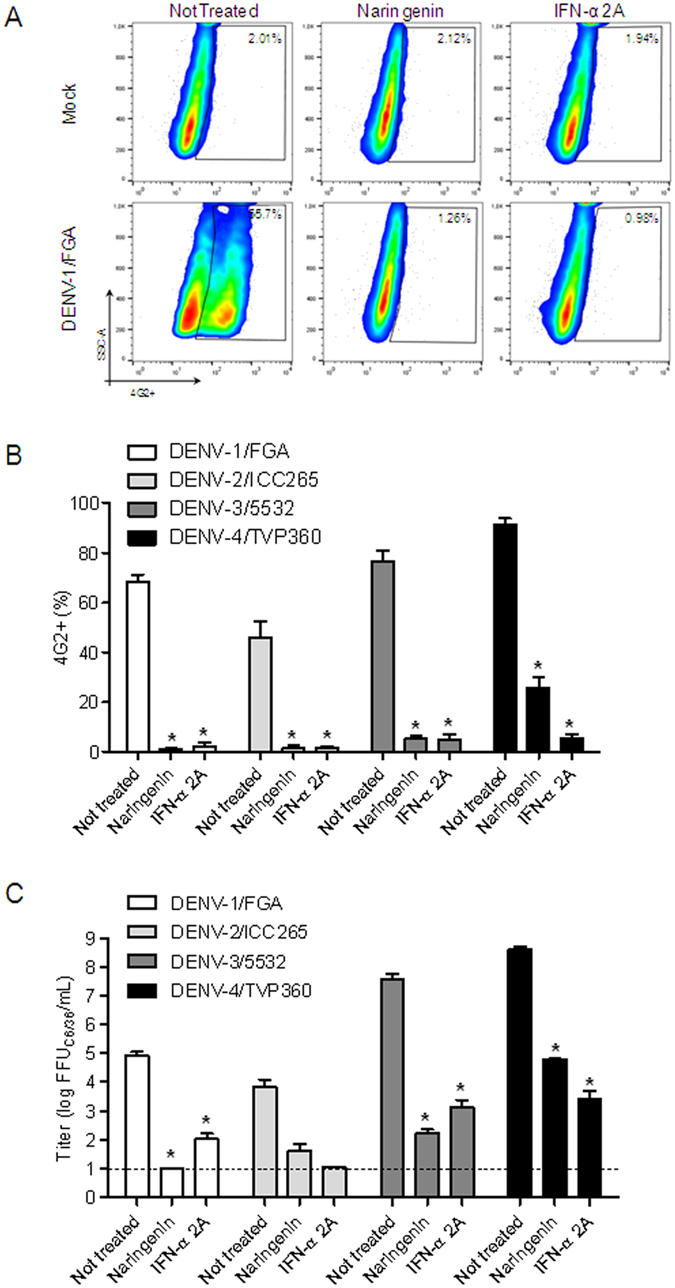
Figure 1
Figure 1. Naringenin inhibits infection by four DENV serotypes in Huh7.5 cells.
Representative dot plot (SSC × 4G2) analysis of Huh7.5 cells infected with DENV-1 (FGA/89) serotype after 72 h of treatment with naringenin (250 μM) or IFN-α 2A (200 IU/mL) (A). Flow cytometry data from three independent experiments representing the mean ± standard error (SEM) of Huh7.5 cells infected with the four DENV serotypes treated with naringenin or IFN-α 2A (B). The cell culture supernatants were titrated in C6/36 cells in a foci-forming immunodetection assay (C). Data represent the mean ± SEM from three independent experiments. One-way ANOVA and Dunnett’s test for multiple comparisons (*p < 0.05 compared to DENV control).
Figure 2
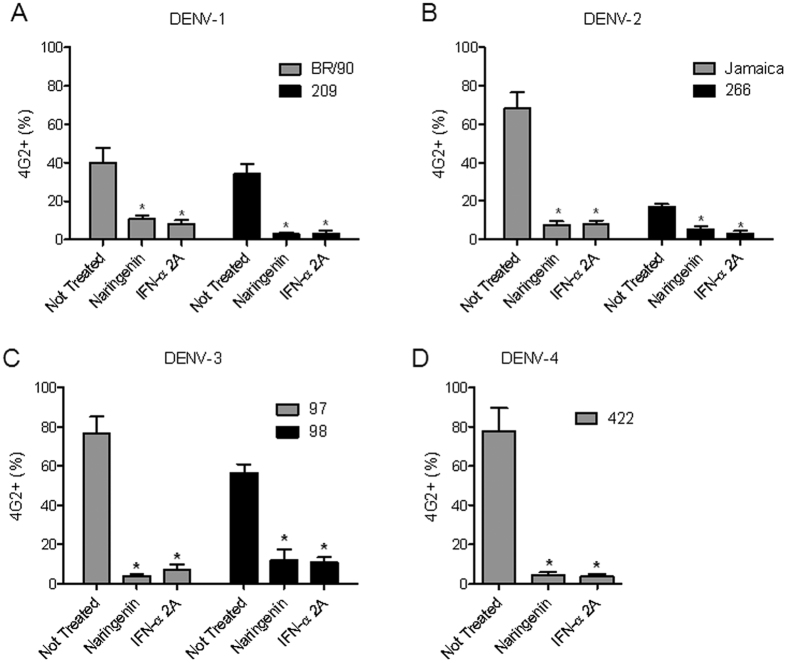
Figure 2. Naringenin inhibits infection by different DENV strains in Huh7.5 cells.
Huh7.5 cells were infected with two additional strains each of DENV-1 (A), DENV-2 (B) and DENV-3 (C) and one additional DENV-4 strain (D) for 72 h, followed by treatment with naringenin (250 μM) or IFN-α 2A (200 IU/mL). The data represent the mean ± SEM from three independent experiments. One-way ANOVA and Dunnett’s test for multiple comparisons (*p < 0.05 compared to DENV control).
Figure 3
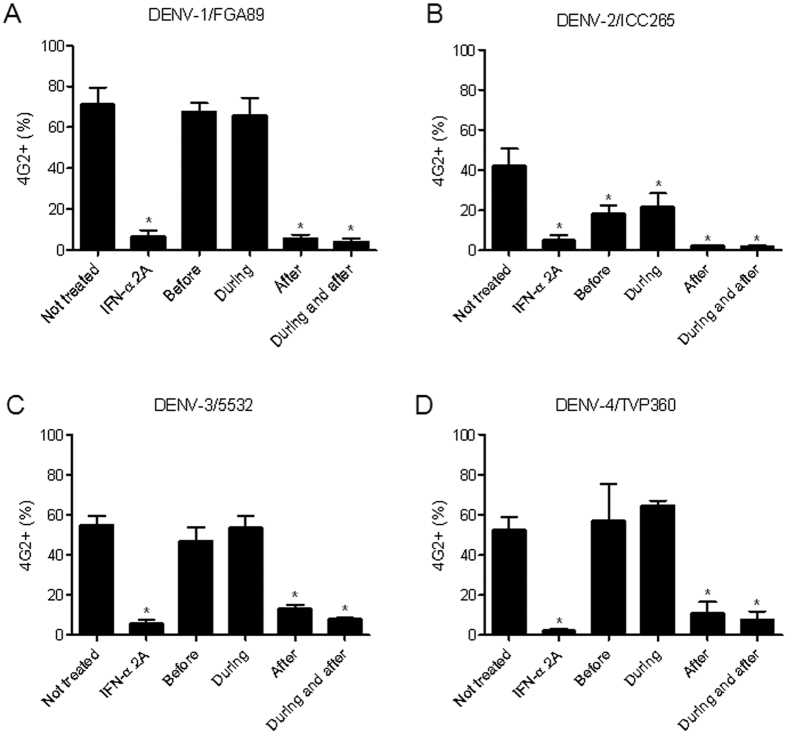
Figure 3. Time-of-drug addition experiments with naringenin.
Huh7.5 cells were infected with DENV-1/FGA/89 (A), DENV-2/ICC265 (B), DENV-3/5532 (C) and DENV-4/TVP360 (D) and treated with naringenin (250 μM) 1.5 h before infection, during infection, after infection, and during and after infection. As a control, cells were treated with IFN-α 2A (200 IU/mL) after DENV infection. The data represent the mean ± SEM of three independent experiments. One-way ANOVA and Dunnett’s test for multiple comparisons (*p < 0.05 compared to DENV control).
Figure 4
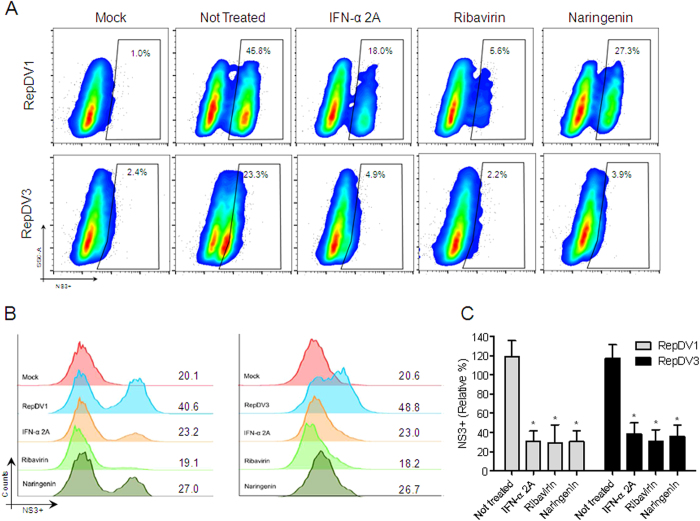
Figure 4. The effects of naringenin on DENV replication.
Huh7.5 cells were transfected with either DENV-1 replicon (RepDV1) or DENV-3 replicon (RepDV3) RNA. After 1 h, the transfected cells were treated with naringenin (250 μM). Dot plot analysis (SSC × NS3) of Huh7.5 cells transfected with RepDV1 and RepDV3 treated with naringenin, ribavirin or IFN-α 2A (anti-NS3 staining using the monoclonal antibody 1722) (A). Histograms show the mean fluorescent intensity (MFI) of transfected cells treated with naringenin, ribavirin and IFN-α 2A or left untreated (B). Average frequency of Huh7.5 cells transfected with RepDV1 or RepDV3 treated with naringenin (C). Data represent the mean ± SEM of three independent experiments. One-way ANOVA and Dunnett’s test for multiple comparisons (*p < 0.05 compared to the untreated control).
Figure 5
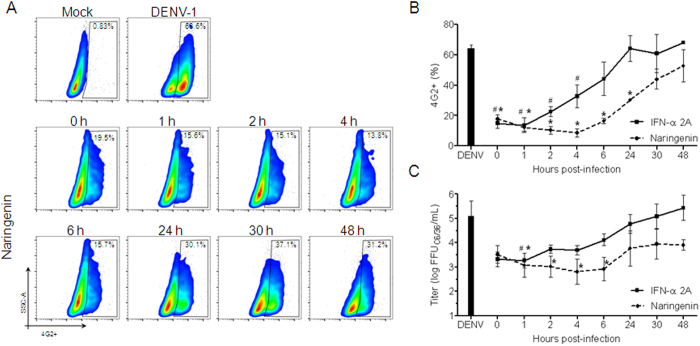
Figure 5. Naringenin treatment after the establishment of DENV infection in Huh7.5 cells.
Huh7.5 cells were infected with DENV-1 (FGA/89) and then treated with naringenin (250 μM) or IFN-α 2A (200 IU/mL) at 0, 1, 2, 4, 6, 24, 30 and 48 h post-infection. Dot plot analysis of infected Huh7.5 cells 72 h after infection was established and cells were treated with naringenin at different time points (A). Average frequency of Huh7.5 cells infected with DENV-1 and treated with naringenin or IFN-α 2A at different time points after infection (B). The cell culture supernatants of infected Huh7.5 cells treated with either naringenin or IFN-α 2A were titrated in C6/36 cells in a foci-forming immunodetection assay (C). Data represent the mean ± SEM from three independent experiments. One-way ANOVA and Dunnett’s post-test (*p < 0.05 compared to DENV control).
Figure 6
Figure 6. Antiviral activity of naringenin in human monocytes.
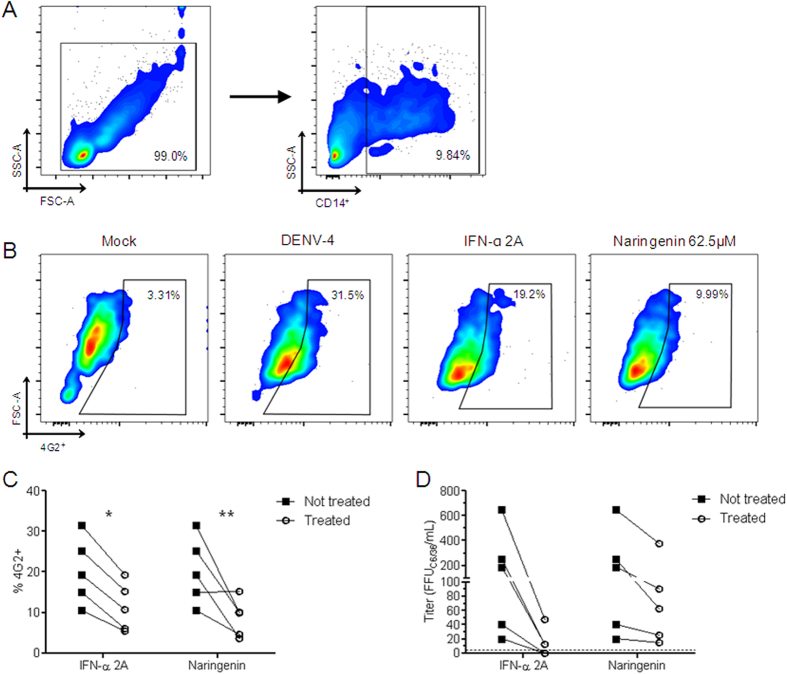
PBMCs were infected with DENV-4 strain TVP/360 (MOI: 10) and treated with naringenin or IFN-α 2A for five days. Gating strategy showing the selection of viable cells and the percentage of monocytes (CD14+) among PBMCs (A). Dot plot of DENV-infected monocytes (CD14+) showing cell size (FSC) × 4G2 staining of mock and DENV-infected controls and treatment with naringenin (62.5 μM) or IFN-α 2A (200 IU/mL) (B). Average frequency of monocytes infected by DENV-4 and treated with naringenin or IFN-α 2A (C). The cell culture supernatants of infected monocytes treated with naringenin or IFN-α 2A were titrated in C6/36 cells in a foci-forming immunodetection assay (D). Data represent each donor measure and were evaluated by two-way ANOVA and Bonferroni’s post-test (*p < 0.05 compared to DENV control).

References

    1. WHO. Dengue: guidelines for diagnosis, treatment, prevention, and control. Spec. Program. Res. Train. Trop. Dis. 147, doi: WHO/HTM/NTD/DEN/2009.1 (2009).
    1. Bhatt S. et al.. The global distribution and burden of dengue. Nature 496, 504–507 (2013). - PMC - PubMed
    1. Henchal E. A. & Putnak J. R. The Dengue Viruses. Clinical Microbiology Reviews 3, 376–396 (1990). - PMC - PubMed
    1. Chambers T. J., Hahn C. S., Galler R. & Rice C. M. Flavivirus genome organization, expression, and replication. Annu. Rev. Microbiol. 44, 649–688 (1990). - PubMed
    1. Hadinegoro S. R. et al.. Efficacy and Long-Term Safety of a Dengue Vaccine in Regions of Endemic Disease. N. Engl. J. Med. 373, 1195–1206 (2015). - PubMed

Publication types