


Omega-3 Fatty Acid Plasma Levels Before and After Supplementation: Correlations with Mood and Clinical Outcomes in the Omega-3 and Therapy Studies
- PMID: 28157380
- PMCID: PMC5397211
- DOI: 10.1089/cap.2016.0123
Omega-3 Fatty Acid Plasma Levels Before and After Supplementation: Correlations with Mood and Clinical Outcomes in the Omega-3 and Therapy Studies
Abstract
Objective: To examine fatty acid profiles, their response to omega-3 fatty acid (Ω3) supplementation, and associations with clinical status and treatment response in youth with mood disorders.
Methods: In a placebo-controlled 2X2 design, 7-14 year-olds (N = 95) in parallel pilot trials (depression N = 72; bipolar N = 23) were randomly assigned to 12 weeks of Ω3 supplementation (1.4 g eicosapentaenoic acid [EPA], 0.2 g docosahexaenoic acid [DHA], and 0.27 g other Ω3 per day); psychoeducational psychotherapy (PEP); their combination; or placebo (mainly oleic and linoleic acid) alone. Blood was drawn at baseline (N = 90) and endpoint (n = 65). Fatty acid levels were expressed as percent of total plasma fatty acids. Correlational and moderator/mediator analyses were done with SPSS Statistics 23.
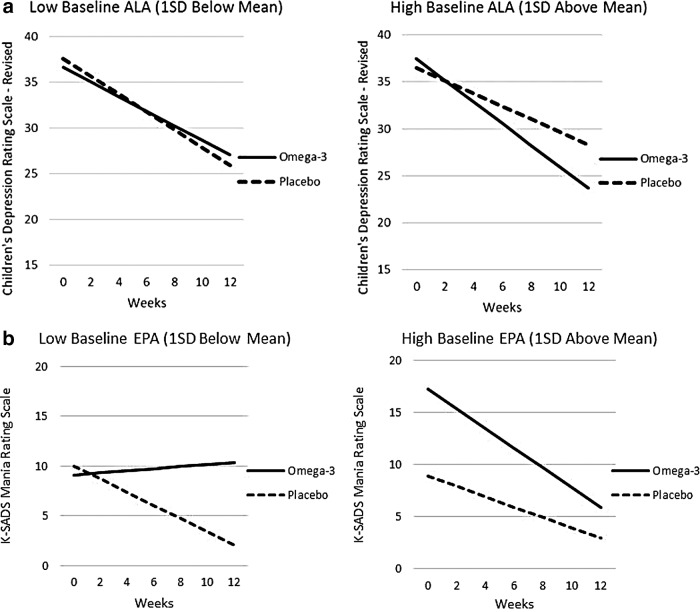
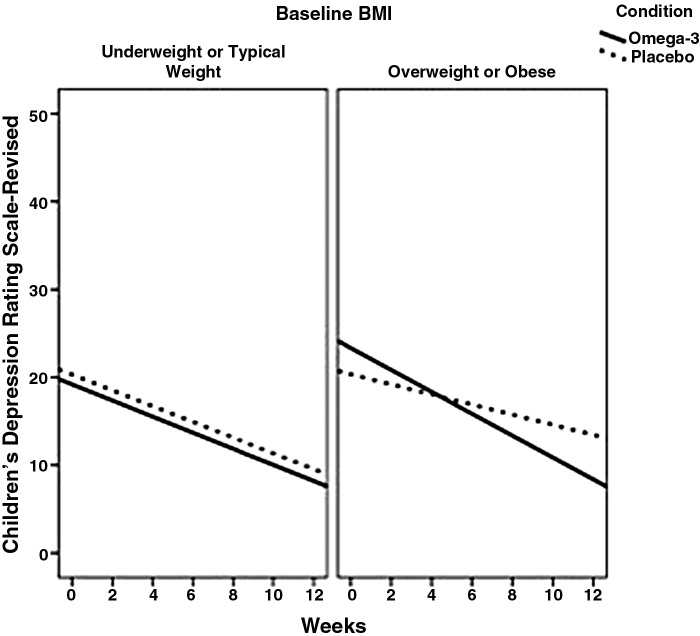
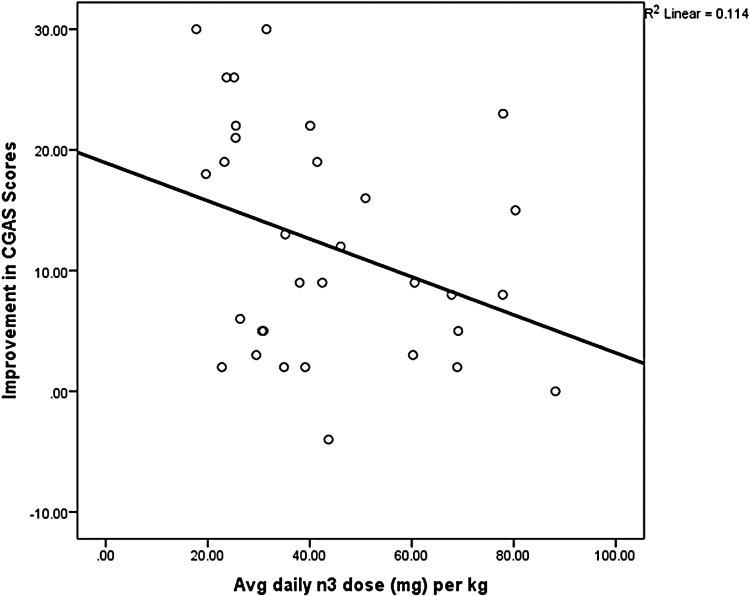
Results: At baseline: (1) DHA correlated negatively with alpha-linolenic acid (ALA) (r = -0.23, p = 0.029); (2) Arachidonic acid (AA, Ω6) correlated negatively with global functioning (r = -0.24, p = 0.022); (3) Total Ω3 correlated negatively with age (r = -0.22, p = 0.036) and diastolic blood pressure (r = -0.31, p = 0.006). Moderation: Baseline ALA moderated response to Ω3 supplementation: ALA levels above the sample mean (lower DHA) predicted significantly better placebo-controlled response (p = 0.04). Supplementation effects: Compared to placebo, 2 g Ω3 per day increased EPA blood levels sevenfold and DHA levels by half (both p < 0.001). Body weight correlated inversely with increased EPA (r = -0.52, p = 0.004) and DHA (r = -0.54, p = 0.003) and positively with clinical mood response. Mediation: EPA increase baseline-to-endpoint mediated placebo-controlled global function and depression improvement: the greater the EPA increase, the less the placebo-controlled Ω3 improvement.
Conclusion: Ω3 supplementation at 2 g/day increases blood levels substantially, more so in smaller children. A possible U-shaped response curve should be explored.
Keywords: mediation; moderation; mood disorders; omega-3 fatty acids; plasma levels; supplementation as treatment.
Figures
References
-
- American Psychiatric Association. Diagnostic and statistical manual of mental disorders, 4th Edition-Text Revision: DSM-IV-TR. Washington, DC: American Psychiatric Association; 2000
-
- Ambrosini PJ, Metz C, Prabucki K, Lee J-C: Videotape reliability of the third revised edition of the K-SADS. J Am Acad Child Psy 28:723–728, 1989 - PubMed
-
- Arnold LE, Hurt E, Lofthouse N: Attention-deficit/hyperactivity disorder: Dietary and nutritional treatments. Child Adolesc Psychiatr Clin N Am 22:381–402, 2013 - PubMed
-
- Belury MA, Kempa-Steczko A: Conjugated linoleic acid modulates hepatic lipid composition in mice. Lipids 32:199–204, 1997 - PubMed
Publication types
MeSH terms
Substances
LinkOut - more resources
Full Text Sources
Other Literature Sources
Medical
Research Materials
Miscellaneous
